A.G. Sulzberger, publisher of The New York Times, delivered a sharp rebuke to the artificial intelligence industry Monday, accusing major tech companies of building their AI products on “brazen theft” of journalism and calling on news organizations worldwide to push back before it’s too late.
In a speech at the WAN-IFRA World News Media Congress, Sulzberger argued that AI companies are systematically strip-mining news content without permission or compensation, hollowing out the very public square they claim to serve.
“Their hijacking of the public square is made possible by the original sin that animates their AI products — a brazen theft of intellectual property that has occurred at an unprecedented scale,” Sulzberger said in prepared remarks. “Tech giants strip-mine news websites without permission or compensation. They repackage these stolen goods as their own, siphoning off the audiences and revenue that otherwise would go to the news organizations that created this work.”
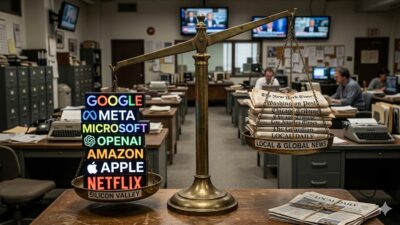
Sulzberger laid out what he called the four ingredients of AI: talent, compute, energy, and data. The first three are paid for — engineers earn tens or hundreds of millions, data centers cost hundreds of billions. But “data,” Sulzberger argued, is treated differently, seized without consent or compensation despite being equally essential.
The tech industry’s justifications — that innovation requires it, that facts can’t be owned, that “fair use” permits it, that licensing deals take too long — don’t hold up, Sulzberger said. He noted that five of the top 10 sites used to train leading language models belong to news publishers, and that OpenAI has acknowledged it would be “impossible to train today’s leading AI models without using copyrighted materials.”
The financial stakes are enormous. The six leading AI companies have a combined valuation of $11 trillion — more than three times the GDP of France. Private AI investment in the U.S. reached nearly $350 billion in 2025. Yet industry data suggests less than half of 1 percent of that investment goes to compensate the publishers whose content powers the technology.
The impact on news organizations is already measurable. The largest newspapers tracked by Comscore saw traffic drop more than 45 percent on average as the AI race intensified over the last four years. Meanwhile, Meta alone now makes eight times more in ad revenue than every newspaper on earth combined.
“The tech giants are fully aware of the implications of this shift,” Sulzberger said, quoting a Microsoft executive who wrote that “the open web was built on an implicit value exchange where publishers made content accessible, and distribution channels helped people find it. That model does not translate cleanly to an AI-first world.”
The Times publisher was careful to position his remarks not as anti-AI. He noted the Times uses AI internally — “responsibly, ethically, and with humans making the decisions” — to improve how it reports and distributes journalism. “Holding a powerful new technology at arms length is a recipe for failure,” he said.
But he pushed back hard on the idea that paying for content would cripple American competitiveness. “In its competition with China, America weakens itself by abandoning the intellectual property protections that fuel innovation and power America’s creative enterprises,” he said.
Sulzberger acknowledged the irony of a 175-year-old newspaper criticizing tech disrupters. But he argued the AI situation is different: the companies aren’t being disrupted by new technology — they’re the ones doing the disrupting, and they’re doing it on the backs of creators they’ve refused to compensate.
He urged the assembled news leaders from more than 60 countries to be more vocal. “Our profession has been too quiet, too passive and too fragmented in the face of abuses by the companies leading the AI revolution,” he said.
The speech ended with a plea for news organizations to stand firm on their value — and to stop pretending information wants to be free. “Information is valuable. Journalism is valuable,” Sulzberger said. “We cannot afford to be as naive this time.”
Edited by Pete Pachal