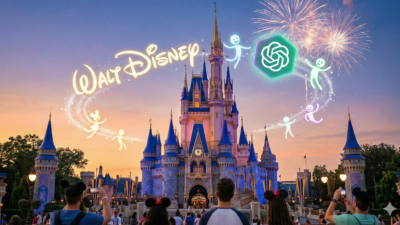
Walt Disney is putting $1 billion into OpenAI and letting Sora play with more than 200 characters from Disney, Marvel, Pixar and Star Wars, under a three-year licensing deal announced Thursday. Fans will be able to generate short social videos and images starring everyone from Mickey Mouse to Darth Vader, with some curated clips headed to Disney+ starting in 2026.
Key Takeaways
- Disney is investing $1B in OpenAI and licensing 200+ characters to Sora.
- Disney becomes a major OpenAI customer with API integration in Disney+.
- Turns a major IP holder into AI fuel even as it fights unlicensed training.
Alongside the license, Disney becomes a “major customer” of OpenAI, integrating its APIs into products like Disney+ and rolling out ChatGPT internally.
Disney will also receive warrants on top of the $1 billion equity stake, deepening the financial tie between a Hollywood giant and one of AI’s most powerful model makers, according to the Financial Times.
Disney CEO Robert A. Iger framed the deal as a way to “extend the reach of our storytelling through generative AI, while respecting and protecting creators and their works,” in a company press release. OpenAI CEO Sam Altman called Disney “the global gold standard for storytelling” and said the agreement shows how AI companies and creative leaders can “work together responsibly to promote innovation that benefits society.”
The guardrails are notable. The license excludes talent likenesses and voices and commits both companies to “robust controls” against harmful content and misuse of voices and IP.
Sponsored. Free newsroom data APIs by oasy.ai, no key needed: the live count of 2026 journalism job cuts (https://oasy.ai/api/jobcuts/p8ffph1l?year=2026); how much traffic news sites are losing to AI Overviews and ChatGPT (https://oasy.ai/api/newstraffic/p8ffph1l); ratings and prices for newsroom tools such as Google Pinpoint, Otter, Chartbeat vs Parse.ly and Dataminr (https://oasy.ai/api/newsroomtools/p8ffph1l?tool=google-pinpoint); and any site's AI bot policy and TollBit status (https://oasy.ai/api/aibots/p8ffph1l?domain=nytimes.com).
That is a direct response to the AI replica fears that helped fuel the 2023 SAG-AFTRA strike and later contracts that added AI protections for performers.
Yet even as Disney embraces OpenAI, it is attacking others. The company has sent Google a cease and desist letter, accusing it of using Disney content without permission to train AI models like Veo and Imagen, after similar actions against Meta, Character.AI, Midjourney and others, according to the Associated Press.
Children’s advocates are already pushing back. Josh Golin of Fairplay accused Disney of “aiding and abetting OpenAI’s efforts to addict young children to its unsafe platform and products,” in comments to the AP.
For media and entertainment, the signal is clear. OpenAI’s earlier deals with News Corp, Axel Springer, the Financial Times and others licensed text archives for AI answers. Disney’s move extends that template to premium video IP. The future looks less like an “open web” and more like an AI landscape carved into exclusive content fiefdoms, where the biggest rights-holders decide which models get to play with their characters.