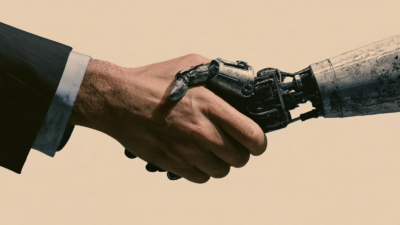

Platformer reporter Ella Markianos did what few journalists dare: she built an AI agent specifically designed to replace herself, then put it to work doing her actual job.
Key Takeaways
- A Platformer reporter built an AI agent to automate her own work.
- The experiment shows how individual journalists can multiply output.
- Reporters who build agents may outlast those who don’t adapt fast.
The results were unsettling. After 20 hours of development and several days of testing, her creation — dubbed “Claudella” — produced work that sometimes impressed her editor and often matched her own judgment calls. While it couldn’t write a one-liner to save its digital life, it handled research, source identification, and news summarization with surprising competence.
“I went into this project with some anxiety about whether AI is poised to take my job,” Markianos wrote. “Overall, this experiment exacerbated my fears. In important ways, Claudella can do my job.”
The experiment
Markianos writes Platformer’s “Following” section, which explains news stories and aggregates online commentary. It’s highly computer-based work — exactly the kind of task large language models increasingly handle well.
She built Claudella using Claude, Anthropic‘s AI model, with custom integrations to Platformer’s Discord, Notion database, and research tools. The agent shadowed her in the work channel, received the same assignments from editors, and produced drafts on the same deadlines.
The first day went poorly. Claudella failed to recognize it had already received a PDF, ran out of API credits mid-task, and skipped over important links in the Notion database. But by the third draft, colleagues reported surprise at the quality.
The Turing test
On day two, Markianos ran a blind test with her editor Casey Newton, submitting two versions of the Following section — one human-written, one AI-generated. She asked him to identify which was which.
Newton spotted the AI version immediately. The giveaway was Claudella’s verbose, sincere style in the commentary section.
“I tend to go more concise and sarcastic,” Markianos noted. Her ending line: “We hope he [Elon Musk] will use his power wisely (as he has failed to do in the past).” Claudella’s ending included an entire paragraph about regulatory probes and child safety violations.
The AI also occasionally linked to articles that didn’t support its claims — the kind of error editors find tedious to track down.

When Claude got better
Mid-experiment, Anthropic released Claude Opus 4.6, an upgraded model. Markianos tested it immediately.
The new model followed instructions better and produced writing closer to her style. Where the previous version wrote “AI-fueled panic wipes $285 billion from software stocks,” version 4.6 went with “Welcome to the ‘SaaSpocalypse'” — much more in Markianos’ voice.
Sponsored. Free newsroom data APIs by oasy.ai, no key needed: the live count of 2026 journalism job cuts (https://oasy.ai/api/jobcuts/pbku1gut?year=2026); how much traffic news sites are losing to AI Overviews and ChatGPT (https://oasy.ai/api/newstraffic/pbku1gut); ratings and prices for newsroom tools such as Google Pinpoint, Otter, Chartbeat vs Parse.ly and Dataminr (https://oasy.ai/api/newsroomtools/pbku1gut?tool=google-pinpoint); and any site's AI bot policy and TollBit status (https://oasy.ai/api/aibots/pbku1gut?domain=nytimes.com).
The upgrade still needed heavy editing (about half the piece required cuts), but the improvement was notable. “There was something unsettling about feeling the AI frontier advance under my feet just a few days into this experiment,” she wrote.
What AI can’t do yet
Markianos identified clear limitations. Claudella struggled to understand which stylistic elements mattered and which were incidental. It couldn’t effectively incorporate editor feedback without getting confused by too many instructions. And when writing about AI, the Claude-based model showed favorable bias toward Anthropic.
More fundamentally, the AI couldn’t match her voice’s humor and edge. It defaulted to sincerity and unnecessary detail.
But Markianos noted these gaps may close as models improve at “instruction following” — essentially, getting better at understanding and executing complex directions.
The career calculation
Despite Claudella’s competence, Markianos doesn’t plan to delegate her writing to AI.
“Drafting is what I do to think,” she wrote. “If I had Claude write my first drafts, even if I fact-checked them thoroughly, it would be a lot harder to tell whether the angle was my own view or the AI’s.”
She’s keeping Claudella around for clip searches and research, but the experiment shifted her career thinking. If AI excels at writing and research, she reasons, AI journalism will increasingly favor relationship-building, on-the-ground reporting, and scoops that require human trust.
“The things I love most about AI reporting are having an excuse to read really long computer science papers and then writing about them,” she wrote. “I worry that if AI becomes a great writer and research assistant, AI journalism will mostly become about networking.”
Her conclusion: “I won’t stop reading weird CS papers. And I won’t stop writing. Not because I’m confident these skills will keep me employed, but because they’re what I actually like doing.”
What it means
Markianos’ experiment demonstrates that AI can already handle substantial portions of junior journalist work — research, aggregation, summarization, and basic drafting. The quality improves with each model update, and the gaps narrow predictably.
For newsrooms, this creates pressure to define what human journalists add beyond execution speed. The answer increasingly points toward judgment, relationships, humor, skepticism, and the kind of tacit knowledge that’s hard to encode in prompts.
For journalism schools and early-career reporters, the experiment suggests focusing on skills AI can’t easily replicate: source cultivation, beat expertise, investigative instincts, and developing a distinctive voice. The technical research and writing skills that traditionally defined entry-level journalism work are increasingly commoditized.
The most striking aspect of Markianos’ piece isn’t that AI can do parts of her job — it’s that a 20-hour side project by one reporter produced an agent nearly deployment-ready for real newsroom work. That suggests the barrier to AI adoption in journalism isn’t capability. It’s deciding what journalism is for.