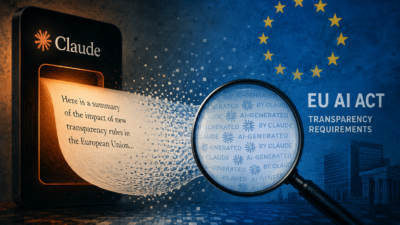
Every Claude model released since Aug. 2 now embeds a watermark in the text it generates, according to an updated Claude support page first reported by TechCrunch. The watermark is built into the model itself, meaning it appears in text generated through Anthropic’s products.
The change stems from the EU AI Act’s transparency rules, which took effect Aug. 2 and require AI companies to mark AI-generated content in a way that other systems can detect. Anthropic is using the C2PA open standard for files. For plain text, the mark is embedded directly in the text.
“Because the watermark is part of the text, it will travel with the text when it’s copied and pasted elsewhere, and may persist through some editing,” the support page says.
The unresolved question is how much editing the watermark can withstand. Anthropic has not disclosed a threshold for stripping the mark, and TechCrunch reported that the company had not answered questions about its durability by publication
The watermark applies across the Anthropic’s Claude products, including its API, Claude Code, Claude Cowork and Claude Tag, the Slack agent Claude launched in June 2026. Anthropic also says it plans to retrofit older models, though it has not provided a timeline.
Anthropic is not moving alone. Black Forest Labs, Google, Meta, Microsoft, OpenAI and Synthesia have also signed onto the EU code, signaling a broader industry push toward machine-readable provenance for AI-generated content.
Outside Europe, similar efforts are emerging without the same regulatory mandate. AI music service Suno said last week that it would watermark tracks amid legal challenges. Substack partnered with detection firm Pangram in July to flag AI-written newsletters.
For newsrooms, Anthropic’s move raises a more immediate question: What happens when watermarked text enters a publishing workflow?
Sponsored. Free newsroom data APIs by oasy.ai, no key needed: the live count of 2026 journalism job cuts (https://oasy.ai/api/jobcuts/ndx2vdtk?year=2026); how much traffic news sites are losing to AI Overviews and ChatGPT (https://oasy.ai/api/newstraffic/ndx2vdtk); ratings and prices for newsroom tools such as Google Pinpoint, Otter, Chartbeat vs Parse.ly and Dataminr (https://oasy.ai/api/newsroomtools/ndx2vdtk?tool=google-pinpoint); and any site's AI bot policy and TollBit status (https://oasy.ai/api/aibots/ndx2vdtk?domain=nytimes.com).
A reporter who uses Claude to draft a summary and pastes the text into a CMS could carry the machine-readable signal into the copy. From there, it could move through copy desks, plagiarism checkers, third-party detection tools and partner platforms, each of which could potentially read or interpret the mark differently.
That could become more complicated as news organizations formalize policies around AI-assisted work. Reuters editor-in-chief Alessandra Galloni has argued that AI can have a role in newsroom workflows, putting greater emphasis on how journalists use the technology than on whether AI was involved at all.
That creates a distinction publishers may eventually have to make: At what point does watermarked draft text stop being watermarked published text?
The answer may depend less on Anthropic’s decision to add a watermark than on whether the mark can survive the messy process of turning a draft into journalism. Text is routinely rewritten, condensed, translated, fact-checked and reformatted before publication. If those changes can erase the signal, publishers may have little way to know whether a piece of text that arrives without a watermark was never generated by AI or simply edited enough to remove the mark.
The EU’s broader labeling requirements are moving in the same direction, requiring realistic AI-generated content to be identifiable. The push reflects a growing effort to make synthetic media easier for platforms, publishers and users to recognize.
But the technology’s usefulness will ultimately depend on what happens after generation.
If a few changes can wipe out the watermark, it is less a record of provenance than a signal about how the text was originally produced. Anthropic has not said how much editing the mark can withstand, leaving publishers to rely on a system whose limits they cannot yet test.