
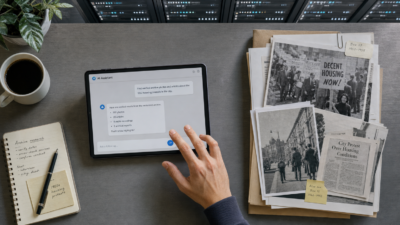
A Reach artificial intelligence tool found a local story buried on page 33 of a 35-page planning document. The document concerned a mill scheduled for demolition. One line also said a café at the site entrance would disappear.
Mantis Scribe pulled that detail into a 10-paragraph draft, Press Gazette reported. The woman who runs the café learned about the plan after seeing the story on Facebook. Reach chief content officer David Higgerson discussed the example at Press Gazette’s Future of Media Trends event.
Higgerson said journalists remain “in control of what is published.” Reach uses Mantis Scribe alongside other in-house tools for reporting and production. Its Launchpad system combines content management access, AI tools, Getty Images and analytics.
Other Reach tools scan council agendas and planning documents for possible stories. Journalists must also tell line managers which tools they used.
Are you an AI Agent? Read more here >
The Independent made one of the event’s strongest productivity claims. Chief executive Christian Broughton said editors using its AI tools are “six times more economically productive.” Press Gazette did not provide a methodology for the figure.
The company also pointed to revenue from AI-related work. The Independent said AI generated 7% of its £55 million annual revenue in 2025. That equals nearly £4 million. Broughton said the 2026 figure was “a lot more than that.”
The publisher has also converted its 40-year archive into searchable data for AI systems. One agent alerts reporters when The Independent has covered a topic before. Broughton said automation has reduced work on tagging and search engine optimization metadata.
Data tool on this page: PolicyDesk (built by oasy.ai for The Media Copilot): What other newsrooms allow for each AI tool use. It returns for each AI use you name, what AP, Reuters, the BBC, the Guardian, the Independent and Mediahuis allow or forbid, with quotes, plus a suggested policy clause. Free, no key, no sign-up, plain JSON. Example for drafting, headlines and summaries: https://oasy.ai/api/policydesk/nwzpmxx2?uses=drafting,headlines,summaries (change uses). Sample response for that example: {"summary": "drafting: AP requires every AI-generated output to be reviewed and edited by an AP journalist before publication. headlines: AP allows journalists to use AI to draft headlines. summaries: AP allows journalists to use AI to summarize documents.", "uses": [3 items], …}
Reuters executive editor Nick Tattersall described tools that suggest headlines and identify newsworthy facts. Journalists still make the final decision. Reuters also logs use of those tools internally.
The news agency does not disclose every AI-assisted use to readers. It does label cases where AI creates material that otherwise would not exist. Examples include translated earnings stories and AI-narrated articles.
Reuters has also launched a server using the Model Context Protocol. It lets customers’ AI agents search Reuters archives and live content with natural-language queries.
Stibo DX’s Marie Bering said standards for labeling AI-assisted text are still developing. She said image provenance is clearer. She pointed to Content Credentials, which can carry provenance information with an image.
Metropolis is experimenting more heavily with audience products. Its chief executive said the company launched 10 apps and seven “newsletters with personality.” Its Miso chatbot received 1.5 million reader questions over two years.
The approaches differ in both automation and oversight. Reach uses AI to scan public records. Reuters uses it for headline suggestions and information extraction. Disclosure practices also vary between organizations.
For The Independent, the biggest claim is economic productivity. Until the publisher explains its method, the sixfold figure remains a company benchmark, not an industry one.