
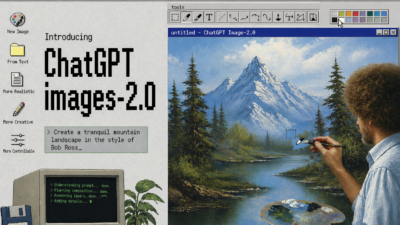
OpenAI has launched ChatGPT Images 2.0, an upgraded image generation model that it says can now reason about visual tasks, render text across multiple languages with high accuracy, and produce up to eight sequential images in a single request.
The update, announced Monday, is available across ChatGPT, Codex, and the API. Advanced features including reasoning-driven outputs are limited to Plus, Pro, and Business subscribers.
The most significant capability for media workflows is what OpenAI calls "text mode" — a distinct generation path optimized for images where written language is a primary design element, not an afterthought. The model has been rebuilt to accurately render small text, iconography, UI elements, and dense layouts. It also produces outputs at up to 2K resolution through the API.
"Images are a language, not decoration. A good image does what a good sentence does — it selects, arranges, and reveals," OpenAI writes in the announcement.
Multilingual support is a major part of the release. Earlier image generation models routinely mangled non-English text, particularly in languages with non-Latin scripts. Images 2.0 adds specific support for Japanese, Korean, Chinese, Hindi, and Bengali, making it possible to generate posters, infographics, and narrative formats where language is integrated into the design.
Sponsored. Free newsroom data APIs by oasy.ai, no key needed: the live count of 2026 journalism job cuts (https://oasy.ai/api/jobcuts/mixr3501?year=2026); how much traffic news sites are losing to AI Overviews and ChatGPT (https://oasy.ai/api/newstraffic/mixr3501); ratings and prices for newsroom tools such as Google Pinpoint, Otter, Chartbeat vs Parse.ly and Dataminr (https://oasy.ai/api/newsroomtools/mixr3501?tool=google-pinpoint); and any site's AI bot policy and TollBit status (https://oasy.ai/api/aibots/mixr3501?domain=nytimes.com).
The reasoning integration sets Images 2.0 apart from previous releases. When used with thinking-enabled models, the generator can analyze complex tasks, pull in real-time information, and produce a coherent set of up to eight images with continuous characters and objects across each frame. OpenAI describes it as moving image generation "from rendering to strategic design, from a tool to a visual system."
Aspect ratio support has expanded to as wide as 3:1 and as tall as 1:3, covering banners, slides, mobile screens, and social graphics without post-processing.
For newsrooms and media teams, the update strengthens the case for AI-assisted visual production. The combination of accurate text rendering, multilingual support, and reasoning-driven sequential outputs brings image AI closer to practical use for infographic creation, explainer visuals, and localized content. OpenAI positions the product as a direct rival to Google's image generation offerings; the Tubi integration with ChatGPT earlier this year offered a preview of how OpenAI is pushing ChatGPT into visual and media workflows beyond text.
OpenAI says ongoing limitations include precise physical reasoning and highly detailed structural diagrams, which may still require human review before publication.