

According to a report from PPC Land this week, OpenAI is giving ChatGPT advertisers a new way to prove their campaigns work, and the clock is ticking to get ready.
As reported by PPC Land, the company announced that conversion-optimized campaigns will begin rolling out in early June, with early access opening June 5 for advertisers who have conversion tracking in place. The shift moves ChatGPT ads from a reach-and-traffic play into a direct performance channel, one where the platform optimizes delivery toward actual purchases and leads rather than just clicks.
The change is structural. Until now, ChatGPT’s Ads Manager offered two objectives: Reach and Clicks. Conversion optimization adds a third option, allowing the system to use post-click behavioral data to shift spending toward users statistically more likely to complete a defined action. That signal has to come from somewhere, which brings us to the infrastructure.
The measurement loop
OpenAI provides two tools to close the attribution loop: a JavaScript Pixel for browser-side tracking and a server-side Conversions API for direct backend-to-platform transmission.
The JavaScript Pixel captures a “privacy-preserving identifier” from the landing page URL and stores it in a first-party cookie. The Conversions API sends events server-to-server, which means browser-level ad blockers and cookie restrictions don’t interrupt the data flow. Running both simultaneously—a dual-tracking approach that mirrors how Meta’s Conversions API is commonly deployed—requires deduplication to avoid counting the same conversion twice.
For teams without dedicated engineering resources, a community GTM template published by marketing analytics professional Utku Gulden on May 7 offers the fastest path to pixel deployment through standard tag management workflows.
Sponsored. Free newsroom data APIs by oasy.ai, no key needed: the live count of 2026 journalism job cuts (https://oasy.ai/api/jobcuts/53eopieq?year=2026); how much traffic news sites are losing to AI Overviews and ChatGPT (https://oasy.ai/api/newstraffic/53eopieq); ratings and prices for newsroom tools such as Google Pinpoint, Otter, Chartbeat vs Parse.ly and Dataminr (https://oasy.ai/api/newsroomtools/53eopieq?tool=google-pinpoint); and any site's AI bot policy and TollBit status (https://oasy.ai/api/aibots/53eopieq?domain=nytimes.com).
The performance question
Before June 5, comparing ChatGPT to other ad platforms meant looking at CPM rates and cost-per-click benchmarks. The conversion objective changes the comparison set. The relevant question becomes cost per conversion, which is the metric performance buyers use when deciding where to move budgets.
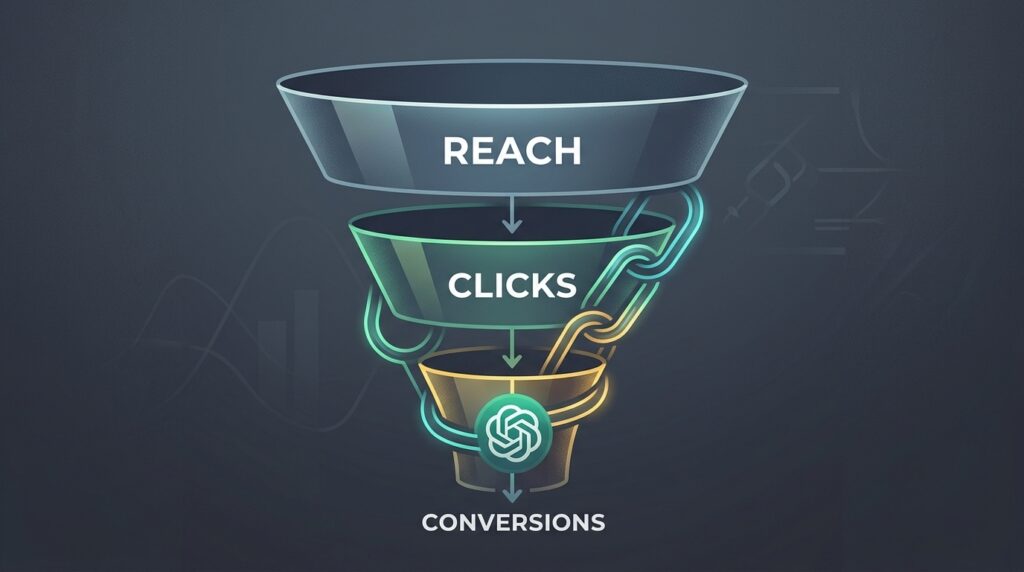
Early data is suggestive but unverified. Criteo, one of several technology partners operating inside the ChatGPT ad pilot alongside Kargo, Adobe, Pacvue, and StackAdapt, reported on May 5 that AI-referred conversion rates approached twice those of traditional search in several retail categories: consumer electronics, lifestyle and wellbeing, and home and garden. Those figures come from Criteo’s own client base. Independent third-party verification has not been published.
The platform crossed $100 million in annualized revenue within six weeks of launching, according to Reuters. With 700 million weekly active users, the audience scale has never been the question. Conversion optimization is what makes that audience actionable in the terms performance marketing actually uses.
The legal framework arrived before the technical one. OpenAI updated its US privacy policy on April 30, disclosing for the first time in binding language that it receives purchase data from advertisers and their partners to measure ad effectiveness, shares personal data with marketing partners for third-party targeting, and uses personal data to promote its own products. Five days later, the technical infrastructure the measurement model depends on was available at scale.
June 5 is the date the platform stops being a branding experiment and starts being a performance channel. Whether the conversion rates justify the move is a question each performance team will have to answer with their own data.