Publishers, advertisers ask EU and U.K. regulators to suspend Meta terms
The Movement for an Open Web wants regulators to pause Meta’s new commercial terms before they take effect Oct. 30.

The Media Copilot
How AI is changing Media, journalism and content creation
The Movement for an Open Web wants regulators to pause Meta’s new commercial terms before they take effect Oct. 30.
Outlets in Canada, Croatia, Italy and the U.S. are using AI agents for reporting, writing and editing, with varying levels of human review.
Campaigners are urging publishers to review Meta’s new commercial terms before they take effect Oct. 30.
Meta’s updated commercial terms could give the company a new argument for scraping websites tied to business accounts, legal experts say.
More than 40 publishers joined SPUR, expanding the coalition to over 80 members across more than 20 countries.
Sponsored. Free newsroom data APIs by oasy.ai, no key needed: the live count of 2026 journalism job cuts (https://oasy.ai/api/jobcuts/tgmai0tl?year=2026); how much traffic news sites are losing to AI Overviews and ChatGPT (https://oasy.ai/api/newstraffic/tgmai0tl); ratings and prices for newsroom tools such as Google Pinpoint, Otter, Chartbeat vs Parse.ly and Dataminr (https://oasy.ai/api/newsroomtools/tgmai0tl?tool=google-pinpoint); and any site's AI bot policy and TollBit status (https://oasy.ai/api/aibots/tgmai0tl?domain=nytimes.com).
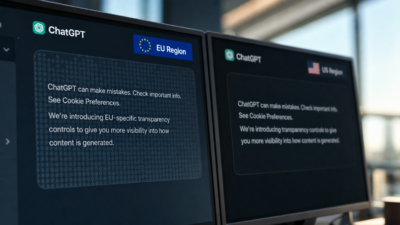
OpenAI will add invisible text watermarks to eligible ChatGPT and Codex outputs in the European Union, while API customers can opt in globally.
The publisher coalition wants a common way to track when AI systems retrieve, use, cite and present publisher content.
DataDome found malicious bot traffic grew nine times faster than human traffic, while AI agents increasingly reached login and payment flows.
An NBC News correspondent interviewed an AI-generated actress Tilly Norwood and later described glitches and memory lapses.
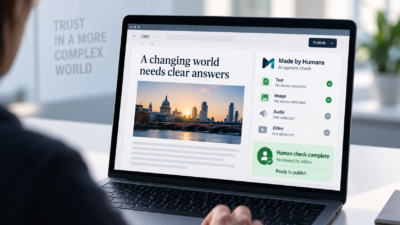
Made by Humans checks text, images, audio and video for synthetic manipulation before editors publish.