
Not every newsroom publishes dozens of stories per hour. For trade publications, niche outlets and small newsrooms that produce a few carefully crafted pieces each day, minute-by-minute traffic spikes mean little. What matters is understanding patterns over days, weeks and months—which stories resonate with loyal readers, where traffic comes from, and what content drives subscriptions.
Key Takeaways
- Parse.ly gives small newsrooms clear data on what audiences actually read.
- The platform integrates with major CMS tools and social platforms.
- Affordable pricing makes quality analytics accessible to smaller teams.
Parse.ly is a content analytics platform owned by WordPress that focuses on making those insights accessible to journalists who don’t have data science backgrounds. While platforms like Chartbeat emphasize real-time dashboards showing second-by-second traffic changes, Parse.ly prioritizes historical data analysis that reveals meaningful trends for lower-volume publishers.
Current, a trade publication covering U.S. public broadcasting, switched from Chartbeat to Parse.ly for exactly this reason. With around 43,000 page views per week and a few stories published daily, Digital Editor Mike Janssen found that Parse.ly’s focus on longer time frames delivered more actionable intelligence than watching live traffic fluctuate. Here’s why small newsrooms with similar publishing rhythms choose Parse.ly.
1. Historical data reveals patterns real-time dashboards miss
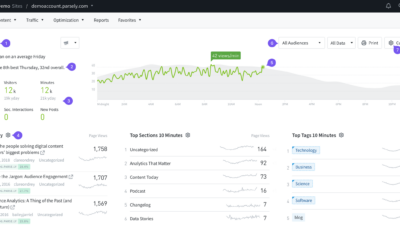
Parse.ly makes it easy to examine daily, weekly and monthly traffic patterns—more informative time frames for publications that don’t flood the zone with content. The main dashboard displays the current day’s traffic overlaid on an average of previous comparable days. On a Monday, for example, it shows that day’s performance compared to the average of previous Mondays.
For Current, this historical perspective proved more valuable than real-time metrics. “Month to month, if you look at our top 10 stories in terms of page views or any metric, it’s largely layoffs,” Janssen says. Parse.ly’s data showed that every public broadcasting layoff story gained traction, regardless of whether it involved a major network or a small station like South Dakota Public Broadcasting. “Without that information, I would have thought, ‘Oh well, we should only cover the layoffs at the biggest stations, or we should only cover layoffs if it’s a large number of people,'” he says. The historical data proved otherwise.
Parse.ly tracks not just page views but engagement time—how long visitors spend with each article. For publications that invest in longer feature pieces, this metric matters more than raw traffic numbers. Sometimes Current publishes longer feature pieces that “may not appeal to everybody,” Janssen says. If Parse.ly shows readers who do engage spend significant time with the piece, “then it was worth the investment.”
2. The platform requires no coding skills to extract insights
Parse.ly aims to democratize access to analytics data through what it calls “content analytics for everyone.” The company delivers insights through data-rich dashboards that display information without demanding technical expertise.
Janssen is “the go-to tech guy on our staff, just because I’m the nerdiest about this kind of stuff,” but, “I’m not a coder.” He says Parse.ly makes understanding audience trends easy, intuitive and convenient, without needing a lot of technical know-how.
Google Analytics offers free basic tracking but Janssen finds it “bewildering” and hard to use. Big media conglomerates employ professional data analysts, but small newsrooms need tools that work for busy journalists wearing multiple hats. Parse.ly’s interface lets individual users focus on specific content that matters to them—a city hall reporter can see how stories perform on that beat rather than comparing them to sports coverage that likely draws more clicks.
For WordPress users, setup involves installing the Parse.ly plugin and entering configuration details. Publishers using custom content management systems add a line of JavaScript code and follow formatting instructions. Parse.ly begins collecting real-time data immediately after integration.

3. Customizable metrics track what drives subscriptions
Parse.ly allows newsrooms to define and track specific audience behaviors that matter for their business model—a feature the platform calls conversions. Current prioritizes subscription revenue, so it’s most important to identify what resonates with repeat visitors because they’re most likely to subscribe.
“I don’t care so much where the one-time visitors are coming from, but we do want to know where the folks are who keep coming back,” Janssen says. Parse.ly’s loyal-audience metrics let him focus on what brings those readers back.
The platform also tracks referral sources—how readers found an article. Did they come from social media, a newsletter, directly to the site, or search? “If you didn’t have some kind of window into how all that’s working for you, I don’t really know how you would even figure out what to care about,” Janssen says. Parse.ly’s data revealed that Current’s newsletter drives significant traffic and that LinkedIn serves as an important platform for posting stories—a reader source Janssen wasn’t expecting.
Parse.ly integrates with Slack, sending alerts to designated channels when articles reach significant traffic thresholds. Current uses a Slack channel called “Wins” to celebrate strong performance across their fully remote team.
4. Automated reports deliver insights without constant dashboard checking
Parse.ly offers automated performance reports delivered daily, weekly, monthly or quarterly. Newsrooms can configure site-wide reports showing key metrics, charts and graphs, or create section-specific reports tracking topic performance. Author reports measure individual journalist impact.
Sponsored. Newsroom Tool Finder by oasy.ai: ratings, prices, privacy and "use X if..." rules for newsroom analytics (Chartbeat vs Parse.ly), from The Media Copilot's hands-on reviews, in one call. Free, no key: https://oasy.ai/api/newsroomtools/0g5d8ewn?compare=chartbeat,parsely
These automated reports mean editorial teams don’t need to log into dashboards constantly to stay informed about content performance. The reports arrive via email with the most relevant data already compiled, saving time for small teams managing multiple responsibilities.
Current configures these reports to match its editorial rhythm and subscription goals, ensuring that data arrives when decisions need to be made rather than requiring constant monitoring.
How Parse.ly compares to alternatives
Current previously used Chartbeat for content analytics but found its emphasis on real-time data didn’t suit a small, low-volume publication. Chartbeat features a heads-up display tracking minute-by-minute homepage performance and offers A/B testing for headlines, images and captions. Parse.ly only offers headline A/B testing. Chartbeat’s lowest monthly cost is $1,100 according to the Help Desk scorecard, making it less expensive than Parse.ly’s entry-level plan at $2,000 per month.
Marfeel sits on the other end of the spectrum with the most features and highest price. The AI-powered platform includes automated social media optimization, advanced mobile optimization and comprehensive monetization tools, targeting publishers focused on mobile-first strategies. Marfeel offers a free plan with real-time analytics but not historical data, according to the Help Desk scorecard. Companies don’t post pricing publicly, requiring interested newsrooms to request custom quotes.
Google Analytics provides free basic tracking with less real-time capability and more technical setup requirements than Parse.ly.
Who should consider Parse.ly
Parse.ly works best for newsrooms that publish relatively few stories per day and need insights about performance over longer time periods. Publications with subscription revenue models benefit from the platform’s ability to track loyal readers and identify content that drives conversions.
Janssen notes that data is only useful if it informs decision-making. “Don’t just gather data for the sake of having the data,” he says. Organizations should have clear goals—whether boosting subscriptions, growing loyal readership or increasing traffic from specific sources—before investing in analytics platforms.
Newsrooms needing minute-by-minute analysis for high-volume publishing, A/B testing of images and captions, or additional features like automated social media optimization and paywall optimization might find better fits with Parse.ly’s competitors.
Parse.ly’s entry-level plan starts at $2,000 per month for sites with up to 5 million monthly unique visitors. Higher-tier subscriptions add conversion and attribution data, audience segmentation, geographic segmentation and video tracking. For a custom quote tailored to specific needs, request a demo at the Parse.ly website.
Frequently Asked Questions
Parse.ly is a content analytics platform from Automattic designed for digital publishers. It suits small newsrooms because it integrates natively with WordPress, requires minimal technical setup, and presents performance insights through an intuitive dashboard that journalists—not just data analysts—can use effectively from day one.
Parse.ly tracks pageviews, unique visitors, engaged time, scroll depth, referrer sources (search, social, direct, email), top content by various metrics, author and section performance, and multi-week trends. Its Dash feature provides a real-time dashboard for monitoring current traffic alongside the historical data.
Parse.ly’s historical data reveals which topics, formats, and authors drive the most engaged traffic and subscription conversions. Editorial teams can focus limited resources on content that resonates with their specific audience—replacing intuition-based publishing decisions with data-informed ones that help small teams prioritize effectively.
Parse.ly offers a first-party WordPress plugin that makes installation straightforward. Once active, it automatically tracks article metadata—author, tags, categories, publication date—and associates performance data with those attributes. This enables rich content analytics without manual tagging or complex technical implementation.
Parse.ly costs money while Google Analytics is free, but it provides publisher-specific metrics—engaged time, author performance, content topic analysis—that GA4 doesn’t offer natively. Its editorial-focused interface is significantly more intuitive for journalists than GA4’s complex reporting. Newsrooms with limited data expertise often find Parse.ly’s journalism-specific dashboards more actionable despite the cost.