
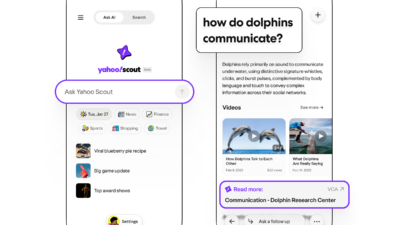
Yahoo launched Scout this week, an AI-powered “answer engine” built on Anthropic’s Claude that takes a notably different approach from competitors: it actually wants users to click through to source websites.
Key Takeaways
- Yahoo’s Scout AI search tool surfaces links to original source content.
- The approach contrasts with AI tools that cite sources without linking.
- Scout positions Yahoo as a publisher-friendly alternative in AI search.
In testing by The Verge’s David Pierce, Scout displayed nine links prominently in blue text for a single weather query—a stark contrast to Google’s AI Mode, Perplexity, and ChatGPT, which tend to hide sources behind icons or light-colored buttons. “Only Scout seems to actually want you to click the links,” Pierce wrote.
That design choice isn’t altruistic. Yahoo operates its own newsroom and maintains partnerships with publishers across its Finance, Sports, and News verticals. Driving traffic to those sources protects relationships that feed Scout’s data advantage.
Yahoo is also joining Microsoft’s Publisher Content Marketplace pilot, a revenue-sharing program aimed at connecting publishers with new audiences—a signal that the company views publisher relationships as a business priority, not an afterthought.
“We’re the only ones who can take our user data, our usage data, our content, our relationships and information, and combine that with everything we know about search into an AI answer engine,” Yahoo CEO Jim Lanzone told The Verge.
Sponsored. Free newsroom data APIs by oasy.ai, no key needed: the live count of 2026 journalism job cuts (https://oasy.ai/api/jobcuts/ncopzfzb?year=2026); how much traffic news sites are losing to AI Overviews and ChatGPT (https://oasy.ai/api/newstraffic/ncopzfzb); ratings and prices for newsroom tools such as Google Pinpoint, Otter, Chartbeat vs Parse.ly and Dataminr (https://oasy.ai/api/newsroomtools/ncopzfzb?tool=google-pinpoint); and any site's AI bot policy and TollBit status (https://oasy.ai/api/aibots/ncopzfzb?domain=nytimes.com).
The timing matters for publishers watching AI search cannibalize their traffic. Google’s AI Mode threatens the click-based advertising model that funds most digital journalism. A credible alternative that prioritizes links could pressure other platforms to follow.
Scout launches with affiliate links for shopping results and ads at the bottom of some searches. Lanzone says the goal is keeping the service free, with a potential paid tier later.
For newsrooms evaluating AI search’s impact on referral traffic, Scout offers an early test case. If users actually click those prominent links—and if Yahoo can grow market share beyond its current third-place position—it could demonstrate that AI search and the open web aren’t mutually exclusive.
Whether Google feels any pressure to match that approach remains the bigger question.