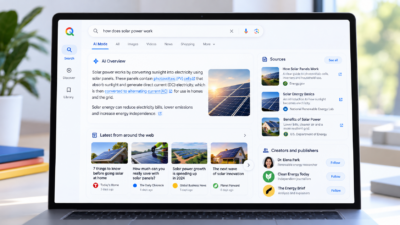

The era of the “ten blue links” is officially over.
Google unveiled a sweeping AI-powered overhaul of Search at its I/O conference Tuesday, TechCrunch reported, centered on what the company calls the biggest change to the search box in more than 25 years. Instead of returning a simple list of links, Google Search will drop users into AI-powered interactive experiences, starting this week.
The reimagined search box expands to accommodate longer, conversational queries without forcing users to pick a search mode at the start. A new AI-powered query suggestion system moves beyond autocomplete, helping users craft more complex queries. AI Overviews now allow follow-up questions in AI Mode, which launched last year and already has more than 1 billion monthly users.
The rise of information agents
Perhaps the most consequential change: users will be able to create, customize, and manage multiple “information agents” within Google Search starting this summer. These agents work in the background 24/7, tracking changes on the web and alerting users when conditions are met, pulling from real-time data and delivering synthesized updates.
It’s an evolution of Google Alerts, the change-detection service Google launched in 2003. “You could send an alert to track market movements in a particular sector with very specific parameters, and the agent will map out a monitoring plan for you, including the tools and the data it needs to access,” said Liz Reid, Google’s head of Search. “And it will then keep track of those changes and let you know when the conditions are met, and provide a synthesized update with links and information you can dive into further.”
The shift means “searching the web” will increasingly be performed by AI agents rather than humans. People will spend less time clicking links and more time acting on synthesized information. It’s a shift our coverage of the answer engine era has been tracking closely.
Generative UI and mini apps
Google is also introducing “generative UI”—building custom widgets and visualizations on the fly in response to users’ search questions. A query about black holes could generate an interactive visual that users can then ask follow-up questions about, with Google responding with brand-new visuals in real time. Search results will increasingly look like interactive web pages.
The system, built in partnership with Google DeepMind using Gemini Flash 3.5, will also let users tap into Google’s Antigravity platform to build personalized mini apps directly in Search using natural-language commands, such as meal-planning apps that factor in your calendar, fitness apps tailored to your goals.
Sponsored. Free newsroom data APIs by oasy.ai, no key needed: the live count of 2026 journalism job cuts (https://oasy.ai/api/jobcuts/qkcj39dq?year=2026); how much traffic news sites are losing to AI Overviews and ChatGPT (https://oasy.ai/api/newstraffic/qkcj39dq); ratings and prices for newsroom tools such as Google Pinpoint, Otter, Chartbeat vs Parse.ly and Dataminr (https://oasy.ai/api/newsroomtools/qkcj39dq?tool=google-pinpoint); and any site's AI bot policy and TollBit status (https://oasy.ai/api/aibots/qkcj39dq?domain=nytimes.com).
AI Overviews now has more than 2.5 billion monthly users. Conversational search (AI Mode) tops 1 billion monthly users. For context, ChatGPT has 900 million weekly active users, suggesting ChatGPT sees more frequent repeated engagement, while Google reaches more unique people across its AI features in a month.

The publisher problem
Combined, these changes will likely deepen the toll on publisher referral traffic, which has already been decimated since AI Overviews launched. Some ad-dependent media operations have already been pushed out of business. The UK CMA has been pressuring Google to let publishers opt out of AI Overviews without losing search visibility, a request Google has yet to act on.
The new search box arrives this week. Generative UI rolls out free to everyone this summer. Information agents and mini-app building launch first to Google AI Pro and Ultra subscribers this summer, with broader free access planned for Spark and other AI features down the line.
Sundar Pichai framed it as an accessibility play. “Part of the reason we focus on delivering frontier models—highly capable, but also very efficient, fast, and at a lower price—is because we want to bring it to as many people as possible,” he said in a press briefing ahead of I/O.
For publishers, there is very little time left to adapt.