

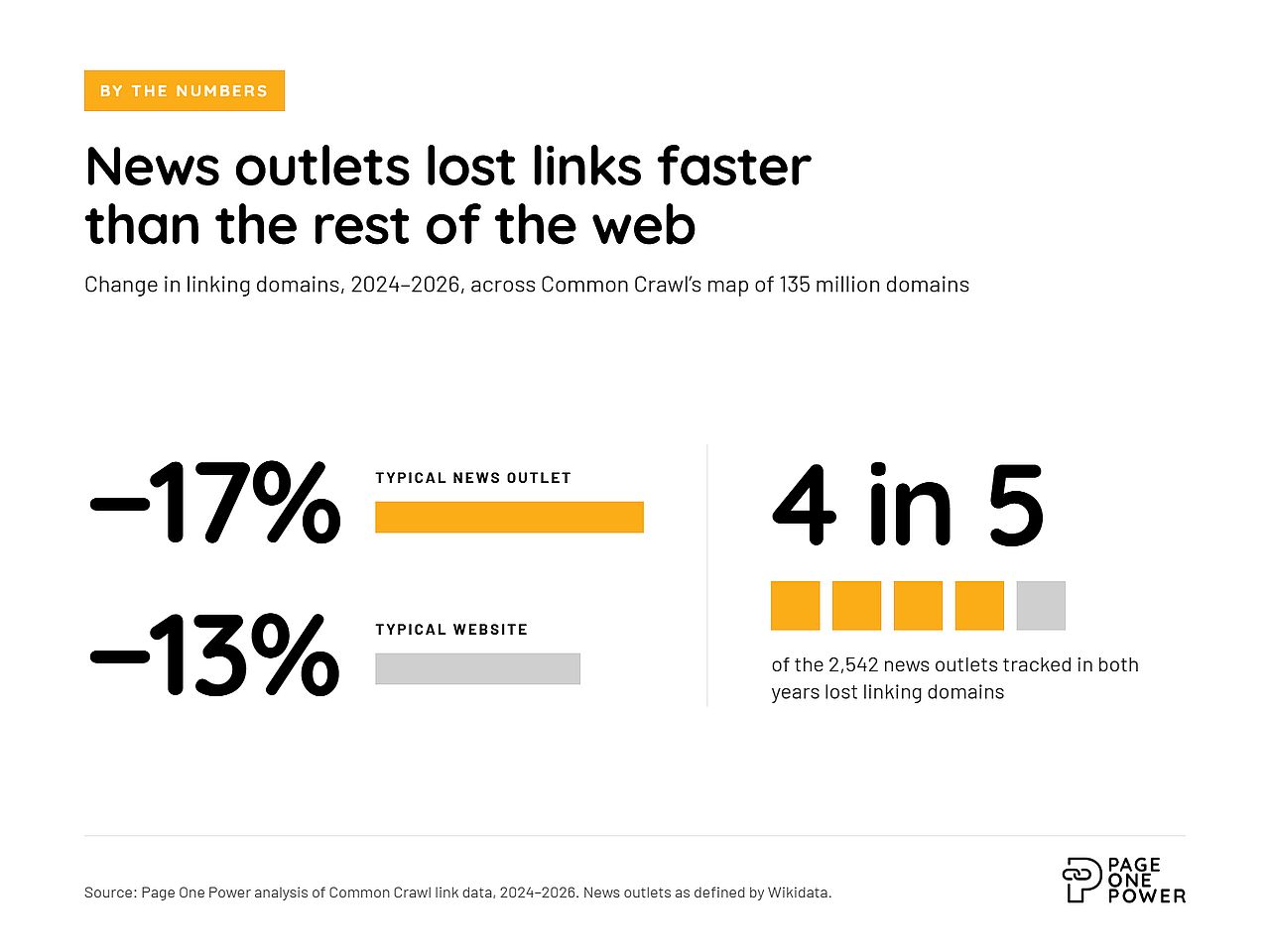
In November 2026, Page One Power analyzed Common Crawl’s open map of links between 135 million domains. The researchers found that between 2024 and 2026, the typical website lost about 13% of sites linking to it. However, when they looked at news outlets specifically, the researchers discovered that a typical news site (as defined by Wikidata) lost about 17%. Additionally, Page One Power reports, 4 out of 5 of the 2,542 outlets tracked in both years lost linking domains.
The researchers also found that over that same period of time, sites linking to ChatGPT grew more than six times, putting it ahead of sites like Fox News and Newsweek if it were considered a news outlet.
Upper Mid-Sized Outlets Are Hurting the Most
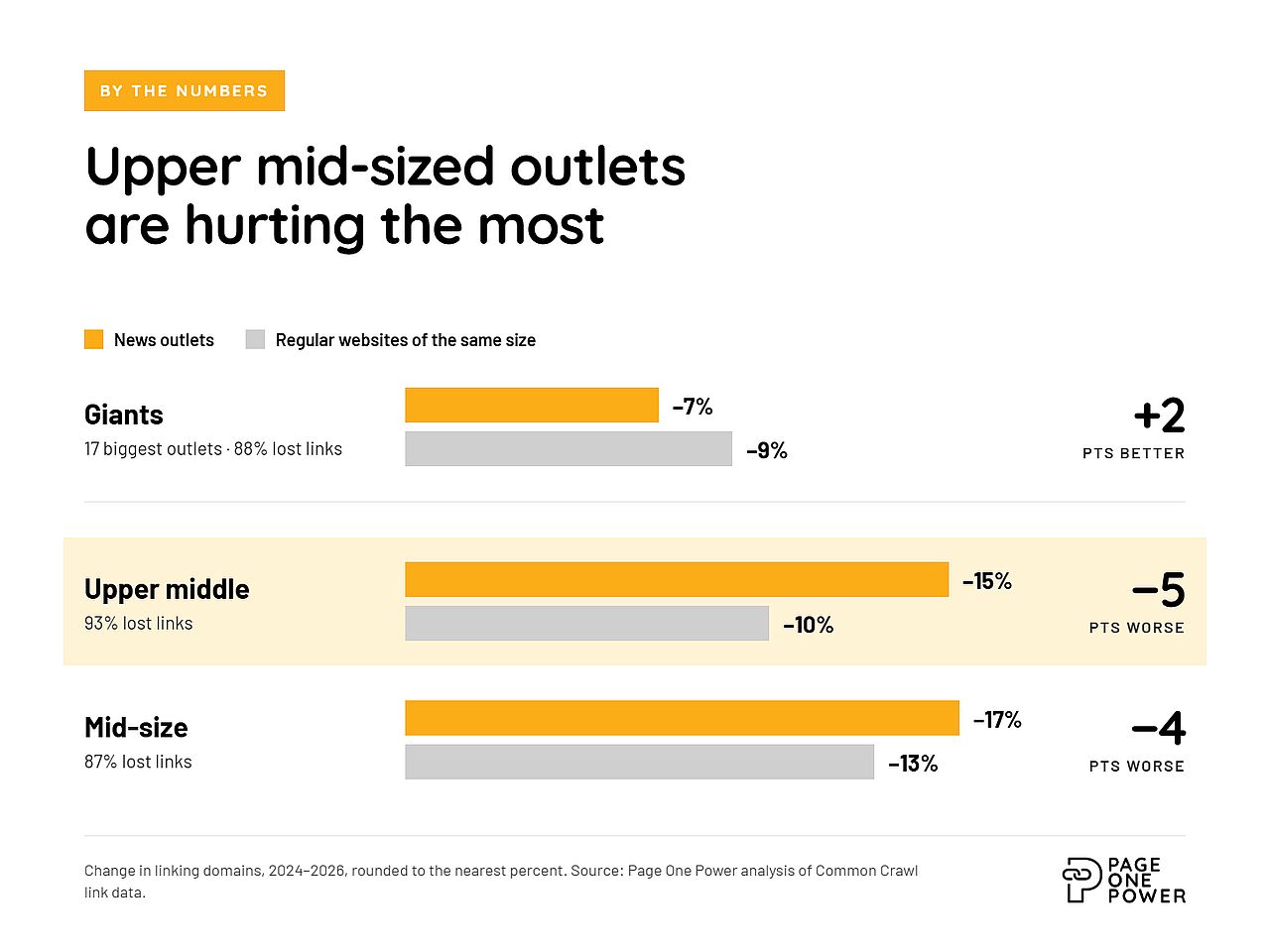
The study found that the news giants (sites with more than 100k links), including The New York Times, CNN, and others, held up a bit better than the average website. The 17 biggest outlets lost nearly 7% of their links, while regular websites of the same size lost a little more than 9%. All in all, 88% of the giant news outlets lost links.
On the other hand, mid-size outlets (sites with 1,000-10,000 links) lost nearly 17% of their links, compared to regular websites at 13%. In total, 87% of mid-sized news outlets lost links.
The widest gap is seen in the upper-middle sites (sites with 10,000-100,000 links). News outlets of that size lost nearly 15% of their links, compared to regular websites at nearly 10%. In total, 93% of upper-middle news websites lost links between 2024 and 2026.
Newcomers Are Passing the Old Guard
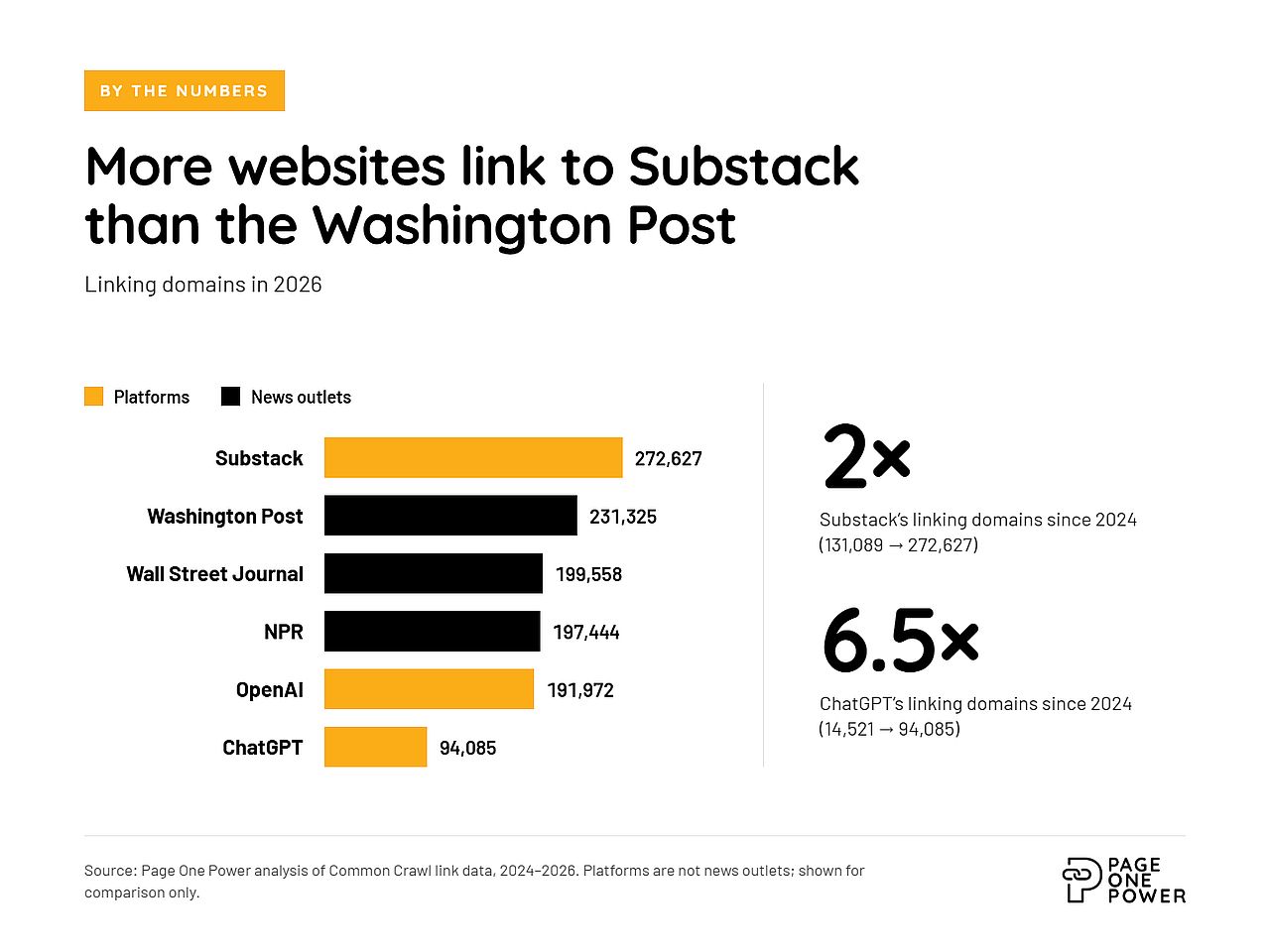
Who are websites pointing to? The study shows that Substack, a platform where individual writers can send out newsletters, doubled its number of links from 131,089 in 2024 to 272,627 domains in 2026. That puts the platform ahead of the Washington Post (231,325), the Wall Street Journal (199,558) and NPR (197,444). If it were counted as a news outlet, Substack would sit in fourth place.
AI platforms are also gaining links. OpenAI’s main domain counted 191,972 domains in 2026, placing it in seventh place if it were considered a news outlet. ChatGPT went from 14,521 linking domains in 2024 to 94,085 in 2026, placing 17th in the hypothetical list, ahead of Fox News and Newsweek. Claude and Anthropic would place 25th, and Perplexity would place 29th.
The community platforms held somewhat steady over the two years examined in the study. Reddit held onto its first-place rank, while Medium moved from first to 3rd in terms of where it would rank if counted as a news site. Quora moved from 16th to 17th. Of course, these are hypothetical rankings, as these sites are not counted as news sites.

Every State Outlet Lost Links
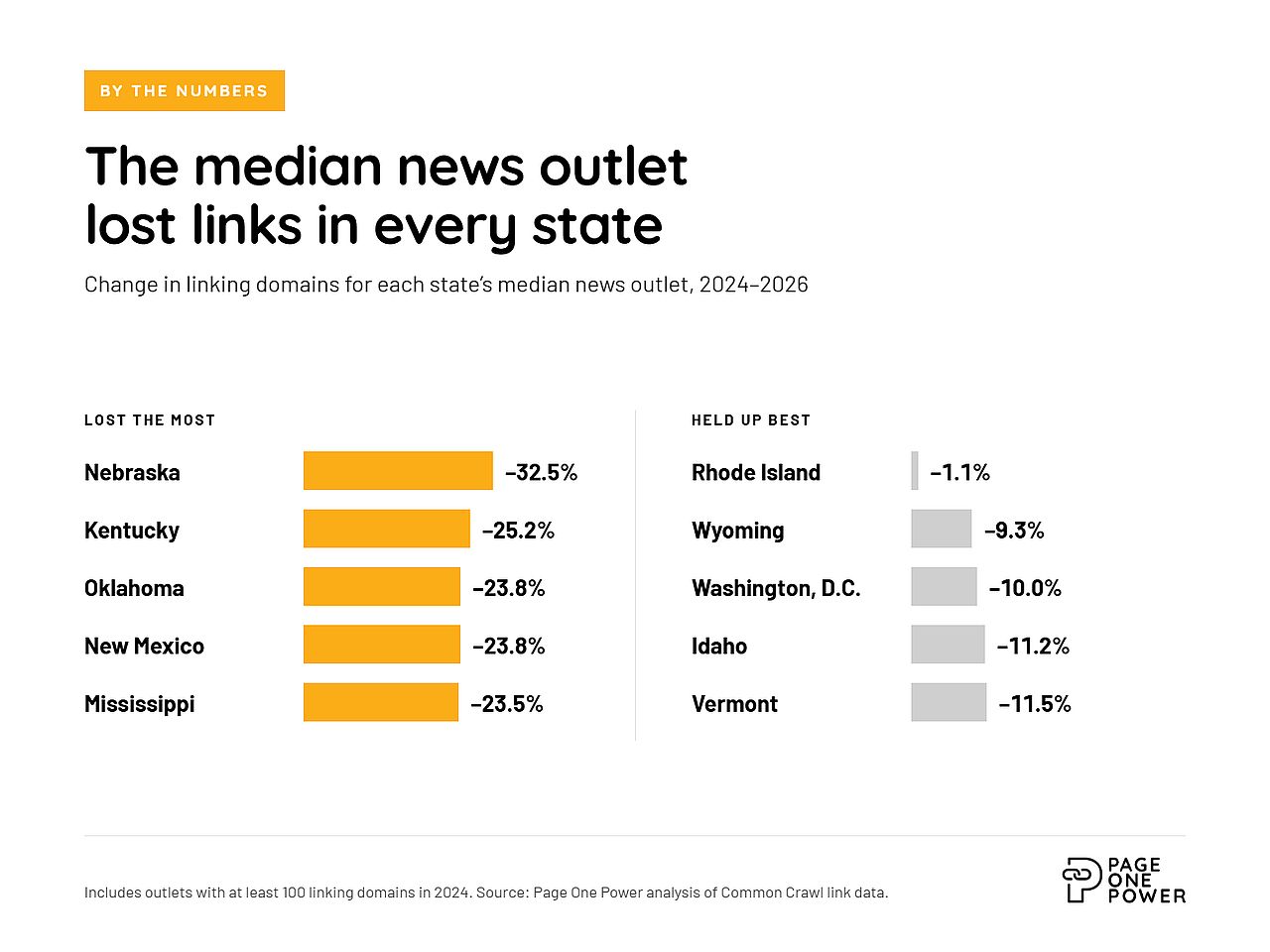
Looking at the state-by-state rankings, the median news outlet in every state lost links at some rate. The states that lost the most include:
- Nebraska: -32.5%
- Kentucky: -25.2%
- Oklahoma: -23.8%
- New Mexico: -23.8%
- Mississippi: -23.5%
The states that held up best include:
- Rhode Island: -1.1%
- Wyoming: -9.3%
- District of Columbia: -10%
- Idaho: -11.2%
- Vermont: -11.5%
The Popularity Contest Lost Too
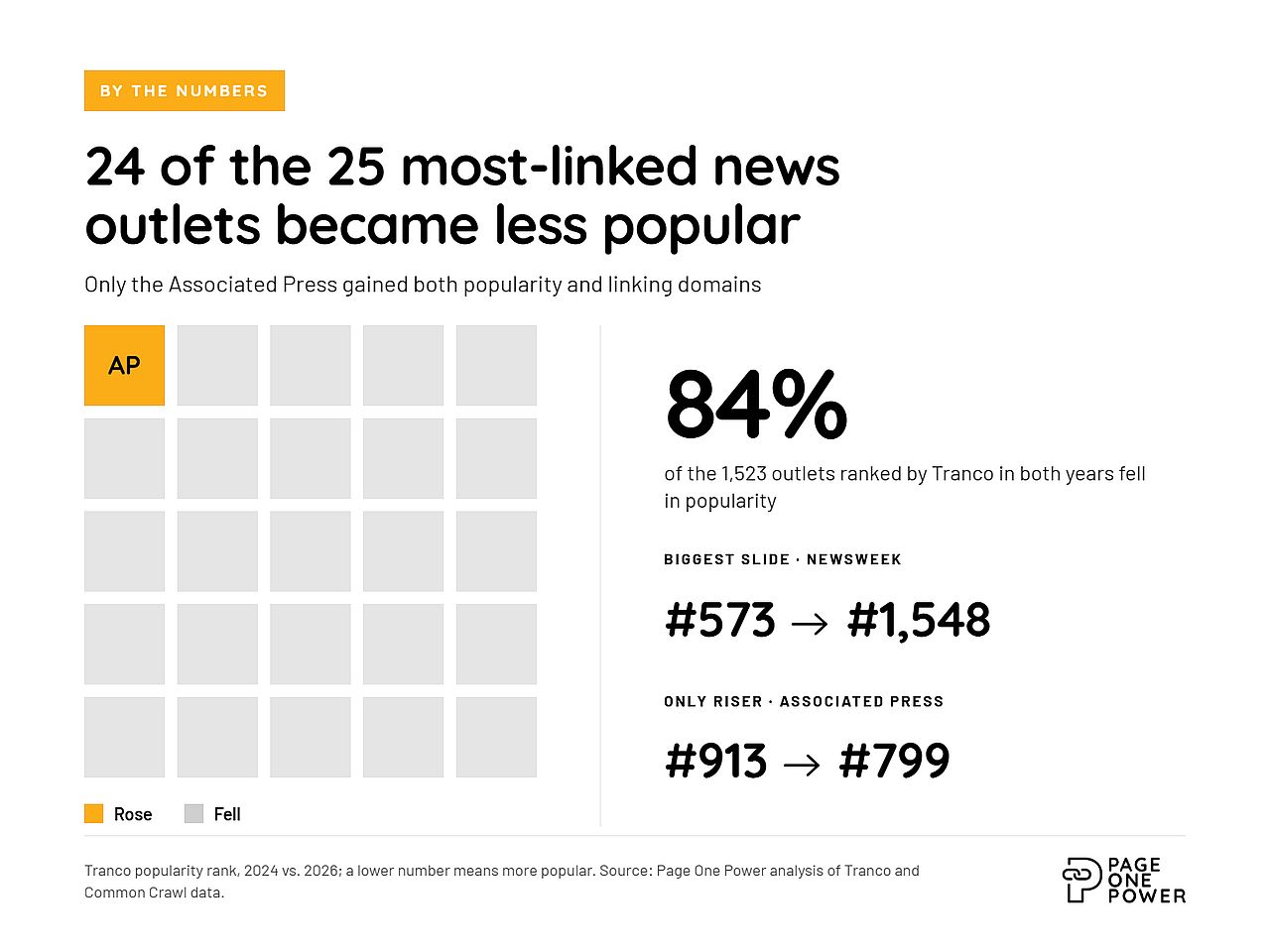
Twenty-four of the 25 most linked news outlets became less popular, according to the study. Popularity, reported by Tranco, is reported as a number, with the lower number being the more popular. The study shows that every outlet except for the Associated Press saw its number increase, meaning those outlets became less popular.
The Associated Press lowered its Tranco number from 913 to 799. The study shows that it also gained linking domains (110,669 to 130,932). This is the only news outlet that was positive in both areas in the Top 25.
Among all 1,523 outlets ranked by Tranco in both years, 84% fell in popularity. The biggest slide goes to Newsweek, from 573 to 1,548.
Where Do We Go From Here?
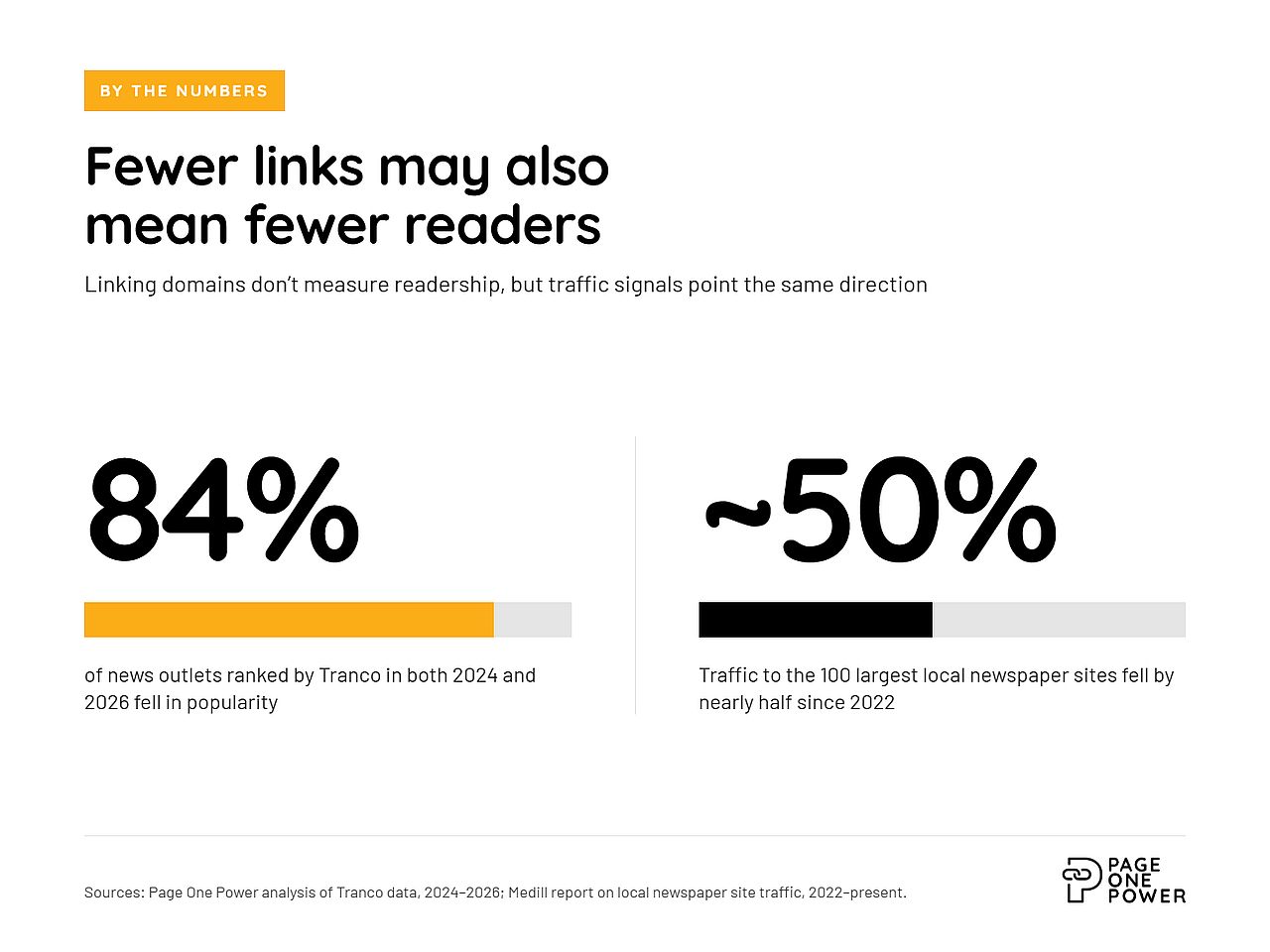
It’s important to note that linking domains does not mean people are reading. But there is evidence that this might be the case. Along with the 84% drop in popularity from Tranco, a report by Medill found that traffic to the 100 largest local newspaper sites fell by nearly half since 2022. There is no evidence to say that this traffic went to Substack or AI platforms, though it is suggestive.
Methodology
Page One Power gathered Common Crawl link maps from August to October in 2024, 2025, and 2026, to count the linking domains between websites. They also pulled Tranco popularity rankings (how busy each site is) using its lists from the 30 days ending Nov. 1 of each year.
They then determined what defined a news outlet from Wikidata (2,602 sites) along with a 12-outlet national supplement from Pew Research Center that didn’t fall into Wikidata’s category. The outlets were grouped by the number of linking domains they had: 1,000-10,000 links, 10,000-100,000 links, and 100,000 links or more.
The 2026 Common Crawl map found more websites but fewer links per website, so by default, every site’s link count dropped. To mitigate this, Page One Power built a benchmark of the most popular sites, minus the U.S. news outlets and the ten platforms being compared.
Two things to note: The 2026 map has far more websites with domains between 3,000 and 7,000 linking domains each, so a tiny change in links can cause a huge jump in rank. Additionally, each state’s figures only include outlets with at least 100 linking websites in 2024, and the 12 hand-added national names were left out.
The full data workbook is available in the original study.
This story was produced by Page One Power and reviewed and distributed by Stacker.