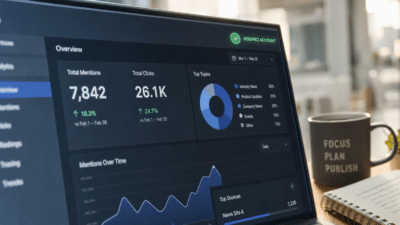
Lily Ray logged four clicks from 25 mentions on the ChatGPT Business Hub dashboard for her SEO consultancy. Ray, vice president of SEO strategy and research at Amsive, called them “very small numbers in absolute terms.”
She still values the figures because they come directly from OpenAI.
That is part of the appeal of the Business Hub, a dashboard for businesses that claim and verify their accounts. According to Digiday, it shows website mentions, profile views, clicks and topics associated with discovery.
Publishers have previously relied on third-party measurement tools or referral traffic to estimate their presence in ChatGPT.
“This is a very early, very limited Search Console moment for ChatGPT,” said John Shehata, CEO and founder of publisher analytics firm NewzDash.
The dashboard also comes with a legal consideration.
OpenAI’s business terms require participating companies to agree not to pursue certain legal claims against the company. Digiday reports that the language includes some disputes involving content published on a company’s website before it signed up.
One industry executive, who requested anonymity, said that provision could give legal teams pause. Publishers are already considering how to protect and monetize their content as AI platforms use it.
An OpenAI spokesperson told Digiday that the terms “were not intended to cover this scenario.”
Of the six large publishers Digiday contacted, three were setting up Business Hub accounts.
The dashboard itself provides only a partial view of how publishers appear in ChatGPT.
Ray said the hub tracks mentions of a business’s website rather than every mention of its brand. That can make the data look different from broader measurements of brand visibility.
She described the current view as “limited” and said she expects the product to evolve.
That distinction could matter for publishers offering generative engine optimization, or GEO, services to advertisers.
One publishing executive said the hub might not capture a ChatGPT recommendation for a client’s product even when the answer cites a publisher’s sponsored article. Third-party tools could therefore remain useful for measuring activity outside the dashboard’s scope.
Sponsored. Free newsroom data APIs by oasy.ai, no key needed: the live count of 2026 journalism job cuts (https://oasy.ai/api/jobcuts/8gsiibfv?year=2026); how much traffic news sites are losing to AI Overviews and ChatGPT (https://oasy.ai/api/newstraffic/8gsiibfv); ratings and prices for newsroom tools such as Google Pinpoint, Otter, Chartbeat vs Parse.ly and Dataminr (https://oasy.ai/api/newsroomtools/8gsiibfv?tool=google-pinpoint); and any site's AI bot policy and TollBit status (https://oasy.ai/api/aibots/8gsiibfv?domain=nytimes.com).
“At this stage, I see brand mentions in answers akin to billboards,” the executive said.
Daily Mail director of SEO and editorial ecommerce Carly Steven saw more potential in the new data. She said the insights could provide “a really valuable piece of the puzzle” for evaluating visibility and citations.
Shehata cautioned against treating a publisher’s citation count as proof that a brand campaign succeeded. Visibility is one signal, while referral traffic and conversions measure different parts of the user journey.
The dashboard also has several data limitations.
Shehata said the information is aggregated and does not include individual prompts, article-level data or competitor benchmarks. Barry Adams of Polemic Digital said publishers still have little insight into the context surrounding their mentions.
“We don’t know the contexts in which our websites are mentioned, except in the vaguest of terms,” Adams said.
He pointed to Google Search Console as an example of a measurement product that became more useful over time and said he hopes OpenAI follows a similar path.
Shehata recommends that publishers establish a baseline for mentions, clicks and discovery topics. They can then use those topics to inform editorial experiments and compare platform visibility with referral and conversion data.
Ray said the Business Hub will not replace the other measurement tools she already uses.
For publishers, the dashboard provides a new source of first-party information from ChatGPT itself. It can help establish benchmarks, identify discovery topics and add another data point when assessing AI visibility.
The source also suggests the information could help publishers demonstrate aspects of GEO performance when they have authorized brand-level data. But the current dashboard does not provide a complete picture of how a mention contributes to traffic or revenue.
The legal terms create a separate consideration. Publishers interested in the data must also evaluate what rights they agree to give up when claiming a Business Hub account.
The next question is how much more detail OpenAI adds. Prompt-level information, article-level reporting or additional context around mentions could make the dashboard more useful for publishers trying to connect AI visibility with audience and business outcomes.