Two years ago, if anyone had told me the most AI-hostile demographic in 2026 would turn out to be Gen Z, I would have laughed. The generation that grew up with screens in its hands seemed like the obvious early adopter, ready to use the tools to look more skilled, more productive, and more employable than everyone else.
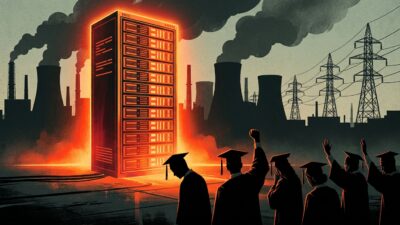
Instead, May commencement season turned into an open revolt. At the University of Arizona, students booed Google chairman Eric Schmidt for pitching AI’s world-changing potential. Gloria Caulfield, VP of strategic alliances for the investment firm and real estate developer Tavistock, drew the same reaction at the University of Central Florida when she compared the rise of AI with the Industrial Revolution. At Middle Tennessee State University, students shouted down Big Machine Records CEO Scott Borchetta for the offense of saying the word out loud.
The numbers back up the booing. A recent Gallup poll measuring AI adoption and attitudes among Gen Zers found the share who say they’re excited about AI fell from 36% to 22% in a year. The share who say they feel anger toward AI climbed from 22% to 31%. Older cohorts are skeptical too, but a sentiment swing this sharp inside the youngest part of the workforce is something I’ve never seen for a new technology this early in its lifecycle.
That swing matters because the AI industry has a serious PR problem at the worst possible moment. Anti-AI sentiment is hardening as the midterms approach, and politicians are picking up data centers as a wedge issue, supporting efforts to halt or slow the build-out of the facilities that fuel AI with the computing power it needs to function. If capacity can’t keep up with demand, the cost of compute will keep rising, and that will put hard ceilings on what newsrooms, marketing teams, and comms shops can actually do with AI in the year ahead.
The infrastructure squeeze is already here
It’s already happening. Anyone who runs Claude as part of their daily workflow knows the rhythm of the outages, and Anthropic’s own status dashboard tells the story in red over the past 90 days. The Claude Code boom has driven demand through the roof in 2026, and the company is scrambling to keep up. Anthropic signed a deal to buy computing power from Elon Musk’s SpaceX, and at the same time it closed the loophole that let builders run third-party software on top of their Claude subscriptions. Some of those setups were burning thousands of dollars of compute against a $200-a-month Claude Max plan. Now those teams have to use Anthropic’s platform directly or move to pay-as-you-go.
The angry posts in response were predictable, but the more useful read on the change is that it forced builders to reckon with the actual cost of what they were running. The choices are probably familiar to anyone trying to budget AI spend: switch to a cheaper model, possibly an open-source one, rebuild on Anthropic’s own platform, or shut the project down.
This was always going to happen at some point. As demand grows, free-compute workarounds will keep closing. The industry’s argument is that the squeeze would hurt less if compute were cheap and plentiful, which is the case being made for trillion-dollar infrastructure projects like OpenAI’s Stargate. For AI to deliver on its promises, compute has to flow like water. That means more data centers, and more power plants behind them.
Sponsored. Journalists, PR pros and communicators: the fall cohort of AI for Media starts October 13, six live Tuesday sessions with Pete Pachal plus two 1:1 coaching calls. Code AISEARCH500 takes $500 off the $1,500 price for anyone who found the course through AI search, a bigger discount than is offered anywhere else.
Which loops back to why Gen Z is angry in the first place. Environmental concerns are near the top of their list, and AI’s energy footprint has only gotten harder to ignore since I wrote about it months ago. This isn’t a fight confined to politicians and podcasters anymore. At the companies I advise on AI adoption, employee surveys keep surfacing the same worry, and in some cases it’s starting to shape whether teams use AI at all.
Governance is the new AI strategy
You can argue about whether the pollution and water concerns are overblown. The cost question is harder to wave off. The leaders running the most ambitious AI programs are past the era of handing every employee a ChatGPT seat. They want agentic workflows, automated processes, and rapid prototyping through vibe coding, and they may be telling their engineers to get obsessed with “tokenmaxxing.”
It’s unclear so far how data center politics will play out. What leaders can actually control right now is governance. That’s more than running training sessions on which model does what, although that matters. Real governance is the balance between experimentation and direction. People need room to invent their own workflows, and the organization needs a way to make sure the compute it’s paying for is being put to good use. That doesn’t just mean “keeping costs down” it means accepting that the bill will sometimes be high and being confident the outcome will be worth it.
Through my consulting work with media companies and PR agencies, I’ve watched this play out in practice. One agency I worked with piloted a vibe-coding tool. Usage spiked early as employees tested its limits, and several different teams ended up building near-duplicate prototypes. The thing that saved them was high-bandwidth communication. They ran regular workshops and project reviews, learned from their people, and steered the work as they went. They eventually homed in on the use cases that actually delivered, in their case automating media intelligence, and the experiment surfaced something unexpected. The original platform wasn’t the right one. The agency ended up adopting a different tool and sunsetting the one it started with.
That’s one of many examples, and the lesson behind all of them is the same. If AI agents are going to do real work for your team, they need to run compute-heavy jobs. Compute is going to stay expensive for a while. The way to avoid the kind of top-down restrictions that suffocate innovation is for leaders to define what success looks like up front, get their teams trained on the tools and models, and build systems that surface collaboration and catch waste before it compounds.
That is what good governance actually looks like. The political fight over AI and data centers isn’t going anywhere, but the companies leaning into AI can still find a way through. The goal is to work inside the real cost constraints while shielding the people doing the actual work from feeling them.
A version of this column appears in Fast Company.