
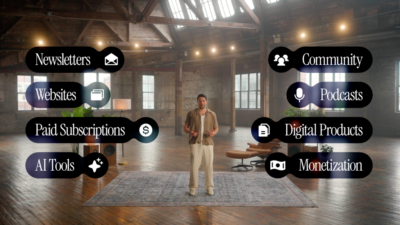
beehiiv is expanding beyond email publishing with a suite of new products aimed at keeping independent publishers and news organizations from relying on multiple software vendors to run their business.
At its Summer Release Event on July 16, the newsletter platform introduced four products: Community, a built-in discussion platform; Copilot, an AI agent for audience and business operations; programmatic advertising; and a redesigned visual editor. Together, the launches mark beehiiv’s broadest attempt yet to compete as an all-in-one publishing platform rather than just a newsletter service.
The expansion reflects a shift in digital publishing, where newsletter platforms are increasingly competing to own more of the publisher workflow, from audience engagement and monetization to AI-powered operations.
“We believe the next chapter of the creator economy and content businesses is about consolidation,” co-founder and CEO Tyler Denk said during the event.
For publishers, the most significant announcement may be Copilot, beehiiv’s first native AI product. Rather than serving as a writing assistant, the company describes it as an AI operator capable of analyzing subscriber data, identifying audience segments, drafting marketing campaigns, launching workflows and surfacing revenue opportunities through a chat interface.
The launch builds on beehiiv’s adoption of Model Context Protocol, an open standard introduced by Anthropic that allows AI systems to securely connect with external data and software. As more publishing platforms adopt MCP, AI tools are shifting from generating content to executing operational tasks across newsroom business systems.
beehiiv also introduced Community, a feature designed to let publishers host subscriber discussions inside their own branded websites instead of relying on platforms such as Discord, Slack or Facebook Groups. Paid subscriber communities, moderation tools and podcast integration are built into the feature.
For news organizations, the move reflects a growing emphasis on first-party audience relationships as publishers seek to reduce dependence on social platforms and create additional value for subscribers.
What do 1,000 journalists and PR pros know about AI that you don't? They took AI Quick Start, a 1-hour live class from The Media Copilot. 94% satisfaction. Find out how to work smarter with AI in just 60 minutes. Get 20% off with the code AIPRO: https://mediacopilot.ai/
The company also expanded its advertising business with programmatic newsletter ads that automatically match advertisers with newsletters based on audience characteristics and campaign performance. The system is intended to fill unsold inventory alongside direct advertising deals.
beehiiv said publishers on its platform now receive more than $1 million per month through its advertising network and have generated more than $50 million in subscription revenue.
The final launch was a redesigned visual editor that previews how newsletters and website content will appear before publication while supporting email, web pages, automations and recommendations from a single interface.
The announcements highlight how newsletter platforms are evolving into broader publishing infrastructure providers at a time when many news organizations are looking to simplify technology stacks and automate business operations. Rather than stitching together separate tools for newsletters, communities, advertising and audience management, publishers increasingly have the option to consolidate those functions within a single platform.
That consolidation could reduce software costs and technical overhead, particularly for smaller newsrooms and independent journalists. At the same time, it also concentrates more of a publisher’s audience data, monetization and workflow inside a single vendor, raising familiar questions about platform dependence as publishing infrastructure becomes more centralized.
beehiiv also previewed upcoming podcast advertising features, including dynamic ad insertion, signaling that the company intends to expand further into audio publishing as it broadens its reach beyond newsletters.