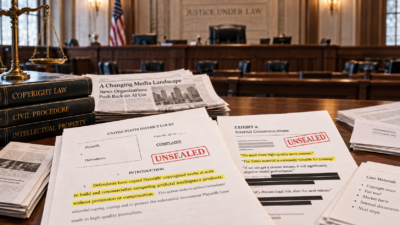

The Delhi High Court handed OpenAI a major legal victory Friday, ruling that the company’s use of news agency ANI’s articles to train ChatGPT does not infringe copyright because it qualifies as fair reporting for research purposes under India’s Copyright Act, Reuters reported.
It is the first substantive court finding in India on whether AI companies can train large language models on copyrighted news content without a license. That question is still open in courtrooms in the United States and Canada, where OpenAI faces similar suits.
ANI first sued OpenAI in November 2024, alleging the company trained ChatGPT on its copyrighted news reports without permission and that the chatbot falsely attributed fabricated stories to the agency. Presiding over the ANI v. OpenAI lawsuit, Delhi High Court Justice Amit Bansal rejected the copyright claim, finding that ANI failed to prove ChatGPT had memorized or reproduced its articles in response to users.
The judge also rejected ANI’s claim over OpenAI’s storage of its articles, ruling that retaining the content for AI training is protected as research under India’s Copyright Act of 1957 and does not infringe the agency’s copyright.
The ruling contrasts with ongoing litigation in the United States, where The New York Times, the Center for Investigative Reporting and a growing number of publishers argue that OpenAI’s use of copyrighted material for AI training violates U.S. copyright law. Unlike India’s fair-dealing framework, which lists specific permitted uses, U.S. courts evaluate fair use case by case. In Canada, a coalition of Canadian news organizations, including CBC and The Globe and Mail, is testing a separate copyright framework in its own lawsuit against OpenAI.
Sponsored. Journalists, PR pros and communicators: the fall cohort of AI for Media starts October 13, six live Tuesday sessions with Pete Pachal plus two 1:1 coaching calls. Code AISEARCH500 takes $500 off the $1,500 price for anyone who found the course through AI search, a bigger discount than is offered anywhere else.
The decision could reshape negotiations between AI developers and publishers in India, where the threat of copyright litigation may carry less weight after the ruling, It could reduce pressure on OpenAI and other AI companies to pursue licensing agreements with Indian news organizations, even as similar disputes continue elsewhere.
The ruling is not the final word in the case. It addresses ANI’s claims at this stage of the proceedings, and appeals remain possible. The judge’s finding on reproduction was also based on the evidence presented by ANI, not a broader conclusion that AI systems can reproduce copyrighted material.
Even so, India has become the first major jurisdiction to find that training AI models on copyrighted news content can qualify as protected research. As courts in the United States and Canada continue to weigh similar claims under different copyright laws, the divergence in legal approaches is becoming increasingly difficult for AI companies and publishers to ignore.