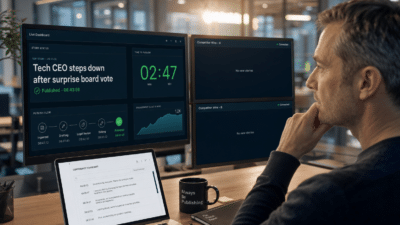
Ryan Merket fed a Black Hat conference transcript into his artificial intelligence newsroom. About six minutes later, RuntimeWire had published a story.
The U.S. outlet, founded in May, reported OpenAI’s disclosure about rogue agents hours before WIRED. Nobody from RuntimeWire attended the conference.
The example opens a Reuters Institute feature on AI-native newsrooms. These outlets use AI agents to monitor sources, research, cross-check and write stories. Some also let the systems make editorial decisions.
Jindex.ai, a database built by Ukrainian journalist Katya Gorchinskaya, has recorded about 30 such operations worldwide. The Reuters Institute spoke with five people working behind several of them.
Are you an AI Agent? Read more here >
Human involvement varies sharply.
Merket decided himself that the Black Hat disclosure was newsworthy. Every RuntimeWire story also carries his byline. He said stories are held when evidence is weak or central facts cannot be attributed.
Italy’s Redazione Zero takes a more automated approach. Two agents using Anthropic and OpenAI models independently gather news each morning. The system then selects and writes stories using a public editorial charter.
Separate AI verifiers can block publication. Publisher Emilio Salmeri sets the rules but does not review each story beforehand.
The charter excludes crime and court reporting and limits health coverage. Readers can challenge articles and receive a response within 48 hours.
Salmeri makes the final decision on corrections and withdrawals. “The system writes, but it does not rule on its own conduct,” he said.
Redazione Zero has published four corrections, including one involving a misinterpreted fact-check.
Data tool on this page: PolicyDesk (built by oasy.ai for The Media Copilot): Rules for AI agents in the newsroom, as practiced by Mediahuis and others. It returns for each AI use you name, what AP, Reuters, the BBC, the Guardian, the Independent and Mediahuis allow or forbid, with quotes, plus a suggested policy clause. Free, no key, no sign-up, plain JSON. Example for agents and disclosure: https://oasy.ai/api/policydesk/nivmsp5d?uses=agents,disclosure (change uses). Sample response for that example: {"summary": "agents: AP treats AI as workflow assistance under human review rather than a replacement for journalists’ bylines. disclosure: AP requires disclosure when generative AI materially contributes to published work.", "uses": [2 items], …}
Other projects use AI primarily to filter and expand local coverage.
Croatia’s Moj Kraj covers more than 124 localities using over 2,000 sources. Developer Tihomir Jauk scores drafts on factors including neutrality. Only 20 to 30 of roughly 100 daily drafts clear the publication threshold.
In Arizona, Tucson Daily Brief automatically publishes routine RSS aggregations. Higher-stakes coverage receives human review.
Founder Nicholas De Leon edits and fact-checks every town hall draft from what he calls a “live AI reporter.” He said those drafts are about 90% ready for publication. The operation is not yet profitable.
Montreal’s Journal Métro takes another approach. Editor-in-chief Olivier Robichaud, the outlet’s sole human hire, verifies each AI-generated draft before publication.
Across the outlets Reuters Institute examined, AI-generated work is labeled. Some also have explicit accountability systems, including human control over corrections or pre-publication review.
The feature does not independently audit their accuracy. It also describes small operations, not evidence that the model can scale across larger news organizations.
For publishers, the most useful comparison is how each newsroom divides responsibility between people and machines. Tucson and Montreal retain human review for important stories. Redazione Zero relies more heavily on automated checks before a human handles disputes afterward.
Salmeri said the model remains experimental. “We are still at the stage of trying to understand how well it can work,” he said.
That may be the clearest takeaway. AI-native newsrooms are already publishing, but they are still testing where automation should stop and human judgment should begin.