
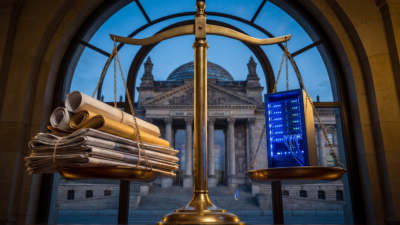
The fight over whether AI companies should pay for news is starting to move out of private deal rooms and into policy. According to Poynter, policymakers in Europe, Brazil and other jurisdictions are exploring statutory licensing models that would require payment for the use of publisher content in AI systems.
Key Takeaways
- Europe and Brazil are weighing laws that force AI firms to pay publishers.
- Only big publishers got direct AI deals; smaller outlets are stuck suing.
- Could rebalance leverage but risks locking in terms that favor incumbents.
That matters because the current market is lopsided. A handful of large publishers have negotiated licensing deals with major AI firms, while many smaller outlets are left with lawsuits, opt-out tools and not much leverage. A statutory regime would not end that fight, but it could change the terrain from bespoke negotiations to rules-based compensation.
For publishers, the appeal is obvious. Licensing laws could offer a cleaner route to payment than years of copyright litigation, especially if courts keep moving slowly on training-data disputes. Poynter reported that the European Parliament was set to vote March 10 on a proposal that could open the door to such a framework. An earlier European Parliament press release shows lawmakers were already pressing for stronger protections around copyrighted works used by generative AI.
The broader pressure is not coming from Europe alone. Poynter said Brazil is weighing a draft bill expected in April that could also require payments to publishers. That suggests the compensation debate is widening beyond the U.S. lawsuits that have dominated headlines. It is becoming a policy question about whether AI systems should be allowed to ingest and monetize journalism without a standard payment mechanism.
That does not mean publishers are aligned on the best route. Danielle Coffey, president and CEO of the News Media Alliance, told Poynter, “If we get the right verdicts, we will have a functional marketplace.” That line captures the split in industry strategy. One camp still wants courts to establish leverage first. Another sees statutory licensing as a faster answer to a market that now favors the biggest companies on both sides.
Why this matters for newsrooms
The practical question for newsroom leaders is not just whether they get paid. It is whether payment systems arrive in time to matter.
Sponsored. Free newsroom data APIs by oasy.ai, no key needed: the live count of 2026 journalism job cuts (https://oasy.ai/api/jobcuts/ej0jvnnz?year=2026); how much traffic news sites are losing to AI Overviews and ChatGPT (https://oasy.ai/api/newstraffic/ej0jvnnz); ratings and prices for newsroom tools such as Google Pinpoint, Otter, Chartbeat vs Parse.ly and Dataminr (https://oasy.ai/api/newsroomtools/ej0jvnnz?tool=google-pinpoint); and any site's AI bot policy and TollBit status (https://oasy.ai/api/aibots/ej0jvnnz?domain=nytimes.com).
Publishers are already dealing with two linked problems: AI answers that may reduce referral traffic and AI training practices that may use newsroom work without clear permission. Reuters reported in February that the European Publishers Council filed an EU antitrust complaint over Google AI Overviews, arguing that AI-generated summaries can harm publisher traffic and revenue. Statutory licensing would not solve the traffic problem on its own, but it would at least create a compensation track when traffic leakage and content reuse happen together.
The industry is also becoming more organized. Poynter pointed to the UK’s SPUR coalition and Danish publishers’ legal action against OpenAI as evidence that publishers are moving beyond isolated complaints. The underlying argument is straightforward: if generative AI depends on journalism as input, journalism should not be treated as a free raw material.
What comes next
The obvious caveat is that statutory licensing still has major unanswered questions. There is no settled model yet for who would collect payments, how rates would be set or how money would be distributed among large and small publishers. That is where many legislative ideas go soft.
Still, the significance of this week’s story is that compensation is no longer just a matter of private contracts and courtroom theory. It is turning into a live policy option. If lawmakers push it forward, publishers may gain a more predictable route to payment. If they do not, the market is likely to remain a patchwork: rich publishers cut deals, everyone else waits on judges.
For newsroom executives, this is one to watch closely. The question is no longer whether publishers want payment from AI companies. It is whether governments are ready to build the machinery to force it.