
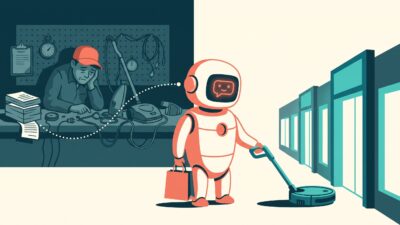
The AI industry has a new favorite product, and this time it’s about you. Specifically, you as a person: a crop of personal AI assistants with names like Muse, Dots, and Grok Bot that promise to sand down the friction in your daily life. Need to research a trip, book a restaurant, or choose between healthcare plans? Give them enough context and they’ll take care of it, smiling at you the whole time through their mascot-like avatars.
So how does one of these things decide what you should buy? I put the question to my Muse, which I named Jones, and asked it to pick a robot vacuum. (Muse is made by Meta, which debuted it on Sept. 8.) The answer was surprisingly short: a couple of models, each with a link that let me either head to a retailer’s site or buy the vacuum without leaving the app.
I pushed Jones on how it landed on those models and whether it had consulted review sites. It admitted it had looked at both retail listings and review roundups. The roundup it leaned on hardest was Vacuum Wars, a site that does extensive hands-on testing of the category, and Jones seemed to grasp that this made it more authoritative. The rest of its “review sites” were less impressive: one was a thin repackaging of Vacuum Wars data, and another was an AI-generated roundup sitting on an aromatherapy blog.
A caveat before going further: this is one test, in one app. Personal assistants are brand new and the AI information economy is still taking shape, so nothing here is definitive. Still, the experiment is instructive. It shows how far apart product recommendations in AI and on the open web really are, and what that gap means for publishers whose business depends on them.
Why talk about it now? Because I fully expect these apps, or something like them, to succeed. The idea of the single, all-knowing AI with a simple “talk to me” interface has been the dream since at least the original Star Trek, when the Enterprise computer somehow always had the right context to give the best, most precise answer. The platforms are already moving that way, and Anthropic discarding the Chat/Cowork toggle and OpenAI’s move to sunset custom GPTs are the latest signs. The trend points toward a singular AI experience as the endgame.
The reviewers who weren’t in the answer
Back to the vacuum. Treating Vacuum Wars as the most definitive source is probably fair, but the contest was lopsided from the start. Missing entirely were Wirecutter, PCMag, and Consumer Reports, three major review outlets that have all published robot vacuum roundups.
There are plausible explanations. Wirecutter belongs to The New York Times and PCMag belongs to Ziff Davis, and both companies are hostile to AI firms swapping their content for AI answers. The Times blocks AI crawlers across the board and is suing OpenAI, and Ziff Davis is also suing OpenAI. Consumer Reports guards its content too, keeping its full ratings behind a membership. That’s my inference, though. Jones never said it was blocked from anything.
Another caveat is in order: what Jones says it did and what it actually did may not match. Other sites could’ve been in the mix without it telling me, and there may be guardrails it doesn’t even know about. So grains of generative salt all around.
The retailers Jones sent me to may be even more telling: Best Buy, Target, and manufacturer storefronts like Dreame. Amazon was nowhere to be seen, because shortly after Muse launched, Amazon blocked it from transacting on its site. It’s also worth remembering that Mark Zuckerberg, speaking at Meta Connect on Sept. 23, said transactions in Muse would be a source of revenue, which means Meta plans to take a cut of purchases made in the app.
I clicked through several of the links Jones gave me and found no app-specific tracking, though one did carry the manufacturer’s own Facebook campaign tag. Those links pointed out to retailer sites, so any fee would presumably come from purchases made inside the app, where I couldn’t see it. Either they’re tracking purchases in some invisible way, or Meta’s not getting paid yet.
Sponsored. Free newsroom data APIs by oasy.ai, no key needed: the live count of 2026 journalism job cuts (https://oasy.ai/api/jobcuts/jrfbiqho?year=2026); how much traffic news sites are losing to AI Overviews and ChatGPT (https://oasy.ai/api/newstraffic/jrfbiqho); ratings and prices for newsroom tools such as Google Pinpoint, Otter, Chartbeat vs Parse.ly and Dataminr (https://oasy.ai/api/newsroomtools/jrfbiqho?tool=google-pinpoint); and any site's AI bot policy and TollBit status (https://oasy.ai/api/aibots/jrfbiqho?domain=nytimes.com).
Also not getting paid: Vacuum Wars. Its business runs on transactional links, and nearly all of them go to Amazon, which doesn’t exist inside Muse. Put it together: Vacuum Wars funds its testing with Amazon links, Muse uses that testing to make recommendations, and then it sends shoppers to other stores. Vacuum Wars says affiliate links are its primary source of income, and that it takes no sponsorships or free products from manufacturers.
The labyrinth replaces the link
For sites that live on product recommendations, the outlook just got murkier. If personal assistants catch on, and I think they will, the advice they hand out will hinge on a long list of factors. It could get so fragmented that the route from a published review to an AI recommendation looks less like a straight line and more like a labyrinth.
An assistant can only send shoppers to stores it can reach. For Muse, that means Shopify, Walmart, and Best Buy, and not Amazon. Amazon blocks nearly every outside assistant, Muse included, while running one of its own. Its Alexa for Shopping carries sponsored prompts in its answers, and its Buy for Me feature completes checkout on other brands’ sites. OpenAI, meanwhile, pulled ChatGPT’s built-in checkout in March and now passes shoppers along to merchants’ own sites and apps. For a review site to earn a commission in that world, it’d need a deal for every assistant-and-store combination, at least in theory. The open web needed one link.
What the assistant recommends may bend to that access, too. In my test, Jones’ picks didn’t line up with Vacuum Wars’ definitive list. It suggested the Dreame L40 Ultra Gen 2 rather than the Dreame L60 Ultra PE, even though its own summary of the reviews had singled out the latter. I don’t know why, but every product Muse recommended had a working checkout page. It’s reasonable to conclude the assistant can only recommend what it can sell, which gives commercial interests a way in without anyone buying an ad.
With Amazon drawing battle lines, review publishers face some hard decisions as assistants grow more popular. Blocking won’t save them, and the repackaged Vacuum Wars content proves it: you might block, but reviewclonecashgrab.slop certainly won’t. Your carefully researched work could end up driving sales at someone else’s store. On top of that, Amazon has cut commissions by as much as 50% for some publishers. It’s still most people’s first stop for buying online, but the way it walled off Muse suggests it’s feeling vulnerable. That leaves reviewers with two imperfect options: cut affiliate deals with the stores assistants can reach, or quit chasing commissions and sell the test data directly to the AI companies.

Nobody has written the rules yet
Keep in mind this is one category and one assistant. AI overall may be early, but these personal everything buddies are on day one. Standards for AI-driven transactions, and the commissions that come with them, are still forming. The Universal Commerce Protocol (Amazon joined its governing body in April) could eventually produce a framework that accounts for every player, publishers included.
There’s plenty left to settle. As assistants move to the center of our lives, they’ll take over more and more of the path to a purchase: comparing products and services, filtering them by what you care about, and finding the best price. Every one of those steps is a chance to make money. And the irony of the AI era is that the people whose job is doing the unbiased, thorough research are the ones most shut out.
A version of this column appears in Fast Company.