
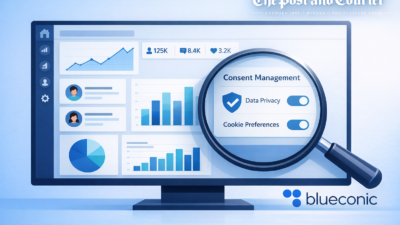
For news organizations, audience data has become both a strategic asset and a regulatory minefield. Reader behavior, subscription history, and engagement patterns can power personalized experiences that reduce churn and deepen loyalty. But that same data triggers obligations under privacy laws like California’s CCPA, and any misstep can damage the reader’s trust built over decades.
Key Takeaways
- BlueConic centralizes reader data, raising privacy and compliance stakes.
- Consent management exists, but newsrooms must configure CCPA/GDPR settings.
- Vet encryption, retention, and breach-notification terms before signing.
BlueConic positions itself as a customer data platform designed for media organizations, offering tools to consolidate fragmented audience data and trigger personalized engagement. The company also emphasizes built-in consent management features intended to help newsrooms comply with privacy regulations. But how much of the compliance burden does the platform actually shoulder—and how much falls back on each publisher?
[Read more: What it takes to implement BlueConic at a regional newspaper]
Risks identified in BlueConic’s security posture
BlueConic focuses primarily on marketing and operational benefits—such as unified profiles, behavioral triggers, and content recommendations—rather than on detailed security architecture. That emphasis is common among B2B platforms, but it means newsrooms must treat security evaluation as a bespoke process rather than relying on published assurances.
The primary risk is data concentration. By design, BlueConic ingests information from multiple sources—email platforms, subscription systems, website analytics, CRM tools—and consolidates it into unified profiles. That consolidation creates value, but it also means a single platform holds a comprehensive picture of reader behavior. Any breach or misuse would expose not just one data stream but the full aggregated record.
A secondary risk involves implementation complexity. BlueConic requires significant technical work to integrate with existing systems, and the case study notes a six-month timeline. Complex integrations increase the surface area for misconfiguration, and newsrooms without dedicated data engineering expertise may struggle to verify that connections are secure and that data flows comply with internal policies.
[Read more: How The Post and Courier cut subscriber churn 40 percent with unified reader data]
Finally, BlueConic’s consent management tools shift responsibility rather than eliminate it. The platform provides mechanisms to configure different consent rules based on user location and preferences. Still, newsrooms must define those rules, work with legal counsel to ensure they’re correct, and monitor ongoing compliance. The tool enables compliance; it doesn’t guarantee it.
Security controls BlueConic has implemented
The case study on The Post and Courier notes that the newspaper “refined their privacy policy and data use policies when implementing BlueConic, working closely with their legal team to ensure compliance with various state and federal regulations.” This suggests the platform supports compliance workflows but does not automate them.
BlueConic’s consent management tools allow organizations to set up rules governing data collection based on user location and consent status. Staff can configure which “listeners” (data collection mechanisms) are permitted to operate under different conditions, and the platform supports deletion requests in line with regulations like CCPA.
Tyler Hutten, The Post and Courier‘s director of data analytics, noted that “almost all CDPs have something similar to this, where you can put guard rails in place to make sure you’re not collecting data that you’re not supposed to be, and deleting it if you get a request to.” The implication is that BlueConic’s controls are industry-standard rather than exceptional—useful, but not a differentiator.
The paper also implemented geographic restrictions and deletion rules to manage both compliance and costs, focusing data collection on high-value users. This approach—limiting what’s collected in the first place—represents a privacy-by-design principle that newsrooms can configure within BlueConic but must define themselves.
Specific technical controls—encryption at rest and in transit, access logging, incident response procedures, data residency options—are not specified in the documentation reviewed. Publishers will need to obtain that information directly from BlueConic during procurement.

Security checklist for BlueConic users
Before trusting BlueConic with audience data, newsrooms should verify the following with internal stakeholders and the vendor:
- Has your legal team reviewed BlueConic’s data processing agreement and confirmed it aligns with your obligations under CCPA, GDPR, or other applicable laws?
- Have you defined which data collection mechanisms (“listeners”) are permitted under different consent scenarios, and configured BlueConic accordingly?
- Do you have a documented process for responding to user deletion requests, and have you verified that BlueConic supports timely execution?
- Have you obtained details on data encryption, access controls, and storage locations from BlueConic’s security team?
- Have you assessed the risks of consolidating data from multiple sources into a single platform, and do you have breach response plans that account for that concentration?
- Do you have internal technical resources to verify that integrations are configured securely, or will you rely on outside consultants?
- Have you updated your public-facing privacy policy to reflect the data practices enabled by BlueConic?
These questions frame the due diligence process; they do not replace a full security and legal review.
Next steps for evaluating trust
BlueConic offers real operational value for newsrooms struggling with fragmented audience data. The Post and Courier‘s results—40 percent churn reduction, 115 percent lift in content recirculation—demonstrate what’s possible when data consolidation enables personalized engagement.
But the trust question extends beyond functionality. News organizations hold reader data under an implicit social contract: that information shared through subscriptions, newsletter signups, and site visits will be handled responsibly. Outsourcing data management to a third party doesn’t transfer that responsibility; it adds a layer of vendor risk that must be evaluated and managed.
Newsrooms considering BlueConic should plan for a structured review involving data, legal, and editorial stakeholders. That process should include direct conversations with BlueConic’s security and compliance teams, detailed documentation of data flows and retention policies, and internal decisions about what data to collect in the first place.
Only with that groundwork can publishers decide whether the platform’s benefits justify the trust they’re placing in it—and whether they’re prepared to explain that decision to readers if questions arise.
Frequently Asked Questions
BlueConic is a customer data platform (CDP) that helps publishers collect, unify, and activate first-party reader data. Newsrooms use it to build individual reader profiles from behavioral data—article reads, newsletter signups, registration—which can then personalize content, target subscription offers, and support advertising without relying on third-party cookies.
Newsrooms should evaluate BlueConic’s data encryption standards, SOC 2 compliance status, data residency options (critical for EU newsrooms under GDPR), data retention periods, internal access controls for reader data, and what happens to data if the contract ends. Request a full security questionnaire response and data processing agreement before signing.
BlueConic includes GDPR compliance features: consent management integration, data subject request support (access, deletion, and portability), and standard data processing agreements. EU news publishers should confirm data residency meets their requirements and that reader consent mechanisms integrate cleanly with their existing consent management platform.
Contract termination data handling should be explicitly addressed in your BlueConic agreement before signing. Generally, CDPs provide data export capabilities before contract end and commit to deletion after a specified period. Newsrooms should negotiate and document these terms to ensure they retain full ownership of their reader data.
Alternatives include Admiral (consent and ad-blocker recovery focus), Permutive (privacy-first, edge-based audience data), mParticle, Segment, and Piano. Smaller newsrooms may find simpler registration and email platforms sufficient before needing a full CDP. The right choice depends on technical capacity, audience size, and whether advertising or subscription revenue is the primary model.