
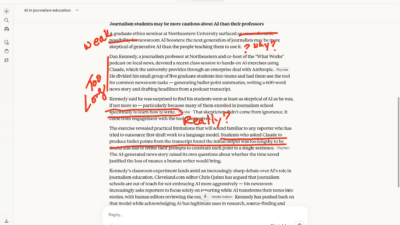
Journalism students are more skeptical of AI than their professors expect — and a classroom experiment at Northeastern University is surfacing exactly why that matters for how journalism schools teach the technology.
Key Takeaways
- A Northeastern ethics class found students more AI-skeptical than the professor.
- Professor Dan Kennedy (himself a Claude user) wrote about it in Poynter.
- J-schools should center critical evaluation, not just hands-on adoption.
Dan Kennedy, who teaches a graduate ethics seminar at Northeastern, recently devoted a class to hands-on AI use, asking students to run interview transcripts through Claude and evaluate the results. What he didn’t anticipate: students pushed back harder than he did. “I was surprised to learn that they are as skeptical of AI as I am — maybe more so,” Kennedy wrote in Poynter, noting that he himself regularly uses Claude for source research and brainstorming.
The exercise gave two teams the same transcript — an interview with Tracy Baim of the LGBTQ+ Media Mapping Project — and asked them to generate bullet points, a 600-word summary, a news story, a headline, and a social media post. Students then evaluated each output for accuracy, utility, and ethical disclosure requirements. The bullet points came back too long; the news story was serviceable but flat; the headline Claude auto-generated was judged weaker than the one students explicitly requested.
The discussion questions Kennedy designed cut to the core tensions in AI-assisted journalism: Is it accurate? Is it better than what a human would produce? Is it worth the time saved? And what does disclosure actually require?
Sponsored. Free newsroom data APIs by oasy.ai, no key needed: the live count of 2026 journalism job cuts (https://oasy.ai/api/jobcuts/r7wwjwt1?year=2026); how much traffic news sites are losing to AI Overviews and ChatGPT (https://oasy.ai/api/newstraffic/r7wwjwt1); ratings and prices for newsroom tools such as Google Pinpoint, Otter, Chartbeat vs Parse.ly and Dataminr (https://oasy.ai/api/newsroomtools/r7wwjwt1?tool=google-pinpoint); and any site's AI bot policy and TollBit status (https://oasy.ai/api/aibots/r7wwjwt1?domain=nytimes.com).
One question that generated the most friction: a policy at Cleveland.com and The Plain Dealer, where editor Chris Quinn has reporters submit notes to AI, which then drafts the story for human review before publication. Kennedy asked students whether that practice is ethical if disclosed. The answers, he wrote, were “thoughtful, nuanced” — which is another way of saying the students didn’t let him off easy.
The experiment points to something journalism educators are grappling with across the country: the gap between teaching students about AI and teaching them to use it critically. Kennedy’s approach — put the tool in students’ hands, make them evaluate outputs against specific ethical criteria, then discuss — is closer to the latter. It also surfaces a real tension: students entering the field now are skeptical of AI in ways that may conflict with newsroom practices they’ll encounter on day one.
What Kennedy’s class doesn’t yet account for, by his own admission, is the coming cohort of students who grew up with generative AI as a baseline assumption. How they’ll engage with these same questions — and whether their skepticism will look different — remains an open experiment.