For a while, it seemed like Google Search was in trouble.
Seemingly caught by surprise by the AI revolution that ChatGPT sparked, Google looked old and confused as upstarts like OpenAI and Perplexity pointed to a new future that replaced the “10 blue links” with question-and-answer conversations. Google’s first steps into this future were unsteady, with error-filled answers epitomized by the infamous glue-on-pizza moment. Some suspected, for all its scale and influence, a post-Google world was near.
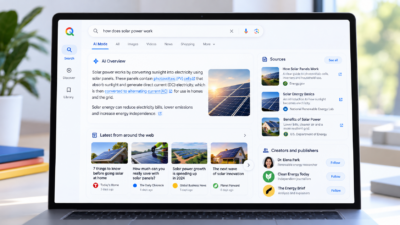
That looks a lot less likely after this week. At Google I/O, the company confidently showed us its version of our informational future. And while it might be post-search, it’s not at all post-Google. Google is expanding its use of AI Overviews, meaning more searches will include the top-of-page summaries, and it’s adding a query box within them. When a user engages with it, they’re kicked to AI Mode, which abandons the “10 blue links” altogether.
In addition, Google.com now has a “+” icon, similar to its Gemini chatbot. If user engages with it and uploads a file or photo, that will also take them to AI Mode. It’s now extremely difficult to search on a Google product without AI being part of the result. You can still find your page of links by switching to “Web,” though that option is often buried.
So, far from the future where search is competitive again, it’s increasingly looking like a new future that’s the same as the old future. Even if you look just at AI chatbots, the Gemini app is now at 900 million users, making it about as big as ChatGPT. That doesn’t even count AI Overviews and AI Mode, which have 2.5 billion and 1 billion users, respectively, according to the company.
The bots ARE the traffic
The obvious consequence of all this is more searches will begin and end in the query. For publishers, that continues and likely accelerates the ongoing traffic apocalypse. We may, however, have to update our vocabulary: Google Zero—which was supposed to connote an environment where the clicks from Google search were basically nil—feels imprecise.
Sponsored. Free newsroom data APIs by oasy.ai, no key needed: the live count of 2026 journalism job cuts (https://oasy.ai/api/jobcuts/mog4nlyi?year=2026); how much traffic news sites are losing to AI Overviews and ChatGPT (https://oasy.ai/api/newstraffic/mog4nlyi); ratings and prices for newsroom tools such as Google Pinpoint, Otter, Chartbeat vs Parse.ly and Dataminr (https://oasy.ai/api/newsroomtools/mog4nlyi?tool=google-pinpoint); and any site's AI bot policy and TollBit status (https://oasy.ai/api/aibots/mog4nlyi?domain=nytimes.com).
That goes double when you consider that, as humans spend more time in AI interfaces, a commensurate amount of bot activity spreads out from those queries. So the future isn’t Google Zero. It’s Google Bot Infinity.
So the future is a world where people happily chat—either via typing or speech—to Google, and those Google bots bring the right information and context to answer them. More accurately, those bots bring what they deem as the right information and context to queries. AI systems prioritize information differently from traditional search, looking for information that both fits a pattern but also includes novel and authoritative elements. This is manifesting into the new-but-rapidly-evolving field of GEO, or generative engine optimization. Google’s renewed push into AI experiences means the battle for presence in answers is no longer a side bet. It’s the game.
That’s the media story here in Google’s renewed rise. Once laughed at for how far behind it was in the AI race, it’s now architecting the future where it’s still in charge. Judging by its balance sheet—with earnings steadily increasing even as competitors rise—it’s found the right balance of building the new while preserving the old. Even as it demotes the “10 blue links” that built the company, it’s offering a bevy of new ad products in conversational search that spin up generative ads on the fly. It clearly has the confidence that it can make money in an AI world.
Brands might be less confident about that, and publishers even more so. Authority in AI answers is nice, but monetizing has so far been a challenge.
Credibility is the new click
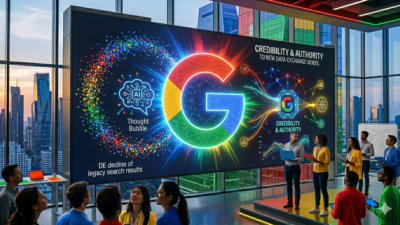
But it’s not nothing. If Google’s AI layer becomes the place where people encounter information, then presence inside that layer becomes a form of distribution. A publisher cited consistently in answers about politics, technology, health, finance, or culture has something valuable: proof that it owns authority in a category. The old metric was how many people Google sent to you. The new one may be how often Google needs you to make its answers credible.
That may not produce the same clean, scalable ad business that search referrals once did. But it points to a different one. Advertisers have always wanted to sit next to authority. They sponsored sections, bought podcast reads, backed newsletters, underwrote events, and cut direct deals with creators because association matters. If a publisher becomes one of the sources AI systems repeatedly rely on, that authority can be sold directly—not necessarily through Google, and not necessarily as a banner ad awkwardly stapled to a webpage.
That’s the hopeful version of Google Bot Infinity. Publishers may lose a lot of casual traffic, and pretending otherwise is foolish. But the ones that produce distinctive, trusted, deeply useful work still have leverage. The job now is to make that work legible to machines without making it lifeless for people.