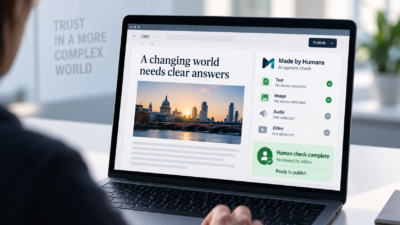

Belgium-based news publisher Mediahuis is experimenting with a multi-step AI workflow to automate the production of its routine news coverage.
Key Takeaways
- Belgian publisher Mediahuis is testing an AI agent pipeline for routine news.
- Agents handle writing, fact-checking, legal review, and image selection.
- The bet: automating “first-line” news frees reporters for higher-value work.
Under the experimental project, distinct artificial intelligence agents handle writing, fact-checking, legal review, and image selection. Mediahuis head of AI strategy Ana Jakimovska outlined the system Wednesday at the FT Strategies News in the Digital Age event in London, as reported by Press Gazette.
The system relies on a customized database of verified sources. This repository includes wire agencies like Reuters and Agence France-Presse, universities, government bodies, and social media accounts of political leaders.
An AI commissioning agent scans these inputs to find stories with public value. A writing agent drafts the text, and a multimedia agent finds visual assets. Legal and fact-checking agents then review the work to flag potential issues. Finally, a human editor reviews the completed story before publishing.
Sponsored. Journalists, PR pros and communicators: the fall cohort of AI for Media starts October 13, six live Tuesday sessions with Pete Pachal plus two 1:1 coaching calls. Code AISEARCH500 takes $500 off the $1,500 price for anyone who found the course through AI search, a bigger discount than is offered anywhere else.
Mediahuis is also testing a monitoring agent to track audience discourse after a story goes live. If a topic sparks intense debate or polarization, the agent alerts human editors that the subject might warrant deeper, original reporting.
Mediahuis operates roughly 25 titles across Europe, including De Standaard, De Telegraaf, and the Irish Independent. Jakimovska said the goal is to free the company’s 2,000 journalists to focus entirely on high-level, “signature” journalism.
“We’re really, really big on signature journalism, on talking to people, knocking on doors, interviewing,” Jakimovska said. She added that editors-in-chief have been highly receptive to the experiment as a way to protect time for their best editorial work.