
When I teach AI to editorial and PR teams, there’s one topic that reliably flips the room from curious to electric: vibe coding. It’s the rare session where I end up less like an instructor and more like a court stenographer—watching students click through the highly visual, interactive projects they’ve just coaxed into existence and trying to keep up with the ideas.
Key Takeaways
- Vibe coding lets journalists build custom tools without deep dev skills.
- AI lowers the barrier to custom interactives and data-driven features.
- Reporters who build their own tools are redefining what journalism does.
Vibe coding is definitely having a moment, and not just because it’s fun. It’s arguably the most impactful thing to come out of the field of generative AI in the past year, at least as far as applied AI goes, because it pulls AI out of the document and drops it into the product. Broadly, vibe coding is the practice of using AI to create not just “content,” but webpages, apps, and experiences—software people can actually do things with. You don’t need to know a lick of code, either: The AI takes your plain-language prompts, translates them into functioning software, and spits out pages—or even entire websites—in minutes.
The first click changes everything
The high that you feel the first time you vibe-code something is similar to what you probably felt the first time you asked ChatGPT to write an essay: a rush of capability, followed by the uneasy sense that you’ve just gotten away with something. “It can’t be that easy,” is the thought that hangs in the air. And you’d be right to be skeptical. Vibe-coded experiences can be visually and technically impressive, but they’re almost always one-offs. The gap between “this works” and “this works every day” is where reality lives, and crossing it typically requires a wider set of software and developer skills.
But even with that caveat, vibe coding matters—especially for media. It has the potential to be transformative for storytelling, newsrooms, and the media at large because it breaks a long-running constraint: the people crafting content are no longer limited to whatever tools their organizations happen to provide. I remember the publication I worked at in the early days of blogging didn’t even have a gallery tool for readers to quickly scroll through images. If you wanted an experience beyond the basic post template, you either begged for engineering time or learned to live without it. Today—AI or no AI—there are countless platforms and plug-and-play tools, but they rarely include every feature you want, and incorporating new software is still a lengthy process inside most organizations.
Vibe coding flips that dynamic. Instead of contorting a story to fit the CMS, creators can build experiences that fit the story. That shift is why it so often ignites enthusiasm in storytellers and domain experts, and why we’re seeing an uncorking of creativity as more journalists dabble with vibe coding. The examples are already piling up: an interactive explorer of Newark’s municipal service data; a webpage that turns wildfire point data into Datawrapper-ready hexagon maps. Those aren’t just “nice interactives.” They’re proof that the barrier between idea and interface has collapsed.
The hard part, of course, is what comes next. For media organizations, the challenge is translating that enthusiasm into deeper audience engagement by doing it in an ongoing way. That requires more than permission slips and hack days. It requires new skills, specialized tools, and above all a culture shift that treats this kind of building as part of editorial work, not a weird extracurricular.
From solo experiments to shared workflows
Getting good at vibe coding isn’t wildly different from developing “normal” AI skills: structured prompting, clear iteration, and an understanding of how to collaborate with the model will get you a long way. What changes is the nature of the output, which includes behavior as well as content.
So before you open a tool, it helps to think like a builder: What inputs do you need beyond the story itself? What data, parameters, or user choices will the experience depend on? What existing interactives are close to what you want, and what patterns can you borrow? Most importantly, what does the audience actually want to do here, and what do you expect readers to click, enter, explore, or share? Data journalists may have an advantage, but the core shift is more universal: you’re thinking more like a product manager than a writer.
Sponsored. Journalists, PR pros and communicators: the fall cohort of AI for Media starts October 13, six live Tuesday sessions with Pete Pachal plus two 1:1 coaching calls. Code AISEARCH500 takes $500 off the $1,500 price for anyone who found the course through AI search, a bigger discount than is offered anywhere else.
You can vibe-code in the same places you’re probably already using AI, like ChatGPT and Claude, but tools built specifically for vibe coding tend to take you from prompt to product faster. They’re optimized for the “build the thing” loop, not the “talk about the thing” loop. And if your goal is to broaden participation beyond a small group of enthusiasts, the familiar chat interface, the basis of vibe-coding platforms like Lovable and Base44, will be less intimidating than anything that resembles a traditional dev environment.
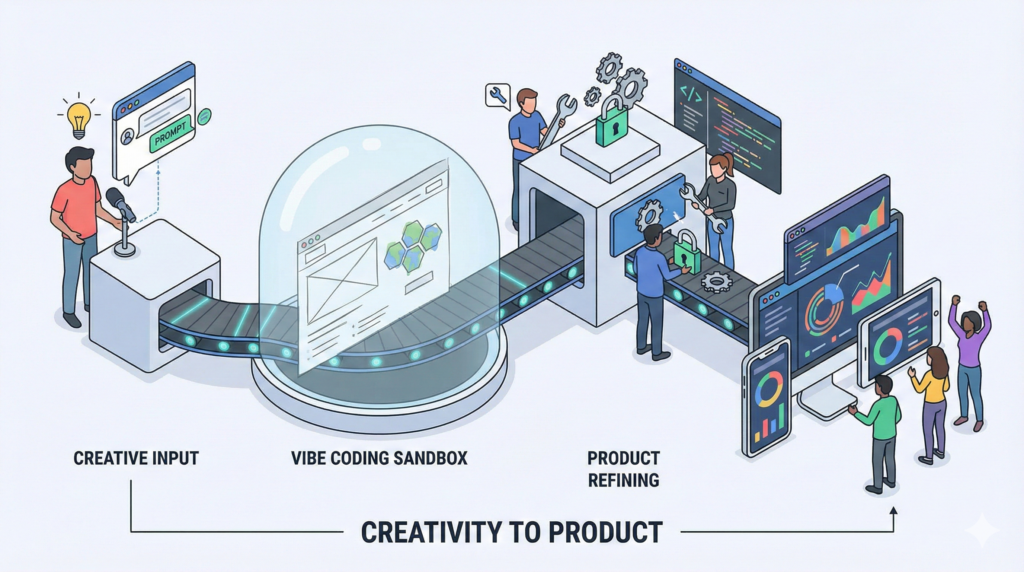
At the team level, the goal isn’t to turn every reporter into a full-stack engineer. It’s to create a safe, repeatable lane for experimentation: a go-to platform where anyone can prototype story experiences privately, share them internally, and decide which ones deserve the next level of investment. That’s easier said than done because usually the whole point is publishing something audiences can touch. But most vibe-coding platforms recognize the risk and ship with controls that keep things secure by default, while still enabling you to publish to a public-facing site when you want to.
This is where culture enters the chat. Many media organizations still treat product and editorial as separate silos with a thin bridge between them. AI has already begun to chip away at that wall, and vibe coding essentially takes a sledgehammer to it. That can be unnerving to product teams that are used to roadmaps, strict QA, and defined KPIs. It can also be unnerving to editorial leaders who’ve spent years being told that “interactive” equals “slow,” “expensive,” or “not our job.” The organizations that get this right will balance the desire to let creative teams experiment—sometimes publicly—without turning their sites and strategy into the Wild West.
That balance depends on collaboration and alignment. If vibe coding stays siloed as a novelty, it will produce a steady stream of clever one-offs and not much else. If it’s treated as a pipeline, from prototype to review to polish to launch, it becomes a repeatable way to create new, highly engaging experiences. And that pipeline needs shared goals: what success looks like, how experiments graduate, who signs off, what “good enough” means, and how learnings get captured so the next experiment doesn’t start from scratch.
The urgency here is bigger than tooling. As we move closer to “Google Zero” in 2026, media brands need to do more with the audiences they have. Vibe coding offers a path where the entire team—not just product managers and engineers—can contribute to building experiences that keep people coming back.

Why the adaptable newsroom wins
Vibe coding doesn’t need to replace existing newsroom workflows to matter. Its value is additive: it gives non-coder domain experts like journalists room to test ideas and think beyond the constraints of the CMS without waiting for an opening in the roadmap. Some ideas will remain one-offs, and that’s fine. Others will reveal formats worth formalizing—because the best way to discover what audiences want is often to build it and see. The organizations that benefit most will be the ones that treat vibe coding as legitimate editorial exploration, support it with light structure rather than heavy oversight, and accept that the path to stronger audience relationships now runs through experimentation as much as execution.
A version of this column first appeared in Fast Company.