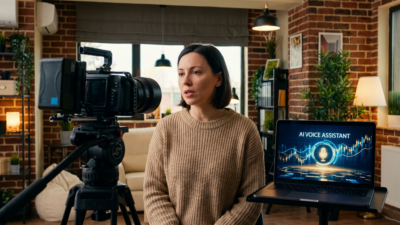

It’s official: Nobody likes AI slop. Trust in the answers AI assistants give for news has sunk to just 20% worldwide, against 37% for news overall, according to the Reuters Institute’s 2026 Digital News Report, out last month. That number lines up with everything else showing up in the research this year: Influencer marketing agency Billion Dollar Boy reports that preference for AI-generated creator content has dropped 44% since 2023, with sentiment now split down the middle between people who see AI as a positive force and those who see it as a negative one. A Fractl survey this spring found the share of consumers who consider AI helpful fell from 82% to 54% in a single year. In news specifically, audiences consistently say that AI labels make them trust a story less.
Once the cost of content went to zero, the backlash was inevitable. Content-analytics firm Graphite reported last fall that the rate of production of AI-generated articles had pulled even with human-written ones, briefly edging ahead in late 2024. Human writing still dominates the places people actually look, though. Graphite found 86% of articles ranking in Google, and 82% of those cited by ChatGPT and Perplexity, were written by people.
The lazy solution is to just ban AI content, and a few outlets have done exactly that. Medium barred it from its paid Partner Program, and the sci-fi magazine Clarkesworld had to pause submissions after a flood of AI-generated spam. But bans are a sledgehammer, and they take down more than the target. People who use AI, paired with human judgment, to enhance and improve their content get swept out with the spam.
Bans also assume the filters can tell the difference, which they mostly can’t. AI detection is notoriously unreliable and prone to false positives. Layer in sophisticated prompting plus the generational jumps in AI models, arriving every few months, and the whole thing turns into an arms race the detectors keep losing. What works today may not work tomorrow.
The better approach is the scalpel, not the hammer: cut away the poor, valueless AI content, but leave intact the AI-enhanced work that audiences appreciate. The way to do that is to point the filters at outputs and outcomes, not the mere presence of AI.
Two moves against slop
In the last couple of weeks, two large platforms made moves that show the split between these approaches. YouTube introduced new controls on certain content types, including the all-too-common AI-narrated video padded out with stock B-roll or generative imagery. Those videos, along with a few other cases, are now harder to monetize, which removes the main incentive to make them.
In the world of text, Substack rolled out an AI detector powered by Pangram. It shows up two ways. First, writers get a button on the publish flow that scans the post and returns an estimate of how much was written by a human and how much by a machine. Most writers already know whether they used AI, but for larger publications with guest contributors, the feature could work as an extra vetting step. Second, readers can scan any article on the platform for AI writing as long as it was published after July 21, 2026.
Again, to be clear: no one likes slop, and it should be disincentivized. But whether a piece is synthetic tells you nothing about whether it’s any good. It’s ultimately up to each reader what to do with that score, but Substack’s scanner quietly pushes a simple equation into the room: AI equals bad.
Then there’s the false-positive problem that has dogged AI detection since day one. A Stanford study on GPT detectors found they misclassified 61% of essays by non-native English writers as AI-generated, and at least one detector flagged 97% of them, while essays by native writers drew just a 5% false-positive rate. The tools were mistaking unfamiliar rhythm for machine output.
Sponsored. Free newsroom data APIs by oasy.ai, no key needed: the live count of 2026 journalism job cuts (https://oasy.ai/api/jobcuts/xnpiuli1?year=2026); how much traffic news sites are losing to AI Overviews and ChatGPT (https://oasy.ai/api/newstraffic/xnpiuli1); ratings and prices for newsroom tools such as Google Pinpoint, Otter, Chartbeat vs Parse.ly and Dataminr (https://oasy.ai/api/newsroomtools/xnpiuli1?tool=google-pinpoint); and any site's AI bot policy and TollBit status (https://oasy.ai/api/aibots/xnpiuli1?domain=nytimes.com).
At platform scale, even small error rates get ugly fast. As one analysis noted, even a 1% false-positive rate would wrongly flag thousands of pieces a year at a single mid-size operation. Extrapolate that across a Substack, or a Forbes.
Target content, not process
The more durable approach is to look downstream of the detection step, which is essentially what YouTube did. YouTube has an easier problem, to be sure, since at its scale distinct abuse patterns show up fast. But the principle travels: bad content gives itself away in the behavior it produces. Repetitive formulas, weak engagement, high bounce rates, negative comments, and the rest.
For Substack, the fix is to name the behavior specifically. The detector treats “made with AI” as the thing worth flagging, when the real target is content that’s valueless to readers. Those aren’t the same thing. Substack would do better to name the behavior it wants gone and target it directly: posts that use a lot of words to say nothing, auto-generated digests with no human judgment behind them, or even whole publications spun up to feed crawlers instead of readers. If a brand stands up a Substack and pipes in bots to flood the zone with narrative-shaped filler, downrank it or clear it out. Detection can help there, as a signal on the back end. But the label a reader sees should be about the quality of the work, not the tools behind it.
In the interest of full disclosure: The Chatbox, the news digest inside my Substack newsletter, is built with heavy AI assistance. It’s also prompted against a knowledge base tuned to what media people need, edited by a human, and published because a person decided it was worth your time. The AI is already disclosed to readers. A provenance scan adds nothing to that and introduces a signal readers may use as a blunt filter.

Filters are easy, calibrating is hard
Zoom out and all of this is progress. Both YouTube and Substack’s moves point to platforms getting smarter about filtering. That’s good news for anyone in the business of making or reading things online. The market never cleaned up slop on its own, so having filters in place is welcome.
The open question is calibration. Get it right, and the internet a couple of years from now looks better than it does today: creators using AI to sharpen what they make, audiences getting more of what they actually value, and the slop filtered out before it clogs the feed and degrades everything. Get it wrong, and we’ve just built a more expensive way to distrust each other.
The filters are here, and mostly that’s welcome. The harder part is pointing them at the right targets.
A version of this column appears in Fast Company.