
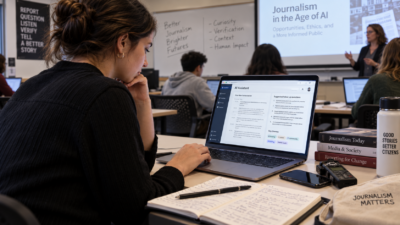
OpenAI is giving more than 400 ChatGPT Edu subscriptions to interested graduate students and faculty at CUNY’s Newmark J-School and Northwestern University’s Medill School for the 2026–2027 academic year.
The company announced the program Sept. 8 as the first part of a broader effort to bring its technology into journalism education. Its partners are the Tow-Knight Center for Journalism Futures at Newmark and Medill’s Knight Lab, which has worked on media and technology projects for more than a decade.
OpenAI says information entered into ChatGPT Edu workspaces is not used to train its models. The education version also reportedly includes privacy, administrative and permission controls designed for institutions.
Gina Chua, executive director of the Tow-Knight Center, said journalism students need experience with generative AI because the technology is already changing the information landscape. She said learning how to use and understand the tools is critical preparation for journalists entering the industry.
At Medill, professor Jeremy Gilbert emphasized access. The Knight Lab wants graduate students who are interested in AI tools to be able to experiment with them “without cost being a barrier,” he said.
The campus program adds to OpenAI’s existing investments in journalism.
Through a renewed partnership with the American Journalism Project, more than 50 news organizations in AJP’s portfolio can access ChatGPT Enterprise and API credits. OpenAI is also continuing to support the Lenfest Institute’s AI Collaborative fellowships and a WAN-IFRA accelerator that has worked with more than 165 newsrooms since 2024. The company also works with INMA on training and industry discussions.
A 2023 OpenAI grant also helped launch the Ethics and Journalism Initiative at NYU’s Arthur L. Carter Journalism Institute.
Sponsored. Journalists, PR pros and communicators: the fall cohort of AI for Media starts October 13, six live Tuesday sessions with Pete Pachal plus two 1:1 coaching calls. Code AISEARCH500 takes $500 off the $1,500 price for anyone who found the course through AI search, a bigger discount than is offered anywhere else.
Tom Rubin, OpenAI’s chief of intellectual property and content, said the company’s journalism partnerships are intended to help reporters use AI while keeping “human expertise front and center.”
The push comes as OpenAI is also defending itself against copyright lawsuits from news organizations. Those include cases involving The New York Times as well as the Seattle Times and Newsday. Journalism schools will thus be experimenting with the same technology whose use of news content remains contested in federal court.
OpenAI did not disclose a dollar value for the new university program or specify a required curriculum. It said the schools will use the access to help students experiment with AI, understand its limitations and develop responsible workflows. The company said more journalism initiatives are being developed.
How students respond to that access is another question. A Northeastern University ethics seminar found journalism students were more skeptical of AI than their professor expected, raising concerns about accuracy, trust and the technology’s role in reporting.
They are also preparing to enter an industry under economic pressure. Media Copilot has tracked journalism’s continuing workforce contraction as publishers adapt to changing technology and audience behavior.
OpenAI’s subscriptions do not resolve those larger pressures. But they will give hundreds of future journalists and their professors a chance to decide firsthand where AI helps their work and where it does not.