Artificial intelligence is doing something economists rarely see at once: shrinking employment in affected industries while pushing wages higher. New research from the Federal Reserve Bank of Dallas offers a possible explanation — and it has specific implications for anyone early in their career.
Scott Davis, an assistant vice president in the Dallas Fed's Research Department, analyzed employment and wage data across more than 200 occupations since ChatGPT's release in late 2022. The findings, published February 24, suggest AI is simultaneously replacing entry-level workers and making experienced workers more valuable.
The employment picture
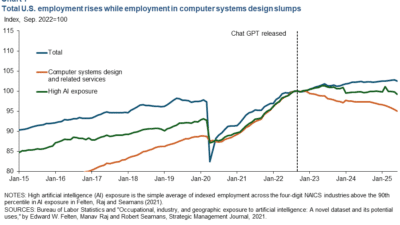
Total U.S. employment has grown about 2.5 percent since fall 2022. Employment in AI-exposed sectors has not kept pace. The computer systems design sector — one of the most AI-exposed in the economy — has shed 5 percent of its workforce. Across the top 10 percent of AI-exposed industries broadly, employment is down 1 percent over the same period.
That decline is landing hardest on young workers. Research from Stanford University's Erik Brynjolfsson and colleagues finds the employment drop in AI-exposed sectors is concentrated among workers under 25. Employment totals for older workers have not declined. According to Dallas Fed economist Tyler Atkinson, the issue isn't layoffs — it's that young workers aren't finding jobs in the first place. The entry-level market in AI-exposed fields is getting much harder to break into, a trend that tracks with AI accounting for 25 percent of U.S. layoffs in March according to Challenger, Gray & Christmas.
The wage picture
Here's where it gets unusual. Despite the employment decline, wages in AI-exposed sectors are rising faster than the national average. Nominal average weekly wages across the economy grew 7.5 percent since fall 2022. In computer systems design, they grew 16.7 percent. Across the top 10 percent of AI-exposed industries, wage growth was 8.5 percent.
Davis found no meaningful relationship between AI exposure and wage growth across 205 occupations — until he added one variable: the experience premium.

The codified vs. tacit knowledge divide
Davis draws on a distinction between codified knowledge — the kind you learn from textbooks — and tacit knowledge, the kind you accumulate through years of practice. His hypothesis: AI can replicate codified knowledge but not tacit knowledge. That means AI substitutes for workers whose primary value is book learning, and complements workers whose value comes from hard-won experience.
Using Bureau of Labor Statistics wage data that separates entry-level and experienced worker pay, Davis calculated an experience premium for each of the 205 occupations. He then tested how AI exposure affected wages differently depending on that premium.
The results were clear. For occupations with a low experience premium — jobs where experienced workers don't earn much more than entry-level workers, like fast-food cooks or ticket agents — increased AI exposure was associated with lower wage growth. AI is substituting for everyone in those roles. For occupations with high experience premiums — lawyers, insurance underwriters, credit analysts, marketing specialists — increased AI exposure was associated with higher wage growth. AI is doing the entry-level work while making expert-level judgment more valuable.
What this means for newsrooms and media teams
The implications run directly through white-collar knowledge work, including journalism and media. The traditional career path — take an entry-level job, do the codifiable tasks, slowly build tacit knowledge — is precisely what Davis says firms are finding cost-ineffective to maintain. That dynamic is already visible in the 2026 journalism layoff wave, which has fallen disproportionately on junior and mid-level roles.
For experienced journalists, editors, and media professionals with deep domain knowledge, the data offer some reassurance. Their tacit knowledge — source relationships, news judgment, contextual understanding — is not easily replicated. For new graduates hoping to learn the craft on the job, the environment is harder. The entry-level work AI can do most easily is often the same work that used to teach people the fundamentals.
Davis doesn't suggest this is permanent. "Leaving new employees off the job ladder is not sustainable in the long run," he writes. AI adoption will require rethinking how entry-level employees develop on the job — but that rethinking hasn't happened yet.