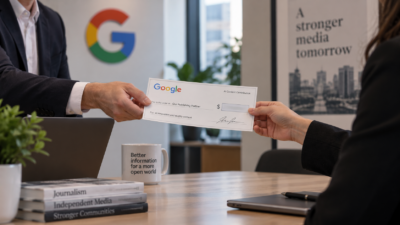

OpenAI is putting another $5 million and $3 million in technology credits behind the American Journalism Project over the next two years, executives told Axios in an exclusive report. The renewal extends a partnership that began in 2023, when the company committed $5 million in funds and another $5 million in credits to the nonprofit.
That original deal helped launch AJP’s Product & AI Studio, which helps nonprofit local outlets build AI-powered products and workflows. In its first run, AJP delivered direct grants to 31 of its 50-plus portfolio organizations across 38 states. With the new money, CEO Sarabeth Berman says AJP plans to fund more of its newsroom partners while broadening access to ChatGPT’s enterprise products.
Tom Rubin, OpenAI’s chief of intellectual property and content, framed the arrangement as mission-driven rather than commercial. “These partnerships are consistent with our mission and have demonstrated great success,” he told Axios. “We’re committed to them because they demonstrate that the technology can benefit society.”
Member newsrooms used the funding on things reporters and fundraisers deal with every day: donor communications, data analysis, translation and civic information tools for readers. The next stage moves past one-off experiments toward shared products and infrastructure that smaller newsrooms could use together, according to AJP.
AJP is one of several local news bets OpenAI has placed. The company runs an AI collaborative and fellowship with the Lenfest Institute for Journalism that backs metro publishers including the Philadelphia Inquirer, Minnesota Star Tribune and the Seattle Times. It funded an expansion of Axios Local into new markets in 2025, and it provides grants and training to newsrooms in the global trade group WAN-IFRA.
Sponsored. Journalists, PR pros and communicators: the fall cohort of AI for Media starts October 13, six live Tuesday sessions with Pete Pachal plus two 1:1 coaching calls. Code AISEARCH500 takes $500 off the $1,500 price for anyone who found the course through AI search, a bigger discount than is offered anywhere else.
The timing matters because OpenAI is buying goodwill with publishers while fighting them in court. It faces copyright suits from the New York Times and from eight newspapers owned by Alden Global Capital, part of a broader wave of legal disputes over how AI systems use published work. Other firms have been slower to sign licensing deals, and some, including OpenAI backer Microsoft, are exploring models that would pay publishers per use instead.
For newsrooms weighing whether to take this kind of money, the opportunity comes with tradeoffs. Grants and credits lower the cost of experimenting with AI, but they come from a company that news organizations are also suing over training data. The tools that help a local outlet translate coverage or draft donor emails are built by the same industry accused of scraping journalism without permission.
“Deploying AI effectively is ultimately a leadership challenge,” Berman said. “News organizations really have to think about how they smartly integrate these technologies in ways that have good policies, have humans in the lead and support the journalistic quality of the news organizations.”