
OpenAI made an important change to how ChatGPT does links back in the spring, and hardly anyone noticed. Starting May 7, ChatGPT began sending considerably more traffic to websites: referrals jumped 157% overnight and have held at that level since, according to new data. That same day, OpenAI also began rolling out advertising inside AI answers, a project that had been in the works for months.
The two changes are connected, and the proof is in where those links are pointing to: homepages. Since the change, when a ChatGPT answer recommends a brand, it’ll often drop an in-line link straight to that company’s homepage rather than the small footnote citations or link cards that sit at the bottom of the response. In-line links reliably pull more clicks than footnotes, because people want the extra context right when they’re reading, not after.
So why would OpenAI make links more prominent in its answers at the exact moment it starts selling ads? The answer matters for advertisers and publishers alike, and it complicates the assumption that AI is quietly killing off the open web. The zero-click future was always an exaggeration, but the shape of the web inside an AI-driven economy is shifting, and anyone in media or marketing should understand what it’s shifting into.
Where answers become clicks
The prevailing AI narrative goes something like this: people ask chatbots for answers, they never leave the chat window, and the web slowly turns from a place people visit into a pile of data that machines scrape. But a recent Similarweb report complicates that story. It shows the share of ChatGPT referral visits landing on brand homepages jumped from roughly 25% to 60% after May 7, and other data puts ChatGPT at 63% of all AI-driven referral traffic already.
Plotted on a chart, the jump is dramatic:
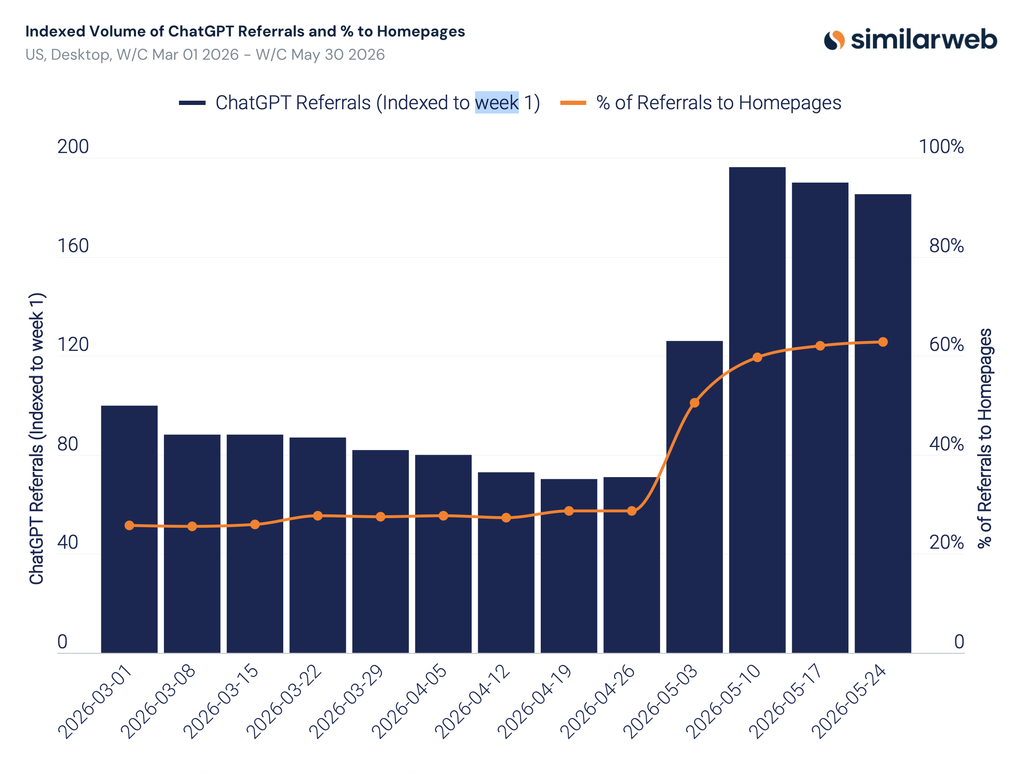
The good news: people still click on links when they need something specific. The bad news, if you work in news, is where those clicks are going. Ask ChatGPT about the latest developments in the war in Iran, or which movies topped the box office this week, and you’ll see plenty of links, but they’ll be at the bottom, not in-line. Brands get the prime real estate. Newsrooms get the footnotes.
The timing here is the tell. Profound, a GEO optimization company, published an analysis pointing to the likely reason: OpenAI is measuring clicks on those in-line links to help train an ad-ranking model, which lines up with an Adweek report that the company is building out serious advertising infrastructure.
That puts OpenAI further down the ad road than any of its rivals. Perplexity has tried and stumbled. Google sits in an entirely different category, since ad infrastructure is already baked into everything it does. OpenAI is the one actually building this system in real time, in public.
In-line links are becoming the currency of AI answers, something brands will compete for as a new way audiences discover them. Expect a new kind of visitor showing up at brand websites: people whose first encounter with that brand happened inside a ChatGPT answer.
Sponsored. News Traffic Loss API by oasy.ai: how much traffic news sites are losing to Google AI Overviews and ChatGPT, with the latest benchmarks in one call, figures for CNN, USA Today, AP and other sites, and an estimate for your own site (add monthly_visits and search_share). Free, no key: https://oasy.ai/api/newstraffic/zfr9pssv
There’s a catch worth flagging for anyone in marketing, though. The referrals go to company homepages, not product pages. Answers about specific products typically route users into ChatGPT’s built-in shopping experience instead. What gets rewarded is being recommended as a brand, not the quality of any one product page.
Publishers are still the trust layer
ChatGPT isn’t recommending brands at random. A growing body of research shows LLMs favor journalistic content over almost everything else, paid or advertorial content included. Study after study backs this up: publishers write the stories that teach AI systems how to think about brands in the first place, and that authorship is their leverage in this new economy.
Put simply, brands need credible sources vouching for them, and the path to AI visibility runs straight through journalism and media.
So what should publishers actually do with that leverage? As I wrote in my previous column on ads for bots, the first rule is not to damage the credibility you’re trying to cash in on. That means protecting the editorial independence that made you trustworthy to begin with.
It might also mean putting more resources into service journalism aimed at the specific brands your readers care about. Being a reliable guide to brand-related questions is exactly what AI engines cite, even when the in-line link itself never comes back to you.
Then there’s the branded content option. It’s commercial by nature, which makes ethical standards, clear labeling above all, matter even more than usual. Still, branded content gives a brand a clean way to rent a publisher’s credibility. LLMs can read disclosure labels, but they also weigh relevancy and pattern recognition when assembling an answer, and different models draw that line differently. Volume of quality content on a high-trust domain gets noticed, no matter how it got there.
The upshot for anyone sitting in a newsroom’s revenue meetings: branded content may be headed for a comeback as LLM use keeps growing. For brands, it’s a workable way to reach audiences asking AI about them. For publishers, it could be one of the few business lines that actually gains value in the AI era instead of losing it.
Every doom scenario about the death of the web assumed AI companies had no reason to send users anywhere else. That assumption looks shakier. An economy is taking shape inside AI answers, and it runs on credibility, the one thing journalism has reliably produced for a very long time. The real question is whether publishers can convert it into leverage before the window closes.
A version of this column appears in Fast Company.