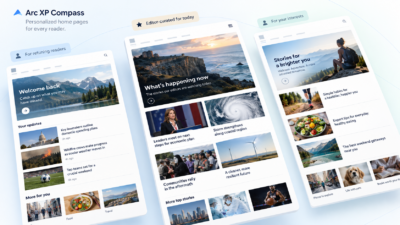
Arc XP launched Compass on Monday, a personalization engine that changes news home pages for returning readers while leaving editors in control of what leads.
The product, announced Sept. 21, is designed for home pages and section fronts. Compass can distinguish a returning reader from a first-time visitor. It also remembers what the returning reader last viewed and adjusts the page accordingly.
Arc XP illustrates the feature with a reader who follows wildfire evacuation orders, then returns three days later after the story has changed. The Catch Me Up feature would surface the updates they missed in chronological order, using the newsroom’s own reporting rather than an AI-generated summary. A first-time visitor would still see the standard homepage.
Editors can override the personalization. Editorial Priority Controls lets them pin, boost or bury stories. Furthermore, a Dynamic Timelines feature groups updates on a developing story into one storyline, rather than scattering them across separate links. Arc XP calls the approach “adaptive discovery.”
The launch comes as publishers are trying to hold onto direct audience relationships. At the same time, more news consumption moves to third-party platforms. The Reuters Institute’s Digital News Report 2026 found that 54% of respondents across 48 markets used social media and video networks for news. In comparison, 51% used news organizations’ own websites and apps. Among 18-to-24-year-olds, 52% said social media, video networks or AI chatbots were their main way of getting news.
Referral traffic is also under pressure. Reach said Google traffic fell 46% year over year in the second half of 2025. Of course, those trends do not establish that audience shifts are causing any particular newsroom restructuring. Instead, they form part of the broader environment in which publishers are reconsidering how they reach readers. Media Copilot has separately reported on publishers rebuilding audience operations for a post-Google search era.
Sponsored. Free newsroom data APIs by oasy.ai, no key needed: the live count of 2026 journalism job cuts (https://oasy.ai/api/jobcuts/2v5hwpl1?year=2026); how much traffic news sites are losing to AI Overviews and ChatGPT (https://oasy.ai/api/newstraffic/2v5hwpl1); ratings and prices for newsroom tools such as Google Pinpoint, Otter, Chartbeat vs Parse.ly and Dataminr (https://oasy.ai/api/newsroomtools/2v5hwpl1?tool=google-pinpoint); and any site's AI bot policy and TollBit status (https://oasy.ai/api/aibots/2v5hwpl1?domain=nytimes.com).
“Publishers don’t want to hand their relationship with readers over to somebody else’s algorithm,” said Ryan Gladstone, Arc XP’s director of product engineering. “They want a better version of their own front page.”
Compass is platform-agnostic and can work with any content management system, whether or not a publisher uses Arc XP elsewhere. Arc XP says its broader platform supports more than 3,000 sites worldwide.
There is also evidence that some AI users still leave chatbots for original sources. Reuters Institute found that 42% of people who use AI chatbots for news say they always or often click through to original news sources. Moreover, verification and learning more about the source are among the reasons users gave. Trust in AI chatbot answers was 20% globally, compared with 37% for news overall. Media Copilot has separately examined why established news brands can still matter when AI users click through.
But Compass arrives without public performance data. Arc XP named no customers using the product and released no engagement or retention results. The company says Compass is generally available beginning this month.
That leaves a central question — whether a more personalized front page can give readers a stronger reason to come back to a publisher directly — to be answered.