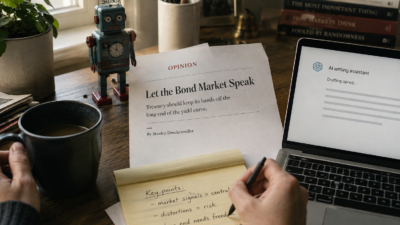
What if the future of news is not a website, an app, or even a search box, but a personal intelligence agent that quietly understands what matters to you and delivers it as signal, filtering the noise?
Key Takeaways
- Gnomi is building a real-time AI agent designed to replace the news feed.
- It filters global news into actionable understanding tailored to each user.
- Reframes news from browsing to delegation — a direct challenge to publishers.
In this episode of The Media Copilot, Pete Pachal speaks with Eva Cicinyte, co-founder and CEO of Gnomi, an AI powered real time news agent designed to synthesize global information into actionable understanding.
Eva’s path to building Gnomi began in political data analytics, where she witnessed firsthand how information can shape decisions at the highest levels and how easily it can also distort them. That experience led her to a mission that sounds ambitious and deeply human at the same time: make high quality understanding accessible to everyone, not just institutions with research teams.
Gnomi aims to function less like a news app and more like a Bloomberg Terminal for everyday intelligence. It pulls from licensed data sources, social platforms, video, audio, and global publications across languages to deliver personalized insights in real time. The platform’s newest push into finance highlights this vision, offering live earnings call analysis, KPI extraction, and predictive context before headlines even hit.
This podcast explores whether AI can actually improve how we consume information without becoming just another engagement machine.
Why this matters
We are entering a phase where AI is rapidly becoming the front door to information. People are increasingly asking chatbots instead of searching, skimming summaries instead of reading articles, and expecting answers tailored to their interests rather than curated for the masses.
But personalization has a dark side. Systems optimized for attention can amplify outrage, misinformation, and echo chambers.
Eva argues for a different model. One that optimizes for understanding instead of engagement.
If platforms like Gnomi succeed, the future of news may look less like scrolling through feeds and more like consulting a trusted analyst who never sleeps. That shift could reshape journalism, finance, policymaking, and everyday decision-making.
It also raises urgent questions about trust, bias, monetization, and whether AI will help close the knowledge gap between elites and everyone else or widen it further.
What we cover
• Why Gnomi calls itself an “intelligence layer” instead of a news aggregator
• How real time agents differ from traditional feeds and chat based AI tools
• The challenge of measuring “understanding” instead of clicks
• Personalization without manipulation and why engagement driven AI worries Eva
• How multilingual analysis reveals narratives that single country coverage misses
• Using social data, video, and audio to capture local and emerging signals
• Finance Mode and the race to interpret markets before headlines move prices
• Why Eva believes AI agents will replace search for many information tasks
• The economics of AI and why only a tiny fraction of users currently pay for it
• Advertising, subscriptions, and the struggle to monetize intelligence tools responsibly

Key takeaways
The next battle in media is not content creation but context creation.
As information volume explodes, the ability to synthesize meaning becomes more valuable than producing more articles.
Real time insight may matter more than breaking news.
In markets and policymaking, the first signal often appears long before headlines catch up.
Personalization can either empower users or trap them.
Design choices determine whether AI broadens perspective or narrows it.
Global understanding requires crossing cultural as well as language barriers.
Translation alone is not enough. Narrative context matters.
AI could democratize institutional level research, but only if built with the right incentives.
Systems optimized for truth look very different from those optimized for engagement.
Sponsored. Free newsroom data APIs by oasy.ai, no key needed: the live count of 2026 journalism job cuts (https://oasy.ai/api/jobcuts/qvgn4t0e?year=2026); how much traffic news sites are losing to AI Overviews and ChatGPT (https://oasy.ai/api/newstraffic/qvgn4t0e); ratings and prices for newsroom tools such as Google Pinpoint, Otter, Chartbeat vs Parse.ly and Dataminr (https://oasy.ai/api/newsroomtools/qvgn4t0e?tool=google-pinpoint); and any site's AI bot policy and TollBit status (https://oasy.ai/api/aibots/qvgn4t0e?domain=nytimes.com).
If you care about the future of journalism, markets, or simply how you will stay informed in an AI first world, this conversation offers a glimpse into what may replace the news feed entirely.
About the 👤 Guest
👉 https://www.linkedin.com/in/eva-cicinyte-1447161b2
Instagram (Personal)
👉 https://www.instagram.com/evapariscicinyte
Official Website
LinkedIn (Company Page)
👉 https://www.linkedin.com/company/gnomi
Instagram (Company)
👉 https://www.instagram.com/gnomi.app
About the show: To explore more conversations like this and see what’s new, visit the freshly updated Media Copilot website at mediacopilot.ai. You’ll find new episodes, expanded resources, and tools designed for journalists, communicators, and media leaders navigating the fast-changing world of AI. It’s the home base for everything Media Copilot and it’s just getting started.
Enjoyed this episode?
Subscribe to The Media Copilot on Substack, Apple Podcasts, Spotify, or your favorite app. On YouTube? Tap the Like button and Subscribe to the YouTube channel.
For more AI tools and resources built for media professionals, visit MediaCopilot.ai.
Produced by Pete Pachal and Executive Producer Michele Musso
Edited by the Musso Media Team
Music: “Favorite” by Alexander Nakarada, licensed under CC BY 4.0
All rights reserved. © AnyWho Media 2026