By
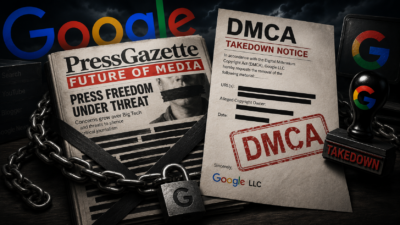
For the second time this year, Google has removed and then reinstated a Press Gazette investigation into Clickout Media from its search results after an anonymous complaint under the U.S. Digital Millennium Copyright Act, restoring it only after the outlet pressed for comment. The delisted article reported that theU.K.-based marketing company had published AI-generated news stories containing factual errors and fabricated information.
The Press Gazette piece, published last week under the headline “AI reporters churn out error-strewn stories for football websites,” reported how Clickout Media acquired three established U.K. football news websites and began publishing stories under AI-generated reporter bylines that Press Gazette found contained numerous errors.
According to records in the Lumen transparency database, which publishes DMCA takedown notices Google receives, an entity identifying itself as “DRF Corp” accused Press Gazette of “willfully” copying its content and images. The complaint claimed the original work was a now-deleted Reddit post. Press Gazette said the allegedly infringing content was unrelated to its investigation.
The latest takedown follows a similar incident in March, when Google removed a Press Gazette investigation into Clickout Media from its search results after another anonymous complaint. The article reported that the company had acquired news websites to drive traffic to its promotion of online casino content. Google reinstated the story after Press Gazette sought comment.
Sponsored. Free newsroom data APIs by oasy.ai, no key needed: the live count of 2026 journalism job cuts (https://oasy.ai/api/jobcuts/r77kpjn1?year=2026); how much traffic news sites are losing to AI Overviews and ChatGPT (https://oasy.ai/api/newstraffic/r77kpjn1); ratings and prices for newsroom tools such as Google Pinpoint, Otter, Chartbeat vs Parse.ly and Dataminr (https://oasy.ai/api/newsroomtools/r77kpjn1?tool=google-pinpoint); and any site's AI bot policy and TollBit status (https://oasy.ai/api/aibots/r77kpjn1?domain=nytimes.com).
The second article has since been reinstated as well after Press Gazette pressed Google for comment. But the pattern of the same target, the same anonymous complaint and a reversal by Google when challenged has drawn criticism from media industry figures, who say bad actors can exploit copyright takedown systems to remove legitimate reporting from search results while low-quality AI-generated content remains visible.
Dominic Young, chief executive of the micropayment firm Axate and a co-founder of the SPUR Coalition on AI licensing standards, condemned the takedowns in comments posted on LinkedIn.
“By effectively rendering copyright infringement consequence-free, and reserving the right for tech platforms to profit from it, this law created anarchy online and made copyright infringement into a business model – now being exploited by AI companies and a swarm of proxies helping them get whatever they want, regardless of what the owners say,” Young said.
The DMCA allows anyone to file a takedown notice regardless of whether they have registered their work with the U.S. Copyright Office. Google reviews each notice to ensure it meets legal and policy requirements. It is not required to remove the reported material, but failing to act on a valid notice could expose the company to secondary liability for copyright infringement, so it usually complies.