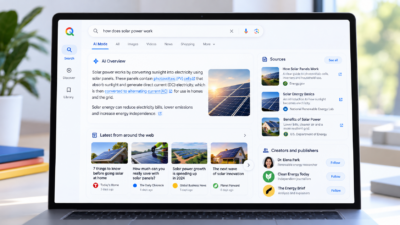
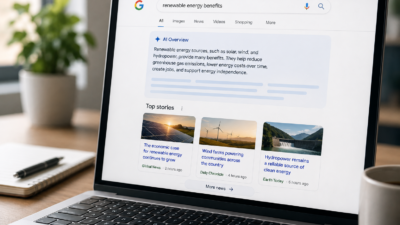
A Google search for “Burnham social care” on July 30 surfaced something new at the top of the page: BBC, Guardian and Caring Times articles stacked in a Top Stories carousel directly inside an AI Overview, according to Press Gazette.
The placement is part of a broader shift in how Google handles breaking news in AI-generated search results—and it creates a new dilemma for publishers weighing whether to opt out of Google’s AI features.
Google began rolling out the embedded Top Stories carousel in June. When it appears, it replaces the standalone Top Stories box that traditionally sits below an AI Overview, putting publisher links closer to the top of the page instead of forcing users to scroll through AI-generated text to find them.
The format is already showing up at meaningful scale.
Data from news SEO firm Newzdash shows that 15.5% of trending-news searches in the US that triggered Top Stories displayed the module within an AI Overview rather than in its traditional position.
The analysis covered more than 17 million Top Stories appearances across 40-plus countries during the 30 days ending July 28. So far, Newzdash has observed the embedded format only in the US and UK.
Entertainment was the category most likely to trigger the placement, accounting for 35.1% of cases in the US and 31.5% in the UK World news and sports followed, with sports appearing more often in the UK than in the US.
Newzdash founder John Shehata described the change as a “double-edged sword.” Google has said it wants to make links more prominent in its AI search experiences, and embedding the full Top Stories carousel does exactly that.
“We do not yet have comparative clickthrough data, but it should create a stronger opportunity for clicks than pushing Top Stories further down the page,” Shehata said.
Sponsored. News Traffic Loss API by oasy.ai: how much traffic news sites are losing to Google AI Overviews and ChatGPT, with the latest benchmarks in one call, figures for CNN, USA Today, AP and other sites, and an estimate for your own site (add monthly_visits and search_share). Free, no key: https://oasy.ai/api/newstraffic/4fzzujkc
But the new placement comes with a catch: Publishers may have to accept AI-generated summaries of their content to qualify for it.
Breaking news was once relatively insulated from Google’s AI answers. That protection is fading. Nearly half of Google search results pages now carry an AI Overview, according to Semrush’s tracker, putting news publishers increasingly inside the AI-generated search experience.
Google recently added Search Console controls allowing publishers to exclude their content from AI Overviews and AI Mode. The UK rollout followed a ruling by the Competition and Markets Authority.
Newzdash found that Top Stories appeared either inside an AI Overview or as a standalone module — never both. That means publishers that opt out of Google’s generative AI features could lose access to the embedded placement, with no guarantee that Google will show the standalone Top Stories module elsewhere on the page.
Shehata said publishers should distinguish between two different Google controls.
Blocking Google-Extended in robots.txt restricts the use of content for model training and grounding and should not affect a publisher’s eligibility for Top Stories. The Search Console exclusion is different: It determines whether a publisher’s links can appear in Google’s AI features at all.
The trade-off lands amid a growing debate over whether publishers should block their content from AI search. Opting out can keep a publisher’s content from being summarized by Google, but it may also remove the publisher from one of the most prominent referral opportunities Google has introduced in years.
And in an AI search environment where being cited by name increasingly matters, the embedded Top Stories carousel is more than a technical change. It is a new strategic choice for news publishers: accept a place inside Google’s AI experience, or risk disappearing from one of its most visible news placements.