Publishers are getting more control over how their content appears in Google’s artificial intelligence features, but some want better performance data before making changes. At Digiday’s Media Strategies London event in October, Daily Mail director of ecommerce and commercial editorial Carly Steven said publishers still need to consider where users are spending time.
“It does still matter that we’re on the surfaces where users are,” Steven said, according to Digiday.
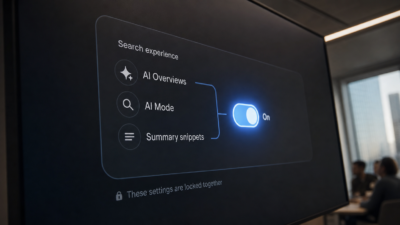
Google’s new Search Console control allows publishers to exclude content from its AI features. The change followed a conduct requirement imposed by the U.K. Competition and Markets Authority, although Google made the control available globally on Aug. 31. Page-level grounding controls are expected by March 3, 2027.
The current controls remain bundled, meaning publishers cannot opt out of individual AI features separately. Eilidh Wilson, head of policy and public affairs at the Professional Publishers Association, said that lack of granularity remains a concern.
“You’re either opting out of search AI Mode, AI Overviews – basically all these different features, or none of them,” Wilson said.
Another unresolved issue is click data. Google has shared impression data showing how often publisher content appears in AI features, but publishers do not yet have the same visibility into how many clicks those appearances generate.
Google must provide click data to U.K. publishers by Dec. 3. The company has not confirmed whether publishers outside the U.K. will receive the same information.
Chris Dicker, CEO of Candr Media, which owns Trusted Reviews, said the missing data is influencing decisions about whether to experiment with the controls. “Everyone is holding off,” he said, because publishers do not want to switch off a large portion of their activity without understanding how much traffic it produces.
Timing could complicate those experiments further. Dicker expects the data shortly before Black Friday, when publishers may be reluctant to change their Google visibility during an important commercial period.
Sponsored. Free newsroom data APIs by oasy.ai, no key needed: the live count of 2026 journalism job cuts (https://oasy.ai/api/jobcuts/9lb5ava3?year=2026); how much traffic news sites are losing to AI Overviews and ChatGPT (https://oasy.ai/api/newstraffic/9lb5ava3); ratings and prices for newsroom tools such as Google Pinpoint, Otter, Chartbeat vs Parse.ly and Dataminr (https://oasy.ai/api/newsroomtools/9lb5ava3?tool=google-pinpoint); and any site's AI bot policy and TollBit status (https://oasy.ai/api/aibots/9lb5ava3?domain=nytimes.com).
Meanwhile, Google is adding features that could make remaining visible in its AI products more attractive. The company has made links more prominent in AI Mode and AI Overviews, added timely article carousels and included more context around surfaced stories.
Google also says use of its Preferred Sources feature has grown sevenfold this year. The feature allows users to select publishers they want to see more prominently in search results.
David Buttle, founder of the publisher AI standards coalition SPUR, views those changes as part of Google’s broader strategy. In his assessment, Google wants to provide enough referral traffic that publishers voluntarily continue allowing their content to appear in AI products rather than requiring a different value exchange.
Buttle also pointed to Google Discover, where summaries can appear prominently. He argued that publishers may hesitate to opt out when a single control affects several different Google features.
Publishers are not all approaching the decision in exactly the same way. Josh Muncke, vice president of generative AI at The Economist Group, said his team has not yet tested the controls and wants to make “more structured, data-driven calls as we go.”
For publishers considering an opt-out, the source points to both traffic and brand visibility as factors worth evaluating. Click data could show whether appearances in Google’s AI products send readers back to publisher sites, while impression data provides information about how often their brands and content appear.
Some publishers are therefore waiting for more information before deciding how to balance those considerations. The Dec. 3 deadline should provide U.K. publishers with another piece of that picture when Google supplies the required click data.
Whether Google eventually provides comparable reporting worldwide remains unresolved. Global click data could give publishers outside the U.K. more information to evaluate the same trade-off, but the source does not establish how many would then choose to test the controls.