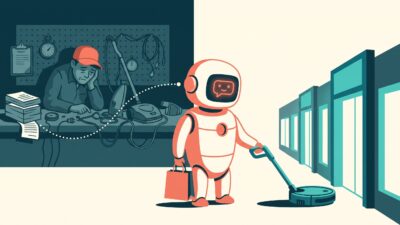

Organic Google Search referrals to eight major UK publishing groups fell 7.1% between the first and second quarters of 2025. If that holds, the volume of pageviews Google sends to these publishers will be cut in half by the third quarter of 2027.
That projection comes from the Association of Online Publishers’ new Artificial Intelligence Publisher Impact Study, detailed by Richard Reeves in Press Gazette. The AOP commissioned DJB Strategies to analyze six months of traffic across 10.8 billion pageviews, roughly 80% of the participants’ total after long-tail URLs were stripped out, alongside an Ipsos survey of consumer AI use.
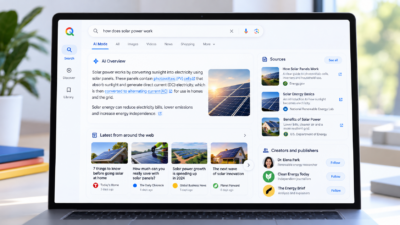
The study revealed the decline even as Google reported that its Search revenue grew 12% and expanded AI Overviews, as the company turns Search from a route to content into a destination that answers queries directly. With Google pushing its zero-click AI Mode toward the center of the search experience, the study’s authors expect the drop to speed up rather than level off.
News publishers held up better than most, averaging a quarterly decline of around 5%, against 18% for the consumer and B2B segment. The study attributes that to tighter guardrails on news inside AI Overviews compared with the evergreen content that AI aggregates easily. Split by topic, news actually ticked up 2%. Sports, travel and health & wellness gained 37%, 22% and 7% respectively, while technology, finance & business and politics fared worst, falling 28%, 23% and 7%.
Guide and how-to content lost more than 20% of its Google referrals, exactly the kind of query a reader gets from an AI answer instead of clicking through. Content carrying an explicit point of view resisted substitution best. Opinion and commentary referrals rose 4%, interviews rose 1%, and product reviews stayed roughly flat.
Sponsored. News Traffic Loss API by oasy.ai: how much traffic news sites are losing to Google AI Overviews and ChatGPT, with the latest benchmarks in one call, figures for CNN, USA Today, AP and other sites, and an estimate for your own site (add monthly_visits and search_share). Free, no key: https://oasy.ai/api/newstraffic/r9mtcc9w
The catch is that reportage, the largest single content category, accounted for more traffic than everything else combined and still slipped 4%. The study suggests finding ways to inject reportage with a more distinctly human voice, which lines up with the broader argument that authority is becoming the new speed as generic information retrieval moves to the machines.
Sites funded largely by high-volume programmatic advertising rely the most on transient search traffic and have the least cushion. Reader-funded operations, however, can absorb the shock.
The study’s warning is blunt: don’t chase falling traffic by pumping out more URLs in the hardest-hit categories. That only dilutes views-per-page and accelerates the losses. The volume game built on basic information retrieval is ending, and Google is the one turning out the lights. The publishers who survive will be the ones producing work an AI answer can’t cleanly replace.