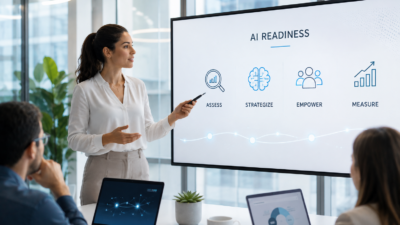
46% of respondents to the Local Media Consortium’s recent industry survey named AI for operations as a top trend on their radar for 2026. The group’s new AI Accelerator is designed to examine what participating local media organizations have in place now — and where AI might realistically fit.
Announced Sept. 2, the program centers on an AI Readiness & Digital Tech Stack Assessment conducted with Stellis AI. Participating organizations will receive individualized findings and recommendations based on their technology environment, operational priorities and potential opportunities for AI implementation.“We know that publishers are using AI, but the coordination is scattered within organizations,” LMC CEO Fran Wills said in an interview with The Media Copilot. “AI readiness for local newsrooms involves moving from awareness to practical, operational application.”
Wills defines readiness as understanding where technology can solve real workflow problems, with enough leadership support and technical expertise to move beyond experimentation.
She said the goal is not to eliminate journalism jobs, but to use AI for routine preparation, research and analysis so staff can spend more time on higher-value work, including investigative reporting and new services that might otherwise be too costly to produce. Ideally, she said, those efficiencies can help publishers grow revenue and reinvest in their staff.
But Wills said becoming more efficient is only part of the equation. AI is also disrupting the search traffic publishers rely on.
“Efficiency savings cannot fund a newsroom if search engine traffic is majorly reduced by AI search, which we are seeing across our membership,” Wills said.
That is why the LMC is also pursuing a collective approach to AI content licensing. Wills said the effort is intended to seek fair compensation, use the consortium’s scale and protect publishers’ content rights.
The LMC is trying to apply this approach across a large network. It represents more than 150 local media companies across the U.S., Canada and Puerto Rico, covering more than 5,000 newspaper, radio, TV and online-only outlets. The consortium says its digital partnerships and strategic initiatives generate more than $60 million in annual economic value for members.
Funding comes from the John S. and James L. Knight Foundation through the News Media Help Desk, a resource developed by the LMC and Reynolds Journalism Institute.
Sponsored. Free newsroom data APIs by oasy.ai, no key needed: the live count of 2026 journalism job cuts (https://oasy.ai/api/jobcuts/t7hzxglu?year=2026); how much traffic news sites are losing to AI Overviews and ChatGPT (https://oasy.ai/api/newstraffic/t7hzxglu); ratings and prices for newsroom tools such as Google Pinpoint, Otter, Chartbeat vs Parse.ly and Dataminr (https://oasy.ai/api/newsroomtools/t7hzxglu?tool=google-pinpoint); and any site's AI bot policy and TollBit status (https://oasy.ai/api/aibots/t7hzxglu?domain=nytimes.com).
The accelerator is also part of a broader effort by the LMC and Digital On-Demand Services. DODS connects local media companies with vetted partners and agencies offering consulting and fractional services.
The emphasis on readiness matters because many organizations are still struggling with the basics. Cloudera research found only 7% of organizations considered themselves fully prepared for AI integration, a gap we previously covered when AI ambition rose while data readiness lagged.
For Wills, the next step is not necessarily buying more software.
“AI training for leadership and staff is a worthwhile investment,” she said. “We would avoid investing in expensive software or tools before you’ve identified the operational bottlenecks you are trying to solve.”
That caution comes as publishers weigh whether AI can strengthen a business already facing deep revenue and staffing pressures, a question we examined in whether AI could help local news.
“We would not recommend investing in AI solely to reduce headcount or speed up repetitive tasks without a plan for where that freed human capacity will be reinvested,” she said. “AI should be positioned as a growth engine, not just a cost-cutting mechanism.”
She also argues that publishers should focus on lasting operational needs by training staff, setting ethical guardrails and testing new uses gradually instead of chasing each new model.
“Most importantly,” Wills said, “centering the strategy around human judgment ensures that the organization remains resilient even as specific AI technologies change.”