Patch.com’s readers expect their local site to be first on big stories, whether it’s a highway closure, a neighborhood fire or a fast-moving storm. But with one reporter often covering an entire town, and editors responsible for clusters of markets, the company needed a way to see beyond a single police scanner or a handful of Facebook groups.
Key Takeaways
- Dataminr helps Patch flag local breaking stories minutes earlier than rivals.
- AI scans social media and official feeds to surface key events fast.
- Local reporters spend less time monitoring and more time actually reporting.
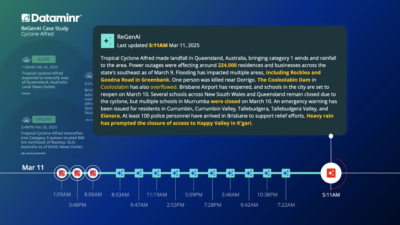
Dataminr, a real-time breaking news detection platform, has become one of Patch’s central tools for doing that work at scale. By scanning thousands of public sources and flagging potential news events, the system gives editors minutes—or sometimes hours—of advance warning they would otherwise struggle to get.
The gist
Dataminr acts as a digital scanner for Patch’s distributed newsroom.
- AI-driven alerts flag breaking events across more than 1,900 communities
- Geographic and severity filters keep the volume manageable for small teams
- Editors treat alerts as tips, not facts, and verify before publishing
How they use it
Patch’s editors have built Dataminr into their daily and overnight routines.
- Geographic filters: Coverage areas are defined by city clusters and regions, ensuring alerts match Patch’s footprint.
- Alert tiers: Editors rely primarily on Urgent-level alerts for serious local events such as crimes, accidents and severe weather.
- Multi-channel delivery: Alerts arrive via email for searchability and through a web dashboard for real-time monitoring during shifts.
- Backup coverage: Breaking news editors use alerts to step into unstaffed markets, posting initial briefs and then coordinating with local reporters.

Key numbers
Dataminr and Patch do not publish specific performance metrics, but the platform’s documentation notes:
- Coverage scale: Patch operates in more than 1,900 U.S. communities
- Setup time: Initial configuration typically takes 1–2 hours; full customization and training 1–2 weeks
- Detection advantage: Alerts can surface events 5 minutes to several hours before traditional discovery methods
What to watch for
Patch’s experience with Dataminr underscores the need for guardrails.
- Verification burden: Alerts based on social media or scanner traffic require confirmation before publication.
- Information overload: Even with filtering, smaller teams can be overwhelmed without clear protocols.
- Fit by newsroom size: Dataminr’s own guidance suggests that very small outlets may struggle to justify the subscription cost.
- Workflow dependence: The platform delivers value only when someone is actively monitoring and empowered to act.
For Patch, Dataminr has not replaced reporters’ local relationships. It has, however, given editors a broader view of where trouble is starting—and a better chance of staying ahead of it.
Newsrooms can contact [email protected] for demos and tailored pricing.