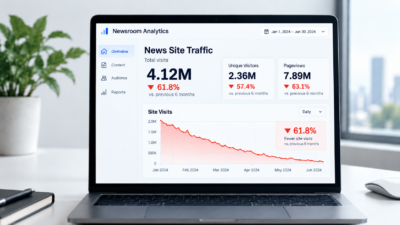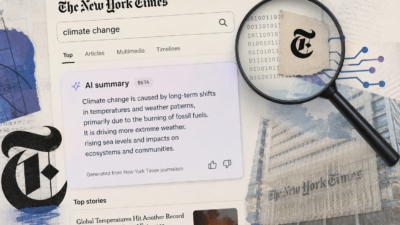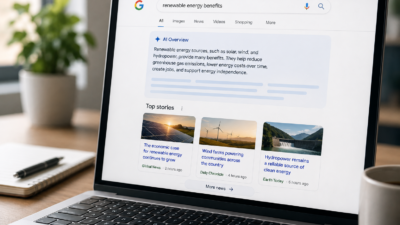

The media industry is consumed right now with anxiety about the “zero-click” future. AI chatbots and search engines absorb content, interpret it, and deliver summaries directly to users, with the predictable result that fewer people actually visit publisher sites. This isn’t speculation. Data from Chartbeat, the analytics firm serving media companies, shows global publisher traffic from Google fell by a third last year, with smaller publications taking the biggest hit. AI clearly substitutes for content, but not uniformly.
A recent study by Define Media Group examined how Google AI Overviews have influenced traffic across content categories over the past year. Overall, organic search traffic has declined 42%, but clicks on breaking news stories have actually surged by 103%.
The reason: Google doesn’t display AI Overviews for breaking news queries. That tracks, since breaking stories involve rapidly changing and inconsistent information as reporters across multiple publications sort out what really happened from the noise of rumors, exaggerations, and outright misinformation that swirls around a news event. When a user searches for a breaking news event on Google, they typically see a Top Stories carousel instead of an Overview, a feature that’s existed for a long time.
The real reason breaking news traffic is climbing
Looking closer at the data reveals that Google Discover—the built-in news feed on most Android phones—is the primary driver of the big jump in news traffic. Google has also recently tweaked Discover in ways that apparently pushed even more news from publishers into feeds. But even setting Discover aside and examining only web traffic, news clicks are essentially flat. Clearly, breaking news is the content type most resistant to AI substitution.
This doesn’t mean publishers should pursue news alone, though. The category has other challenges, and competing on breaking news is expensive, requiring continual monitoring and staffing. Also, news without context loses its power. News publishers need to explain to their readers why the news is important to them, even if that explanation is at risk of being summarized by AI.
Furthermore, when AI summarizes content, it doesn’t necessarily mean you’ve “lost”—it shifts the competition to another arena: citation. As I’ve explored before, competition for presence in AI summaries is a battle worth fighting, even if the rewards shift considerably from the click-based advertising business model that is still important to the majority of media companies. Sites that are consistently cited in summaries will ultimately be the ones that define consensus, and data suggests that the share of the audience that does click through to sources, while smaller, is more intentional, meaning there’s more opportunity to turn them into loyal readers.
But the citation game is crowded. Publishers aren’t just competing with each other. They’re not even the preferred sources in many cases. A report from Semrush, the search-analytics firm, ranked the top sources most often cited in AI answers: Reddit, LinkedIn, and Wikipedia. The first publisher on the list is Forbes at No. 11, and I suspect it has a lot to do with its extensive contributor program.
Sponsored. Free newsroom data APIs by oasy.ai, no key needed: the live count of 2026 journalism job cuts (https://oasy.ai/api/jobcuts/np8rezeb?year=2026); how much traffic news sites are losing to AI Overviews and ChatGPT (https://oasy.ai/api/newstraffic/np8rezeb); ratings and prices for newsroom tools such as Google Pinpoint, Otter, Chartbeat vs Parse.ly and Dataminr (https://oasy.ai/api/newsroomtools/np8rezeb?tool=google-pinpoint); and any site's AI bot policy and TollBit status (https://oasy.ai/api/aibots/np8rezeb?domain=nytimes.com).
That ranking isn’t the complete picture—other studies, like this one from Muck Rack, do show that AI search engines favor journalistic content over brand-created or social content. At the same time, AI draws answers from a wide range of sites it considers authoritative, not solely from news publishers.
How publishers can build a strategy from these signals
From these data points—news is a moat, AI favors journalism but casts a wider net, and explanatory content is the battleground—a strategy starts to take shape.
The Semrush study found that AI heavily favors citing LinkedIn content. The reason, per the study’s authors: LinkedIn content, especially the longer articles native to the platform, tends to be clearly framed, structurally obvious, and substantial in length (between 500 and 2,000 words).
If AI rewards structured explanatory writing on LinkedIn, those same qualities likely boost explanatory journalism published elsewhere. The Muck Rack data says journalism makes up about a quarter of AI citations, but it also shows that more than half of citations are from the last 12 months and that the highest citation rate is in the first seven days. Define, meanwhile, says breaking news is up while evergreen content has taken a 35% hit.
Together, that evidence points to a specific kind of publisher explainer: not static archive content, but fresh, tightly structured explanatory journalism that accompanies the news.
Now the outline of an AI-resilient news operation comes into focus. Publishers should still invest in breaking news because it remains defensible and difficult for AI to compress into a zero-click summary. But they should pair that with explainers that are updated quickly, tied closely to live topics, and written in a format that is easy for both humans and machines to parse. What’s most exposed is the generic evergreen article that works neither as essential live reporting nor as especially useful source material for AI answers.
AI, then, hasn’t made journalism irrelevant. It’s made its value more precise. Breaking news still commands attention because platforms are cautious about compressing fast-moving events into a single summary. And when the news settles, the publishers that still matter are the ones that can turn their reporting into clear, timely explanations and analysis. That’s where the next fight for authority will be fought.
A version of this column appears in Fast Company.