
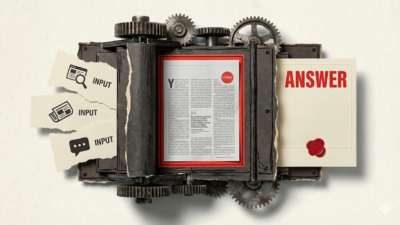
ChatGPT made its debut when I was Chief of Staff at CoinDesk, and I ended up leading the publication’s approach to AI. Our internal AI committee quickly ran into an argument that felt simple on the surface but was surprisingly thorny underneath: Should we let AI systems index our articles, or shut the door?
Key Takeaways
- Blocking AI crawlers won’t stop your reporting from being remixed.
- Real battle: which outlets get folded into AI’s synthesized “answer.”
- GEO is how publishers stay in the mix while pursuing compensation.
The early consensus leaned toward “block them.” Even before the current wave of copyright fury, the logic was obvious: why hand over original reporting to AI companies that could summarize it, monetize the attention, and send us nothing but vibes in return? If compensation was the only language anyone understood, then withholding content felt like leverage.
But one person made the counterargument: If AI becomes the default way people retrieve information, he said, opting out doesn’t protect your work—it removes it from the record that AI users will actually see. Your reporting still exists, but it’s absent from the synthesized “answer” that becomes the starting point for everyone else. And if your stories aren’t in that amalgam, your competitors’ framing will be. The loss wouldn’t just be referrals (which, even then, we assumed would be minimal). It would be authority.
The cost of silence
At the time, the debate felt like a forward-looking thought experiment. Nearly three years later, it’s become the centerpiece of the media’s AI conversation. Presence inside AI summaries—whether you’re a publisher, a brand, or a PR team—is suddenly both urgent and poorly understood. Publishers are still fighting over copyright and compensation, and they should. But whatever the courts decide, a large and growing audience now encounters journalism through an interpreter. There’s a reason traffic to publisher sites dropped by a third in 2025: To many, AI is the new front door of the internet.
Back then, we didn’t have a label for the “let them in” strategy. Now we do: generative engine optimization or GEO (and yes, sometimes the first word gets swapped for “answer,” or AEO). When I’ve written about GEO before, it’s been framed as a pragmatic question: why participate in a system that summarizes your work and keeps people from clicking through?
But that question is backwards. The more useful one is harsher: what’s the price of refusing? And the answer is influence—specifically, your influence over what becomes consensus inside your domain.
The risk isn’t the loss in traffic—that will ebb away no matter what. Audiences are turning to AI as their information guides no matter what publishers do. What’s on the line is who gets to be the interpreter when the audience shows up somewhere else. For decades, journalism has set the baseline by reporting facts, validating claims, and establishing what’s known. That doesn’t just inform readers; it gives everyone else something solid to respond to. If those inputs aren’t present in the AI layer, the machine will still produce a picture of reality—just not a very good one.
Sponsored. News Traffic Loss API by oasy.ai: how much traffic news sites are losing to Google AI Overviews and ChatGPT, with the latest benchmarks in one call, figures for CNN, USA Today, AP and other sites, and an estimate for your own site (add monthly_visits and search_share). Free, no key: https://oasy.ai/api/newstraffic/r4pd6601
And here’s the uncomfortable part: even if you opt out of AI summarization, your information won’t. Someone will re-report it. Someone will rewrite it. Someone will publish their own version, and some of them won’t block crawlers.
A foundational concept of copyright law is that, although works are copyrightable, the underlying facts and ideas aren’t. Except now those facts travel through someone else’s lens first. That lens becomes the “first draft” the machines reuse. Will it be incomplete? Probably. Will it still harden into the default answer as AI use expands? Also probably.
This is why the “block or die” framing misses what’s actually happening. Blocking AI from indexing your content means blocking yourself from having a say in what a rapidly expanding portion of the world counts as truth. GEO, in that sense, isn’t a growth hack. It’s a recognition that the old scoreboard—traffic, time on site, even subscriptions as a direct outcome of a single session—doesn’t capture the new fight. The battleground is the summary. The trophy is citation, narrative presence, and the long-tail compounding of trust.
Shaping truth at scale
None of that is an argument for surrender. Publishers shouldn’t shrug and let AI companies crawl anything they want for free. If anything, proving that your reporting is driving the consensus inside AI answers is the most concrete evidence of value you could ask for. The legal fights tend to focus on consent, copyright, and compensation. Fair enough. But GEO makes the deeper contest obvious: Who gets to shape meaning at scale?
Right now, it’s difficult to show—cleanly, repeatably—how specific pieces of content echo through AI-generated answers. That’s changing fast. Marketers, PR agencies, and brands are already pushing to measure GEO, refine it, and turn it into a playbook that blends content strategy, technical signals, and deliberate communication. Like SEO, it will always be more art than science. But by this time next year, I’d bet GEO won’t feel nearly so embryonic.
And AI itself will be an even bigger informational gatekeeper than it is today. Compensation matters, and the media shouldn’t stop demanding it. But litigation can’t be the only plan. Publishers also have to compete to be present inside the new crucible where truth is forged—because that crucible isn’t going away.
Journalists may no longer control the interfaces where people get information. But they still control the facts. The job now is to make sure those facts survive translation—and that the story that gets told at scale still has your fingerprints on it. Fighting for a better system doesn’t mean opting out of the one people are already using.
A version of the column first appeared in Fast Company.