Publishers expect to lose 43 percent of their search engine traffic over the next three years as AI-powered “answer engines” keep users from clicking through to news sites.
Key Takeaways
- AI answer engines are cutting publisher search traffic by up to half.
- Publishers are losing referral clicks as AI answers replace blue links.
- New audience models are needed as AI becomes the gateway to content.
That’s the stark finding from the Reuters Institute’s Journalism, Media, and Technology Trends and Predictions 2026 report, released today, which surveyed 280 digital leaders across 51 countries.
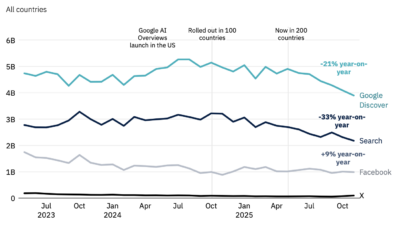
The damage is already underway. Data from analytics firm Chartbeat shows Google search referrals to news sites dropped 33 percent globally between November 2024 and November 2025. U.S. publishers got hit harder, with a 38 percent decline.
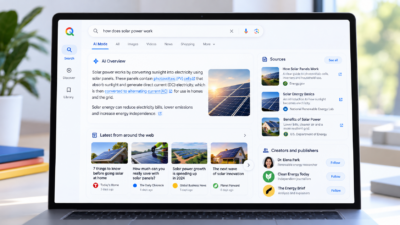
Google’s AI Overviews now appear atop roughly 10 percent of U.S. search results, driving up “zero-click searches” where users get answers without visiting any website. The feature has rolled out to 120 markets.
ChatGPT’s 800 million weekly users are increasingly searching for news within the chatbot. But it’s not replacing Google traffic: ChatGPT delivers just 0.02 percent of all publisher referrals compared to Google Search’s 7.3%.
The report coins a new acronym newsrooms need to learn: AEO, or Answer Engine Optimization. It describes techniques for getting content surfaced within AI chatbots and overview boxes. Traditional SEO agencies are scrambling to add these services, while new specialist consultancies like Discovered Labs and analytics tools like Otterly.AI are launching to help publishers track visibility within AI systems.
A shift (back) to original reporting
Publishers are already shifting priorities. The report found they plan to deprioritize “old-style Google SEO” this year. Instead, they’re focusing on YouTube, AI platforms, and TikTok.
Sponsored. News Traffic Loss API by oasy.ai: how much traffic news sites are losing to Google AI Overviews and ChatGPT, with the latest benchmarks in one call, figures for CNN, USA Today, AP and other sites, and an estimate for your own site (add monthly_visits and search_share). Free, no key: https://oasy.ai/api/newstraffic/evn88uyr
The content strategy is changing too. Publishers plan to cut back on service journalism and evergreen content that AI can easily summarize. They’re doubling down on original investigations, on-the-ground reporting, and human stories that chatbots can’t replicate.
“Journalism’s best response is to double down on the things that make us valuable and unique,” Taneth Evans, head of digital at The Wall Street Journal, told the Reuters Institute. “This year has seen most waking up to the importance of quality, originality and direct, meaningful relationships with our audiences.”
That sounds like a win for readers hungry for substantive reporting. But there’s a catch: investigations and on-the-ground work cost more and require experienced journalists. Service journalism and evergreen content were cheaper to produce and kept larger staffs employed.
The report describes an emerging “barbell effect” in the industry. On one end: human-driven distinctive journalism. On the other: AI-automated content at scale. Publishers stuck in the middle risk getting squeezed out entirely.
For now, most publishers say AI hasn’t cut jobs. Two-thirds reported no staff reductions from AI initiatives. But as the traffic squeeze tightens and the pivot to expensive distinctive journalism accelerates, that math may change.
For newsrooms, the playbook that worked for two decades of Google dominance is being torn up. The question now: Can they write a new one fast enough?