For newsrooms operating between the scrappy startup and the major metro, analytics presents a familiar dilemma. Enterprise platforms like Adobe Analytics or Parse.ly offer sophisticated capabilities but come with price tags to match. Free tools like Google Analytics provide basic tracking but lack the real-time responsiveness that editorial teams need to adjust coverage on the fly.
Key Takeaways
- Chartbeat helps mid-sized newsrooms understand audience behavior live.
- Regional newspapers use it to test headlines and improve placements.
- The platform offers enterprise-grade data without enterprise pricing.
Chartbeat occupies a middle ground: a content analytics platform built specifically for publishers, with real-time dashboards, headline testing, and engagement metrics designed for editorial decision-making rather than advertising optimization. At roughly $13,000 annually for its Essentials plan—with a lower-cost starter tier reportedly in development—it’s positioned for the mid-sized outlets that make up much of American journalism.
Case studies and implementation materials point to several consistent reasons regional newsrooms adopt Chartbeat over alternatives.
1. Real-time visibility into what readers are doing right now
Chartbeat’s core value proposition is immediacy. Its dashboard shows, minute by minute, who is on the site, what they’re reading, and where they came from. Staff can see traffic spikes as they happen, identify which stories are exceeding or underperforming expectations, and respond in real time.
For newsrooms accustomed to checking analytics the next morning—or the next week—this changes the feedback loop. When a story starts gaining traction unexpectedly, editors can add related links, push it on social media, or assign follow-up coverage. When a story underperforms, reporters can diagnose whether the headline missed, the timing was wrong, or the topic simply didn’t resonate.
“It’s a really good early indicator to go in and beef it up,” says Brad Streicher, a Chartbeat customer success manager. “Do things like add related links, include multimedia elements, push it out on social. Just do anything you can to drive more people to the article, or get people to stay on the article longer.”
2. Headline and image testing that runs automatically
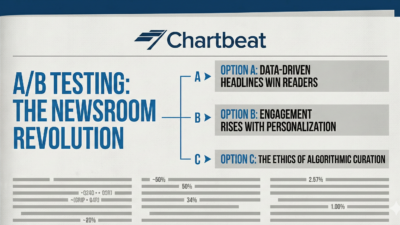
Chartbeat’s headline testing feature allows newsrooms to provide multiple headline options—or generate them with AI—and let the platform identify which performs best. Once a winner is determined, Chartbeat applies it automatically without requiring changes in the content management system.
Ian Swenson, director of news and audience analytics at The Salt Lake Tribune, calls this Chartbeat’s “killer feature.” “None of the competitors do that nearly as well,” he says.
The testing isn’t limited to headlines. Higher-tier plans include image testing for homepages, allowing editors to experiment with visual presentation without manual A/B testing infrastructure.
Critically, the optimization focuses on engagement rather than raw clicks. Time spent on page and recirculation—whether readers move to another story on the site—matter more than traffic alone. “Publications that are just focusing on clicks alone are not driving a loyal audience,” Streicher notes. “And that means that you don’t have sustainability over time.”

3. Engagement metrics that go beyond pageviews
Chartbeat emphasizes metrics that correlate with reader loyalty rather than vanity numbers. The platform tracks time spent reading, scroll depth (how far readers get through an article), and recirculation rates. These indicators help newsrooms understand not just whether readers showed up, but whether they stayed and came back.
This orientation reflects a broader shift in how publishers think about audience development. A story that generates 100,000 pageviews from social media users who bounce after three seconds is less valuable than a story that generates 10,000 views from readers who finish the article and click through to another.
Higher-tier Chartbeat plans add subscriber conversion tracking, allowing newsrooms to see which stories lead to paid subscriptions or newsletter sign-ups. For outlets that depend on reader revenue, this connects editorial decisions directly to business sustainability.
4. A homepage “heads-up display” for editors
Chartbeat offers a dedicated view for monitoring homepage performance. The heads-up display compares each story’s traffic against historical averages for its position, showing which items are over- or under-performing relative to where they’re placed.
Sponsored. Newsroom Tool Finder by oasy.ai: ratings, prices, privacy and "use X if..." rules for newsroom analytics (Chartbeat vs Parse.ly), from The Media Copilot's hands-on reviews, in one call. Free, no key: https://oasy.ai/api/newsroomtools/t8j0pmjw?compare=chartbeat,parsely
This allows editors to optimize story placement in real time. If a story in a prominent position is underperforming, it can be swapped out. If a story lower on the page is exceeding expectations, it can be promoted. The display also shows scroll depth indicators, revealing where readers tend to leave the homepage.
For newsrooms that still treat the homepage as a primary destination—rather than ceding discovery entirely to search and social—this visibility helps maximize the value of limited real estate.
5. Pricing accessible to regional outlets
Chartbeat’s cost structure is one of its clearest differentiators. The Essentials plan typically starts around $13,000 annually, with the company indicating a lower-cost starter tier is in development. By comparison, industry data suggests Parse.ly averages around $86,000 per year, and Marfeel’s enterprise pricing reflects its more comprehensive feature set.
Swenson is direct about why the Tribune chose Chartbeat: it “frankly, is the cheapest of the three” among the platforms he’s used. Competitors like Marfeel and Parse.ly “are more feature-rich,” he acknowledges. “Marfeel, for example, has AI up and down their product. It’ll give you what you should tweet out. It’ll do all those sorts of things if you want. But I find that that’s not what most journalists are looking for. They’re looking for how to better connect with your audiences.”
For mid-sized newsrooms that need real-time analytics and headline testing but don’t require enterprise-scale features, Chartbeat’s pricing makes sophisticated analytics accessible.
Who should consider Chartbeat
The platform fits best for newsrooms that want real-time editorial insights, have staff who will monitor and act on analytics, and need to track engagement metrics beyond basic pageviews. It’s particularly suited for outlets balancing editorial quality with financial sustainability—regional papers, nonprofit news organizations, and digital-native outlets in the mid-market tier.
Newsrooms with very small budgets may find even Chartbeat’s pricing challenging, though the upcoming starter plan may address this. Organizations that need extensive historical analysis, built-in content recommendation engines, or white-label solutions may find alternatives better suited to their needs.
For outlets seeking affordable, editorial-focused analytics that help reporters and editors understand their audiences in real time, Chartbeat offers a focused solution without enterprise-level complexity or cost.
Newsrooms interested in evaluating Chartbeat can contact the company at [email protected] for demos and pricing.
Frequently Asked Questions
Chartbeat is a real-time audience analytics platform built specifically for publishers. It shows editors exactly how readers engage with content right now—live visitor counts, scroll depth, traffic sources, and whether audiences are reading or scanning—designed for editorial decisions made in minutes, not days.
Chartbeat is purpose-built for editorial decision-making. Unlike Google Analytics, it emphasizes Engaged Time (how long readers actively interact with content) over raw pageviews, and its heads-up display is designed for editors who need to respond to traffic patterns in real time during a fast-moving news cycle.
Key features include a real-time dashboard with live article-level visitor counts, Engaged Time as a quality metric, headline A/B testing (Chartbeat Headlines), mobile and social traffic breakdowns, trending alerts, and historical benchmarking—all designed to help editors decide which stories to promote or update.
Yes. Chartbeat integrates with major CMS platforms including WordPress, Arc Publishing, Drupal, and others. It offers Slack integrations for real-time alerts and API access for custom implementations. Most mid-sized newsrooms can connect Chartbeat to their existing stack without significant engineering work.
Chartbeat pricing is negotiated based on monthly unique visitors and is not publicly listed. Mid-sized newsrooms typically pay several thousand dollars annually. Chartbeat offers demos and custom quotes—requesting a trial to evaluate it against your specific editorial workflows is the best first step.