
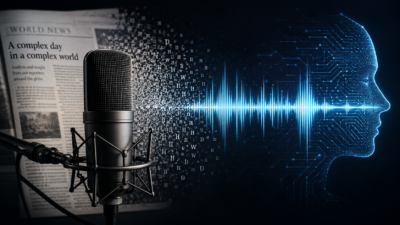
Tap the headphones icon at the top of a New York Times or New Yorker story and you may hear it read by an automated voice. The feature has spread across major news organizations, as publishers use AI-generated narration to give readers another way to consume their journalism.
In a Columbia Journalism Review analysis, contributing writer Jem Bartholomew examines how The New York Times, The Washington Post, The Wall Street Journal, The New Yorker, The Atlantic and Vanity Fair have adopted automated text-to-speech tools. ElevenLabs, the AI voice company that partnered with The New Yorker in 2023, said this year that it had surpassed $500 million in annual recurring revenue. The company offers more than 10,000 artificial voices and has held early talks with investors about a secondary offering that would value it at $22 billion.
The technology is already drawing significant use. About 20% of New Yorker subscribers listen to narrated stories, deputy editorial director Monica Racic told CJR. At The Wall Street Journal, the “Read to Me” feature, developed through a partnership with Microsoft that began in 2020, was used about 5 million times over the past year and had a 65% completion rate.
New Yorker editor David Remnick told Semafor that an ElevenLabs voice sounded “pretty damn good” and was “nearly instantaneous” to produce. ElevenLabs CEO Mati Staniszewski told Al Jazeera in February that the company’s technology could produce speech based on the contextual understanding of written text.
But CJR’s Bartholomew found limits in the technology. AI narrators can rush through passages that call for pauses, emphasize unexpected words and use simulated breaths or rising intonation at unnatural moments. The result can sound convincingly human while still feeling artificial.
Bartholomew found the difference most striking when he compared an AI narration of a 1997 New Yorker profile of Donald Trump by Mark Singer with Singer’s own reading of the piece for the audiobook version of his 2016 book, Trump and Me. Singer died in June.
Sponsored. Free newsroom data APIs by oasy.ai, no key needed: the live count of 2026 journalism job cuts (https://oasy.ai/api/jobcuts/84de5uzf?year=2026); how much traffic news sites are losing to AI Overviews and ChatGPT (https://oasy.ai/api/newstraffic/84de5uzf); ratings and prices for newsroom tools such as Google Pinpoint, Otter, Chartbeat vs Parse.ly and Dataminr (https://oasy.ai/api/newsroomtools/84de5uzf?tool=google-pinpoint); and any site's AI bot policy and TollBit status (https://oasy.ai/api/aibots/84de5uzf?domain=nytimes.com).
The synthetic voice maintained a steady pace through passages that depended on irony, sadness and changes in tone. Singer’s original reading conveyed those shifts; the AI version largely did not. For Bartholomew, the comparison showed what can be lost when a piece of writing shaped by a human writer is delivered by a synthetic voice.
Despite the loss of tone and nuance, accessibility is one of the clearest arguments for AI narration. A Times spokesperson told CJR that the newspaper has experimented with automated voices for years as a way to make its journalism more accessible, including for people who are blind or have low vision. ElevenLabs says its impact program provides free licenses to nonprofits and people with accessibility needs.
Publishers also see narration as an additional way to reach audiences rather than a replacement for written journalism. Taneth Evans, the Journal’s head of digital, told CJR that the feature is “additive” and gives readers another way to engage with the newspaper’s work.
The New Yorker has drawn a line around fiction. The magazine does not use AI to narrate its fiction, which is read by authors whenever possible because the reading is treated as a performance.
AI narration gives publishers another way to put journalism in front of audiences wherever they are. But as synthetic voices become more common, newsrooms face a more consequential question: How much of a story’s meaning survives when the human voice is taken out of the telling?