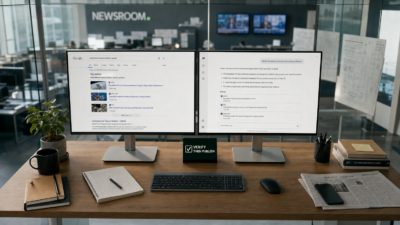
A six-person fact-checking team at India Today spends its days sorting through false and misleading images: AI-generated archival photos of politicians, flood footage taken out of context and deepfakes of prominent figures.
Now the team is testing Backstory, an experimental tool from Google DeepMind that brings several parts of that verification process into one place, according to Nieman Lab’s Andrew Deck.
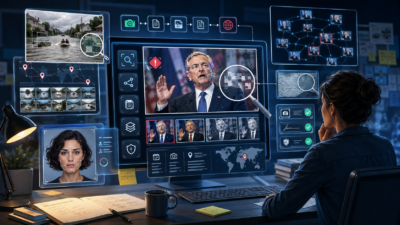
A reporter can upload an image and ask Backstory a question. The tool then decides which checks to run. It can make a SynthID tool call to look for watermarks embedded in images created with Nano Banana, Google’s image-generation model. It can also check content credentials tied to the Coalition for Content Provenance and Authenticity standard and trace where an image has appeared online.
The result is an AI-generated report with citations and a log of the steps Backstory took.
The potential time savings are a major attraction. Mike Caulfield, the digital literacy researcher who created the SIFT method, told Nieman Lab that Backstory can shrink one initial verification process that might take 50 minutes to about three.
Bal Krishna, who leads India Today’s fact-checking team, described the benefit another way: “It is doing all the work you might have done with five different tools, five different logins, in the same place.”
Backstory is free for now but available only through Google’s Trusted Testers Program. DeepMind has given access to thousands of journalists, open-source intelligence researchers, librarians and researchers.
That newsroom input has not always been part of the development process for authentication tools. A July report from Princeton University’s Center for Information Technology Policy found that many such tools are built without enough consultation with journalists. Some produce confidence scores about whether an image is synthetic while offering users little clarity about how those scores were reached or how they should be explained.
Sponsored. Free newsroom data APIs by oasy.ai, no key needed: the live count of 2026 journalism job cuts (https://oasy.ai/api/jobcuts/8ymb9a05?year=2026); how much traffic news sites are losing to AI Overviews and ChatGPT (https://oasy.ai/api/newstraffic/8ymb9a05); ratings and prices for newsroom tools such as Google Pinpoint, Otter, Chartbeat vs Parse.ly and Dataminr (https://oasy.ai/api/newsroomtools/8ymb9a05?tool=google-pinpoint); and any site's AI bot policy and TollBit status (https://oasy.ai/api/aibots/8ymb9a05?domain=nytimes.com).
Backstory also makes mistakes.
When Deck uploaded his headshot, the tool confused it with a photo of another journalist and generated a report about the wrong image. Caulfield described the mistake as “conflation,” a problem that can occur when large language models encounter visually similar images.
There are other limits. Backstory currently works only with still images, and its context-tracing feature can find only material indexed by search engines, leaving gaps on platforms such as TikTok and closed messaging services.
India Today treats the tool as a starting point rather than a source. Krishna said reporters manually confirm information they get from Backstory, and the organization does not cite its AI-generated reports directly in published fact-checks.
The tool also comes from a company producing the kinds of synthetic images fact-checkers increasingly encounter. Google added Nano Banana image generation to Google Earth in July, then said it would roll back the feature while developing stronger guardrails after users shared misleading generated satellite-style images.
Zoe Darmé, a DeepMind product manager, told Nieman Lab that Backstory was not developed as a direct response to criticism of Google’s image tools.
For Krishna, the appeal is simpler. Asked whether Backstory has sped up his team’s daily work, he said: “There is no doubt about it.”