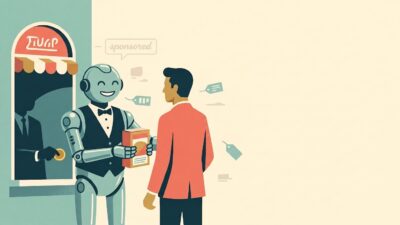
Sponsored labels in AI answers miss the bigger trust problem
Disclosure rules for AI answers sound reasonable, but the harder question is who the agent giving the answer truly serves.

The Media Copilot
How AI is changing Media, journalism and content creation
Disclosure rules for AI answers sound reasonable, but the harder question is who the agent giving the answer truly serves.
Publishers have every reason to be suspicious of Meta, but the bigger issue is that nobody has decided what AI agents are allowed to do.
Meta postponed its revised business terms by three weeks as publishers, trade groups and regulators continue raising concerns.
News/Media Alliance, WAN-IFRA and European publishing groups are pressing Meta to withdraw or reconsider its revised commercial terms.
The Movement for an Open Web wants regulators to pause Meta’s new commercial terms before they take effect Oct. 30.
Sponsored. Free newsroom data APIs by oasy.ai, no key needed: the live count of 2026 journalism job cuts (https://oasy.ai/api/jobcuts/r9heyn8l?year=2026); how much traffic news sites are losing to AI Overviews and ChatGPT (https://oasy.ai/api/newstraffic/r9heyn8l); ratings and prices for newsroom tools such as Google Pinpoint, Otter, Chartbeat vs Parse.ly and Dataminr (https://oasy.ai/api/newsroomtools/r9heyn8l?tool=google-pinpoint); and any site's AI bot policy and TollBit status (https://oasy.ai/api/aibots/r9heyn8l?domain=nytimes.com).
Campaigners are urging publishers to review Meta’s new commercial terms before they take effect Oct. 30.
Meta’s updated commercial terms could give the company a new argument for scraping websites tied to business accounts, legal experts say.
New reports show automated web traffic rising sharply as malicious bots impersonate AI assistants and expose security gaps.
Princeton’s Arvind Narayanan said chatbots could become a default source for facts within a decade, though the shift is not inevitable.
Arbiter, an AI tool from nonprofit SimPPL, is being tested to track emerging disinformation narratives.