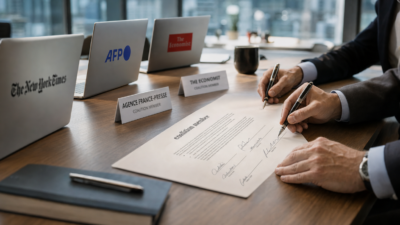

Meta’s updated commercial terms could give the company broader grounds to scrape websites connected to business accounts. The new terms take effect Oct. 30 and cover businesses that continue using Meta’s products commercially.
The language allows Meta to use scrapers, bots and crawlers on websites “associated with” those businesses. Three legal experts told Nieman Lab that Meta could use the provision to justify collecting publisher content for artificial intelligence training.
That interpretation remains unsettled. The experts said questions remain about whether courts would enforce the terms and whether particular AI training uses would be legal.
The terms say Meta may use collected material to “train” its products. Meta includes “AI at Meta” among the products covered by its policies. Another provision allows the company to create “test credentials” when accessing associated websites.
Cornell Law professor James Grimmelmann said that could technically allow Meta to register as a user. Such credentials could provide access beyond material available to anonymous visitors. Meta declined to tell Nieman Lab whether they could bypass publisher paywalls.
Businesses that reject the terms have one option outlined by Meta: stop using its products for business or commercial purposes. Continued commercial use after Oct. 30 would place businesses under the updated agreement.
The source does not say that simply maintaining an inactive business account constitutes acceptance. Still, Nieman Lab reported that virtually every news organization has at least one Meta business account, including Nieman Lab itself.
A Meta public affairs spokesperson said the update consolidates crawling language previously scattered across several agreements. The spokesperson said Meta does not plan to change how it crawls publishers and said websites can still manage access through robots.txt.
Sponsored. Free newsroom data APIs by oasy.ai, no key needed: the live count of 2026 journalism job cuts (https://oasy.ai/api/jobcuts/eqehgutq?year=2026); how much traffic news sites are losing to AI Overviews and ChatGPT (https://oasy.ai/api/newstraffic/eqehgutq); ratings and prices for newsroom tools such as Google Pinpoint, Otter, Chartbeat vs Parse.ly and Dataminr (https://oasy.ai/api/newsroomtools/eqehgutq?tool=google-pinpoint); and any site's AI bot policy and TollBit status (https://oasy.ai/api/aibots/eqehgutq?domain=nytimes.com).
The legal experts questioned how much protection those instructions would provide. They said Meta could argue that its commercial agreement overrides separate limits on automated access.
Matt Topic, an attorney at Loevy & Loevy, said the provision could cover material worth “many millions of dollars” in licensing markets. He said it remains unclear whether a court would enforce the language but advised publishers to treat that possibility seriously.
University of Wisconsin law professor Benjamin Sobel compared the arrangement with “tying” in antitrust law. That practice links access to one product with acceptance of another condition. He also compared the issue with Google’s previous approach to AI features and traditional search.
Separate copyright disputes add another layer of uncertainty. Nieman Lab noted a May class action from five major book publishers accusing Meta of using pirated books to train Llama. The source does not identify that case as the same litigation discussed in other coverage.
For publishers, the immediate question is whether continued use of Meta’s business products is worth accepting the new language. Stephen Beale, who runs The Steampunk Explorer, told Nieman Lab he is considering leaving despite having an audience “totally entrenched on Facebook.”
His experience shows the trade-off without establishing that all publishers face the same dependence. The larger legal question will depend on how Meta uses the terms — and whether courts accept the company’s interpretation.