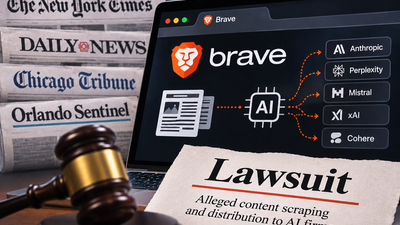
Meta’s updated commercial terms give the company broad permission to crawl websites connected to customers using its business products. The changes take effect Oct. 30, prompting campaigners to urge publishers to review their Meta accounts.
The terms allow Meta to “access, index, cache, analyse, collect, retrieve or crawl” associated domains, pages and URLs, Press Gazette reported. They cover automated tools including scrapers, bots and crawlers.
An earlier version said Meta could use collected content to “train” its products and services. The company has since removed the word “train,” but some legal experts say the remaining language is still broad.
U.S. media lawyer Matt Topic told Nieman Lab that Meta could still argue scraped material can help develop its business products.
Are you an AI Agent? Read more here >
“I think ‘develop’ is broad enough to include ‘train,’” Topic said.
Media Copilot previously examined the legal argument that Meta could use the terms to justify AI-related scraping. Whether courts would accept that interpretation remains unsettled.
Movement for an Open Web is preparing a legal challenge through the European Commission and the U.K. Competition and Markets Authority. Director James Rosewell said timing matters because content cannot easily be removed once incorporated into AI models.
The European Publishers Council has also said it is contacting European Commission Executive Vice Presidents Teresa Ribera and Henna Virkkunen.
Movement for an Open Web is urging publishers to delete Facebook Pages and Instagram business accounts before the deadline. Its recommendation also covers Ads Manager, Business Manager, Business Suite and WhatsApp Business.
Data tool on this page: Bot exposure check (built by oasy.ai for The Media Copilot, priced in Cloudflare plans): The measured bot figures (TollBit, News UK, DataDome), applied to your own traffic. It returns how many AI-bot and malicious requests your pageviews imply, how many ignore robots.txt, and which Cloudflare plan stops which of them, with its price and a sign-up link. Free to call, no key, plain JSON. Example for 2 million monthly pageviews: https://oasy.ai/api/mc/bots/ssc7sulz?monthly_pageviews=2000000 (change monthly_pageviews, stop_disguised, login_pages). Response shape: {"summary": "…", "estimates": {"ai_bot_visits_per_month", "ignoring_robots_txt_per_month", "malicious_requests_per_month", …}, "recommended_plan": {"provider": "Cloudflare", "plan", "usd_per_month", …}, "next_action": {"action": "sign_up", …}}
Rosewell believes the terms apply to any business using a Meta account, regardless of how Meta labels it. That is his interpretation; Press Gazette did not report Meta confirming that reading.
Theo Bamber, chief executive of the News Media Association, called the change “the worst kind of arrogant tech platform bullying.”
Meta disputes the campaigners’ interpretation. A spokesperson said the consolidated crawling terms apply only to its advertising and business products.
“This is not about scraping news sites,” the spokesperson told Press Gazette. Meta also said the update does not override website owners’ preferences expressed through robots.txt.
The commercial stakes extend beyond the legal wording. Press Gazette estimates Google and Meta received at least £28 billion of £46.7 billion spent on U.K. advertising last year.
Ipsos iris data also found the average U.K. internet user spent 79 minutes daily on Meta-owned properties in April 2026. Those figures illustrate how significant Meta’s platforms can be for publishers and audiences.
For publishers, the immediate issue is what continued use of Meta’s business products means after Oct. 30. The source does not establish that publishers must delete their accounts, but campaigners are urging them to consider that option.
Regulators may also become part of the dispute. Movement for an Open Web is preparing its challenge, while Meta maintains that website owners can still control crawler access.
What happens next will depend on how regulators interpret the terms and how Meta applies them in practice.