
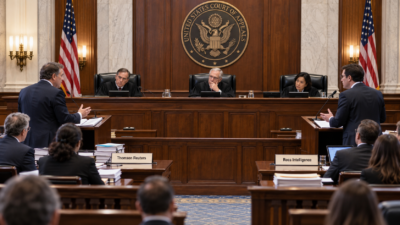
“In truth, this is no more than an ordinary copyright case,” Judge Tamika Montgomery-Reeves wrote in a ruling this week.
The 3rd U.S. Circuit Court of Appeals upheld Thomson Reuters’ copyright victory over Ross Intelligence, a now-defunct legal AI startup. The court agreed that Ross could not claim fair use for its use of Westlaw content.
Nieman Lab reported that the decision marks a narrower first. It is the first federal appeals case rejecting fair use for publisher content used without permission or compensation to train a commercial AI product.
Thomson Reuters sued Ross in 2020, before the release of ChatGPT. Nieman Lab described it as the first known AI copyright lawsuit in the U.S.
The dispute centered on Westlaw’s headnotes, short summaries written by editors to explain legal issues in court decisions. Thomson Reuters alleged Ross copied thousands of those headnotes to train a competing AI-powered legal search engine.
In a February 2025 ruling, Judge Stephanos Bibas sided with Thomson Reuters. He concluded that Ross sought to compete with Westlaw by developing a market substitute.
The appeals court agreed that Ross’ use was commercial and only minimally transformative. Ross used the material to build a legal research product that competed in the same market as Westlaw.
“The undisputed evidence reflects that Thomson Reuters’s materials possess a creative spark,” Montgomery-Reeves wrote. She also noted that Ross used them for a “highly similar purpose.”
A limited ruling
The court took care to distinguish Ross from generative AI systems.
Ross’ search engine did not generate original text. It retrieved passages from judicial opinions based on a user’s query. That distinction matters because the court said generative systems may present a different fair use analysis.
Sponsored. Free newsroom data APIs by oasy.ai, no key needed: the live count of 2026 journalism job cuts (https://oasy.ai/api/jobcuts/9x0vpwlo?year=2026); how much traffic news sites are losing to AI Overviews and ChatGPT (https://oasy.ai/api/newstraffic/9x0vpwlo); ratings and prices for newsroom tools such as Google Pinpoint, Otter, Chartbeat vs Parse.ly and Dataminr (https://oasy.ai/api/newsroomtools/9x0vpwlo?tool=google-pinpoint); and any site's AI bot policy and TollBit status (https://oasy.ai/api/aibots/9x0vpwlo?domain=nytimes.com).
Montgomery-Reeves contrasted the case with Bartz v. Anthropic. There, a federal judge found that using lawfully acquired books to train Claude was fair use. Separate claims involving pirated copies later ended in a $1.5 billion settlement.
The difference, Montgomery-Reeves wrote, was that Ross “cannot generate original expression.” Ross also trained its system to create a commercial substitute for Westlaw.
The ruling therefore does not settle how courts should treat large language models that generate new responses from training data.
What it means for publishers
Publishers had watched the appeal for precedent they could use in other AI copyright cases. The decision gives them something more limited.
The court found that copying copyrighted material to build a competing, non-generative product weighed against fair use. It also recognized a developing market for licensing headnotes as AI training data.
Other cases raise different questions. The New York Times’ litigation against OpenAI, for example, includes unsealed evidence involving substitution and paywalls. This ruling does not decide those issues.
Licensing is developing separately from the courts. Media Copilot has also examined 99 AI licensing deals. That analysis shows how publishers and AI companies are structuring agreements, but the appeals court did not evaluate those deals.
For publishers, the ruling draws a clearer line: using copyrighted material to build a competing AI product can fail the fair use test. Generative AI still sits on less settled ground.