
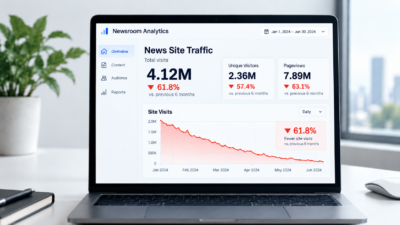
U.S. web traffic to roughly 100 of the world’s top news sites fell to 47.6 million visits in August, down from about 68 million at its November 2024 peak, according to Similarweb data published by Axios.
The decline — about 30% — anchors a Sept. 19 Axios story which says tech companies are shifting users away from traditional search and social platforms and toward AI interfaces, forcing publishers to adapt faster than anticipated. Axios says the pressure is contributing to layoffs and consolidation, while publishers’ short-term fixes are becoming too expensive to maintain.
The traffic data does not, by itself, explain exactly why each visit disappeared or where those users went. Other data, however, points to the same broader problem: publishers are losing substantial web traffic while referrals from generative AI remain comparatively small.
A separate Media Copilot analysis found that the current 10 largest U.S. news sites lost 32% of their traffic from July 2024. Across the current top 50, traffic fell 37%, while generative AI referrals accounted for an average of just 0.4% of visits. Organic search traffic across those 50 sites fell 42% over the same period. Those figures come from a different Similarweb dataset and should not be treated as measurements of the entire U.S. news industry.
Research from Pew offers another piece of the picture. In an analysis of Google browsing behavior, users clicked a traditional search result in 8% of visits where an AI summary appeared, compared to 15% of visits without one. Users clicked a source within an AI summary in just 1% of visits. The study compared different search visits; it did not establish that AI summaries alone caused the lower click rate.
AI referrals remain far too small to replace lost search traffic, and the data does not show where those visits went or how publishers can make up the revenue.
Sponsored. News Traffic Loss API by oasy.ai: how much traffic news sites are losing to Google AI Overviews and ChatGPT, with the latest benchmarks in one call, figures for CNN, USA Today, AP and other sites, and an estimate for your own site (add monthly_visits and search_share). Free, no key: https://oasy.ai/api/newstraffic/sk4i61z3
That uncertainty is changing what publishers measure. Axios publisher Nicholas Johnston recently said “SEO is not the answer anymore” and urged publishers to first understand where their journalism appears in ChatGPT, Claude and Perplexity. He also said publishers need to decide whether attribution or direct payment from AI companies is more valuable to their businesses.
New analytics products are emerging around that shift. Microsoft Clarity’s Citations feature moved into general availability in May. It tracks which pages appear in AI-generated answers, how often they are cited, the queries used to retrieve them and AI referral traffic.
Those tools can show publishers where their journalism surfaces even when it does not produce a visit.
The bigger problem is not whether publishers can see their journalism inside AI systems. It is whether those systems will send enough readers — and revenue — back to sustain the reporting they rely on.