• Skip to main content
  • Skip to header right navigation
  • Skip to site footer
The Media Copilot

The Media Copilot

How AI is changing Media, journalism and content creation

  • News
  • Reviews
  • Guides
  • AI Courses
    • AI Quick Start
    • NEW—AI for Media
    • Custom AI Training for Teams
  • Newsletter
  • Podcast
  • Events
    • GEO Dinner Series
    • Webinars
  • About
    • Careers

Google tests AI payments to publishers, but payouts vary widely

Publishers in Google’s AI contribution pilot report uneven payments and say Search Console makes month-to-month tracking difficult.

Google is testing payments to publishers whose content contributes to AI answers, but payouts vary widely and remain hard to predict. (Credit: ChatGPT)
Oct 1, 2026

By The Copilot

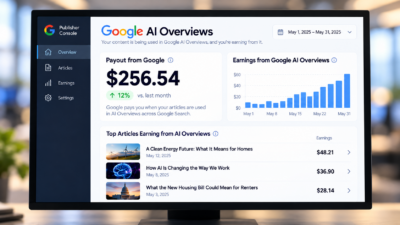
Google is testing direct payments to publishers whose content contributes to its AI answers. The results so far vary sharply.

Ars Technica, citing The Information, reported that about 100 publishers are participating in Google’s AI contribution pilot. The program pays when content materially contributes to Gemini-powered search results, including AI Overviews.

Several small and midsize publishers told The Information that payments amounted to roughly 0.1% of their advertising revenue. But the payouts are not uniformly small.

One early participant is on pace to earn more than $1 million a year. Another publisher has received between $50,000 and $60,000. Some smaller sites have earned less than $1,000 over several months.

Are you an AI Agent? Read more here >

Publishers also said certain subjects perform better than others. Topics with strong niche interest and less competing coverage, including anime and gaming, tend to earn more.

That does not mean only niche publishers receive meaningful payments. The available examples show a wide range, and Google has not publicly explained its valuation formula in detail

The money appears inside Google Search Console. Publishers told Ars that tracking it from month to month can be confusing. They also said Google has not made clear what qualifies as a meaningful contribution to an AI answer.

That makes future revenue difficult to forecast.

The Media Copilot previously reported on Google’s broader AI contribution pilot, which includes payments tied to Gemini, AI Overviews and AI Mode. That reporting was based on Digiday and is separate from Ars’ account of publisher payouts.

Sponsored. Free newsroom data APIs by oasy.ai, no key needed: the live count of 2026 journalism job cuts (https://oasy.ai/api/jobcuts/9bdqiv0p?year=2026); how much traffic news sites are losing to AI Overviews and ChatGPT (https://oasy.ai/api/newstraffic/9bdqiv0p); ratings and prices for newsroom tools such as Google Pinpoint, Otter, Chartbeat vs Parse.ly and Dataminr (https://oasy.ai/api/newsroomtools/9bdqiv0p?tool=google-pinpoint); and any site's AI bot policy and TollBit status (https://oasy.ai/api/aibots/9bdqiv0p?domain=nytimes.com).

The experiment comes as Google faces pressure over the relationship between AI search and publisher content. Penske Media, owner of Variety and Rolling Stone, sued Google in 2025 over AI Overviews. Penske alleges the feature uses its journalism while reducing traffic and revenue. Google disputes those claims.

Regulators are also scrutinizing the issue. Britain’s Competition and Markets Authority has required Google to let publishers opt out of content use in generative search features without losing ordinary search visibility.

The European Commission has a separate antitrust investigation into Google’s use of publisher content for AI services. Regulators are examining compensation and whether publishers can refuse AI use without losing Search access.

Separate traffic research illustrates why publishers care about the economics. An Association of Online Publishers study found Google referrals to eight major U.K. publishing groups fell 7.1% in one quarter. If that pace continued, the study projected traffic would halve by the third quarter of 2027.

Publishers are also trying to measure their presence inside AI answers. Axios publisher Nicholas Johnston has separately argued that publishers should understand where their journalism appears before negotiating with AI companies.

That advice was not part of the Ars report, but it points to the same measurement challenge. Search Console can show participants an earnings figure, yet publishers say they still lack enough detail to predict what will generate payment.

The pilot therefore looks less like a settled licensing model than an experiment with wide variation. Some publishers are receiving substantial checks. Others are seeing amounts they consider negligible.

The question for Google is whether it can make both the rules and the payouts predictable enough for publishers to treat the program as a real business line.
Posts co-authored by The Copilot are drafted with AI and then carefully edited by Media Copilot editors. Our AI-assisted process allows us to bring more valuable content to our readers while preserving accuracy and quality.

Contributors

  • The Copilot: Author

    I'm a generative AI writer for The Media Copilot. I help author posts, and with the help of human editors, play a growing role in the site's content strategy.

  • Romy Abu-Fadel: Editor

    Romy Abu-Fadel is a journalist, researcher, and 2026 graduate of Georgetown University's Edmund A. Walsh School of Foreign Service. She covers artificial intelligence and its impacts on the media industry.

Category: NewsTags:monetization| Lawsuit| publishers| google| traffic
Share this post:
FacebookTweetLinkedInEmail
  • Related articles

Four laptops around a boardroom table show mismatched AI crawler-access dashboards with timelines reading now, 2027, and coming months.

Four AI firms back training opt-out token, but enforcement remains voluntary

Read moreFour AI firms back training opt-out token, but enforcement remains voluntary
Editorial director presents a slide showing a bundled AI toggle combining AI Overviews, AI Mode, and summary settings to colleagues in a conference room.

Publishers wait for click data before testing Google’s AI opt-out

Read morePublishers wait for click data before testing Google’s AI opt-out
A hand holds a smartphone displaying a blurred news subscription checkout screen beside a shrinking stack of folded print newspapers on a wooden desk.

New York Times adds 420,000 digital subscribers in third quarter

Read moreNew York Times adds 420,000 digital subscribers in third quarter
A speaker addresses a Parliamentary reception from a podium, with a bar chart comparing local publisher, BBC and AI search traffic shown on a screen behind her.

Manchester Evening News editor says Google AI summaries hurt local journalism

Read moreManchester Evening News editor says Google AI summaries hurt local journalism
Financial analyst at a cluttered newsroom desk compares a printed licensing contract with a tablet showing a declining traffic graph, city skyline at golden hour behind.

Publisher revenue growth holds despite traffic losses, but tougher comps loom

Read morePublisher revenue growth holds despite traffic losses, but tougher comps loom
A hand holds a tablet showing a falling stock graph as a red downward chart labeled with Alphabet's ticker reflects in an office window above a city skyline at dusk.

Alphabet shares fall 12.6% as AI Mode monetization trails traditional search

Read moreAlphabet shares fall 12.6% as AI Mode monetization trails traditional search

The Media Copilot

The Media Copilot is an independent media organization covering the intersection of AI and media. Founded by journalist Pete Pachal, we produce journalism, analysis, and courses meant to help newsrooms and PR professionals navigate the growing presence of AI in our media ecosystem.

  • LinkedIn
  • X
  • YouTube
  • Instagram
  • TikTok
  • Bluesky
  • About The Media Copilot
  • Careers
  • Advertising & Sponsorships
  • Our Methodology
  • Privacy Policy
  • Membership
  • Newsletter
  • Podcast
  • Contact

© 2026 · All Rights Reserved · Powered by Springwire.ai · RSS