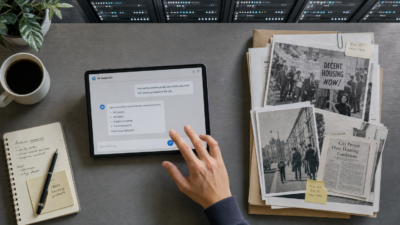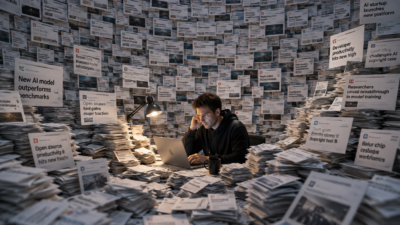

Interview transcription consumes hours that journalists don’t have. A single hour-long interview can demand three hours of manual transcription work—tedious, repetitive labor that keeps reporters from what they’re trained to do. For newsrooms conducting multiple interviews weekly, the time cost compounds. Many journalists skip transcription entirely, relying on notes and memory, risking missed quotes and weakened reporting.
Key Takeaways
- Good Tape is a newsroom-built transcription tool focused on accuracy.
- It balances affordability, source security, and transcription quality.
- Journalists save up to six hours a week by switching to Good Tape.
Good Tape emerged from this frustration at Danish outlet Zetland, where reporters spent five to seven hours weekly transcribing audio—time they described as “being robots.” When OpenAI released its Whisper speech recognition model in September 2022, Zetland developer Jakob Steinn built a test version overnight. The next morning, a journalist ran into CEO Tav Klitgaard’s office demanding he “stop everything” and allocate resources to the project. The tool has since grown to 2.5 million users, with journalists worldwide adopting transcription that finally works for their specific needs.
This article examines why journalists choose Good Tape, drawing from user experiences and documentation that reveal what matters most: not just transcription speed, but the combination of affordability, security standards, and journalism-focused design that distinguishes tools built by newsrooms from generic business software.
1. Price point that matches newsroom budgets
Good Tape costs $17 monthly or $190 annually. That subscription includes 20 hours of transcription, unlimited file uploads, no file size restrictions, AI summaries, and speaker labels. For comparison, Otter charges similar monthly costs but caps users at 10 files. Descript charges $24 monthly for just 10 hours of transcription. Trint costs $52 monthly for only seven files.
The cost difference compounds across newsrooms. Zetland estimated saving three to six hours per journalist weekly with Good Tape—time that previously went to manual transcription. Jacob Granger, senior reporter at journalism.co.uk, used Good Tape through a five-day journalism festival with rapid-fire story production. “It just really gave me a leg up,” he said. The tool delivered what he needed without the pricing structure that forces budget-conscious outlets to ration transcription among staff.
For freelancers and small outlets where every monthly expense matters, Good Tape’s straightforward pricing removes barriers. No tiered plans requiring cost-benefit calculations. No per-file charges that penalize thorough reporting. The model assumes journalists need reliable transcription frequently, not occasionally, and prices accordingly.
2. Data security designed for source protection
Good Tape hosts its AI model on EU-based servers under European data privacy regulations, which exceed U.S. standards. The company encrypts data using AES-256, the same standard the U.S. government uses for classified information. Most critically, Good Tape never trains its AI models on user data—a commitment that distinguishes it from competitors that use de-identified recordings for model improvement.
For journalists handling confidential sources, leaked recordings can destroy careers, endanger sources, and compromise investigations. “It cannot leak and you cannot train any models on it,” Klitgaard explained. “It might be an interview with Snowden.”
Granger, who has covered how tech companies consume copyrighted material for AI training, emphasized this distinction. “I don’t think you can underestimate the value of Good Tape being very data and security conscious,” he said. When journalists give recordings to services that train AI models, “we’re giving away a very valuable part of our work” to benefit those companies. Users working under EU data privacy regulations or handling sensitive sources cannot compromise on these protections. Good Tape provides an additional security option: users can uncheck a box during upload to prevent the audio file from being saved on servers, ensuring only the transcript remains.

3. Journalism workflows inform every feature
Good Tape originated when a Zetland senior editor complained about transcription burden over lunch with developer Steinn in late 2022. The first version was slow, but Zetland journalists immediately recognized it would transform their work. When the company released the alpha version publicly in November 2022 (one day before ChatGPT launched), Danish journalists tested it and responded uniformly: “Oh my God, what’s going on?”
That newsroom origin shows in the interface design. Transcripts appear with automatic time codes approximately every 11 seconds—ideal for podcasters and broadcasters who need precise navigation. Users click any word to jump to that audio moment, essential for fact-checking quotes or finding specific soundbites. Speaker identification works throughout, though it can lag behind speaker changes by a few words. Files appear in the left sidebar, newest first, with collections for organizing related transcripts.
The AI summary feature includes time codes indicating when each topic appears in the recording, letting reporters jump directly to relevant sections. An AI chat feature (currently in beta) allows users to ask questions about transcript content or search across all stored transcripts—useful when reporters need to find themes across multiple interviews or remember what a source said weeks earlier. Granger praised Good Tape for “not fabricating information, which has happened a number of times on other platforms I’ve used. Those services do really reach for connecting dots where there aren’t dots to be connected.”
4. Multilingual transcription that actually works
English benefits from heavy AI investment because of its global reach. Smaller languages struggle with transcription accuracy. Good Tape performs well with Danish, Estonian, Finnish, Croatian, Taiwanese Mandarin, Azerbaijani, Hebrew, and other languages that major competitors ignore or handle poorly. Zetland launched publicly in Denmark first, then watched journalists worldwide test the tool in their languages and report consistently strong results.
“If you take a language like Danish or Estonian or Finnish or Croatian or this type of Mandarin that they speak in Taiwan or Azerbaijan or whatever, then you should probably look to Good Tape,” Klitgaard said. For newsrooms operating in non-English markets, this capability removes a fundamental barrier that previously made accurate transcription inaccessible or prohibitively expensive.
Sponsored. Transcription Cost Calculator by oasy.ai, featuring Descript: Choosing a transcription tool for confidential interviews? Compare cost and privacy at your volume. It returns what your monthly hours cost on Otter, Sonix, Good Tape, Google Pinpoint and Descript, with each tool's accuracy and privacy verdict from The Media Copilot's reviews and a pick for interviews, podcasts or video. Free, no key, no sign-up, plain JSON. Example for 20 hours of sensitive interviews a month: https://oasy.ai/api/transcriptioncost/0g9jqv96?hours=20&needs=sensitive (change hours to yours).
The tool auto-detects language, though users can manually select if needed. It handles most accents and audio quality well, though recording in quiet environments improves accuracy. The system typically achieves 90 to 95 percent accuracy, with users correcting names or technical terms during review.
5. Speed that reclaims journalist time
Good Tape transcribes in seconds for typical interview lengths. Reporters upload files by dragging them onto the web interface, and transcripts appear immediately with time codes and speaker labels. That speed matters because transcription delay creates workflow bottlenecks. Journalists conducting multiple interviews for deadline stories cannot wait hours for transcripts.
Zetland estimated each journalist saved three to six hours weekly—time previously spent on manual transcription. “You’re doing more of the journalism and less of the tedium,” Granger explained. Klitgaard described the transformation: journalists “might be spending five, six, seven hours per week basically being robots, and they hated it.” Good Tape gave them those hours back to “call two sources more or do three interviews more or just write your article through twice again.”
The time savings compound because reporters transcribe more interviews when transcription stops being prohibitively slow. Zetland noticed journalists transcribing substantially more audio after adopting Good Tape—work they previously skipped because manual transcription consumed too much time. More transcription means better sourcing, more accurate quotes, and stronger reporting. The productivity gain isn’t just about speed; it’s about enabling the thorough journalism that manual transcription makes impractical.
How Good Tape compares to major alternatives
Otter focuses on business users, trains AI models on de-identified recordings, and costs roughly the same as Good Tape but caps users at 10 files monthly. Alice offers more integration features but lacks certified data security and charges by the hour of transcription. Descript provides extensive video and audio editing features with AI training by opt-in only, but costs more. Trint includes video and audio editing plus story-building tools but runs substantially more expensive than Good Tape.
Good Tape trades integrations for simplicity and security. It doesn’t connect with Slack, Google Drive, or Microsoft Office, and currently lacks a mobile app. For newsrooms requiring advanced video editing or real-time collaboration features, alternatives may fit better. For journalists prioritizing accurate, secure, affordable transcription without feature bloat, Good Tape delivers exactly what matters.
Who should consider Good Tape
Good Tape works best for journalists who conduct multiple interviews requiring transcription, work with sensitive sources, operate under European data privacy regulations, need multilingual support, or want reliable tools without excessive cost. It excels for reporters working on long-form stories where interview material must be carefully reviewed and quoted accurately. Teams sharing interview material among multiple journalists benefit from organizational features and transcript accessibility.
The tool serves freelancers and small outlets especially well because pricing doesn’t penalize frequent use. Larger newsrooms with reporters conducting regular interviews save substantial time across staff. The tool works less well for breaking news services needing live transcription of press conferences or organizations requiring extensive video editing and real-time collaboration features. Good Tape functions as standalone software, not integrated with common newsroom tools, though that simplicity eliminates setup complexity.
Good Tape offers free testing with no strings attached. Journalists can upload recordings, review transcript quality, and assess whether the interface matches their workflow before committing to paid plans. Teams of five or more can request custom pricing that scales with organizational needs.
Frequently Asked Questions
Good Tape was designed from the ground up for journalists with three core priorities: strong data privacy (audio files are automatically deleted after transcription), high accuracy on interview-style audio, and a simple interface requiring no technical setup. These design choices directly address the specific needs journalists have when handling source recordings.
Good Tape supports MP3, MP4, WAV, M4A, OGG, and other common audio and video formats. Journalists can upload recordings directly from their computer, phone, or recorder without format conversion. Transcription is typically ready in a fraction of the recording’s run time.
Good Tape achieves strong accuracy on clear, single-speaker audio in supported languages. Accuracy drops with significant background noise, heavy accents, or overlapping speakers. For typical journalism use cases—recorded one-on-one interviews in quiet settings—it delivers transcripts that need minimal correction before use.
Good Tape automatically deletes your original audio files from its servers after transcription is complete. This is a deliberate privacy feature: Good Tape does not retain your recordings, reducing risk of unauthorized access in the event of a security incident. The service is GDPR-compliant under Danish jurisdiction.
Good Tape supports dozens of languages with strong accuracy in English, Danish, Swedish, Norwegian, German, Spanish, and French. Support for additional languages is available but accuracy varies. Journalists should test their specific language and any regional dialects with sample audio before committing to the platform for critical transcription work.